
Episode 369
Remi Drozd, DO, FAWM
In this episode of The Psychedelic Podcast, Paul F. Austin speaks with Dr. Remi Drozd, founder of Lucid Therapeutics, about ketamine, SSRIs, and the changing landscape of psychedelic mental health care. Remi explains how his Santa Barbara practice grew from a small ketamine clinic into an interventional mental health center offering ketamine, Spravato, TMS, and other treatments.
They explore the challenges of tapering psychiatric medications, why treatment must be individualized, and how clinicians may need to prepare patients currently taking SSRIs for future psilocybin therapies. Remi also considers what FDA-approved psychedelics could mean for insurance coverage, clinical infrastructure, patient access, and the practical realities of bringing longer psychedelic treatments into existing mental health clinics.
Dr. Remi Drozd is a board-certified physician whose work focuses on enhancing patient health through a more holistic and individualized approach to care. After years working in hospital settings, he became dissatisfied with conventional approaches centered primarily on symptom management and began exploring treatments that address patients within the context of their broader health and circumstances.
Trained as a ketamine practitioner, Remi founded Lucid Therapeutics in Santa Barbara, where his work includes ketamine-assisted therapies and other interventional mental health treatments. He has also explored the therapeutic potential of psychedelics within clinical contexts and trained in MDMA-assisted therapy. Through his clinical work and ongoing research, Remi advocates for understanding the root causes of illness and tailoring treatment to the individual rather than relying on one-size-fits-all approaches.
Podcast Highlights
- The growth of Lucid Therapeutics
- Expanding access through insurance-based care
- Ketamine, Spravato, and treatment-resistant depression
- Navigating ketamine alongside SSRIs
- Why psychiatric medication tapering is individualized
- Distinguishing withdrawal from depressive relapse
- Preparing medicated patients for psilocybin therapy
- Designing stronger support around medication tapering
- Bringing FDA-approved psychedelics into existing clinics
- The practical challenge of six-hour treatments
These show links may contain affiliate links. Third Wave receives a small percentage of the product price if you purchase through the above affiliate links.
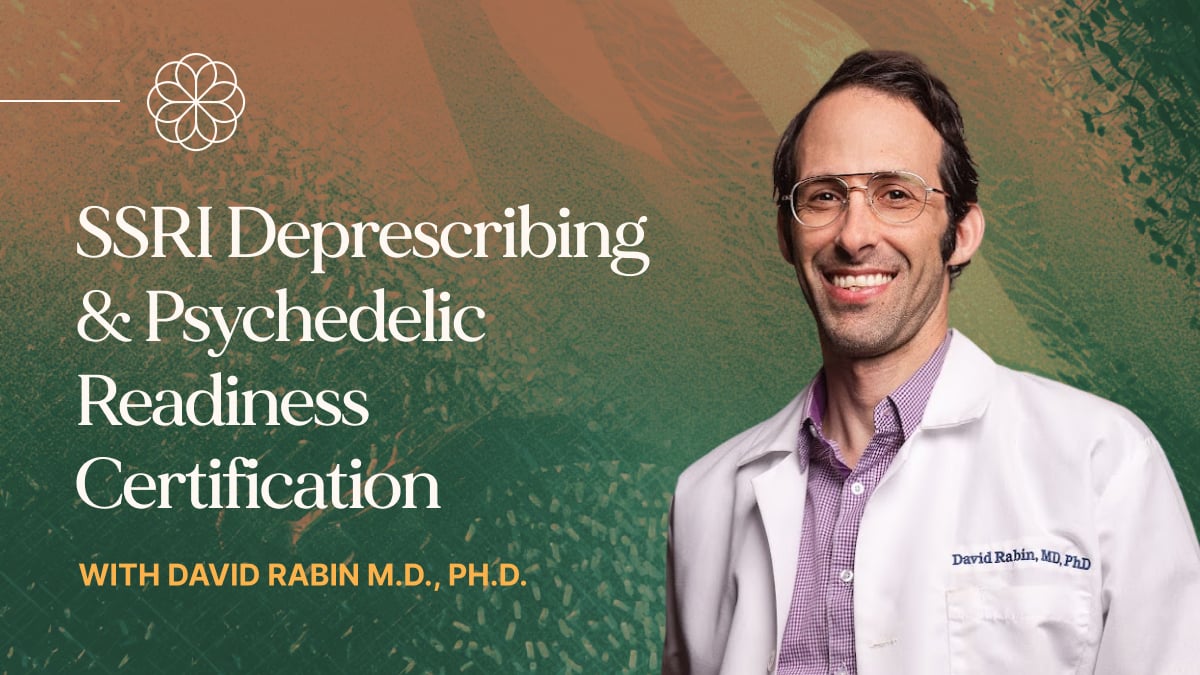
SSRI Deprescribing & Psychedelic Readiness Certification
A 3-month live online training led by board-certified psychiatrist Dr. Dave Rabin for therapists, clinicians, coaches, and facilitators working with medicated clients. Learn practical frameworks for tapering, withdrawal vs. relapse, prescriber collaboration, psychedelic readiness, and supporting clients within your scope.
Podcast Transcript
00:00:01 Paul F. Austin
What happens when someone wants to explore psychedelic therapy but they're already taking an SSRI or SNRI that they've relied on for years or even decades? As psychedelics move closer to mainstream mental health care, I think this is one of the biggest practical questions that we still don't have a reasonable answer for.
00:00:19 Paul F. Austin
Welcome to the podcast. I am your host, Paul Austin, and my guest today is actually returning for the second time. His name is Dr. Remi Drozd, and he first joined me back maybe a few years ago in episode 182, where we went deep into ketamine therapy, the importance of the therapeutic container, and what it means to actively participate in your own healing.
00:00:38 Paul F. Austin
A lot has changed since then, both in this third wave of psychedelics, but also in Remi's practice in Santa Barbara. So what was a scrappy, two-room ketamine practice has grown into a much larger interventional mental health clinic, and so I wanted to bring Remi back to hear what he's learned through that growth, but also to dig into a question that's becoming increasingly relevant for behavioral mental health clinics: how does ketamine interact with SSRIs, and what role does psilocybin play together in an actual clinical practice?
00:01:07 Paul F. Austin
Now, Remi is a board-certified physician and founder of Lucid Therapeutics. After 15 years in emergency medicine, he shifted his focus toward more integrative approaches to mental health care. Today, his clinic offers ketamine treatments, Spravato, TMS therapy, and integration support, while preparing for what the next wave of psychedelic medicine could look like.
00:01:26 Paul F. Austin
Now, this conversation came about because we are launching a new elective training with Dr. Dave Rabin. It's about de-prescribing SSRIs and psychedelic readiness. If you're interested in that training, you can find out more details on our website.
00:01:38 Paul F. Austin
And so, in this conversation today, we talk about how Lucid grew from a small ketamine practice into a 10-room mental health clinic, how Remi approaches ketamine treatment for people who are already taking SSRIs, why tapering psychiatric medication can't be reduced to a single protocol, the distinction between withdrawal and a return of depression, what clinicians may need to consider before patients transition into psilocybin therapy, and why psychedelic approval creates major practical questions for existing clinics.
00:02:09 Paul F. Austin
Dr. Remi Drozd is a board-certified physician and founder of Lucid Therapeutics in Santa Barbara. His work focuses on individualized care, expanding access, and preparing for how emerging psychedelic treatments may fit into the existing mental health care system. This was a fantastic conversation.
00:02:26 Paul F. Austin
As always, if you run a clinic, you work for a clinic, you're on SSRIs, you work with clients who are on SSRIs, I think you're going to get a lot of benefit from this conversation.
00:02:36 Paul F. Austin
But before we go into that conversation, let's hear a word from our sponsors.
00:02:43 Paul F. Austin
Third wave sometimes shares or partners with outside providers, but we don't control and aren't responsible for their statements, conduct, products, or services. We encourage you to do your own research and consult appropriate professionals.
00:02:55 Paul F. Austin
Hey everyone, I want to take a moment to share something important with you. At Third Wave, one of our biggest commitments is helping people to explore the power of microdosing safely, intentionally, and with the right support systems in place. That's why I'm excited to introduce you to our go-to company, Golden Rule, one of the most respected names in the microdosing space.
00:03:14 Paul F. Austin
Golden Rule crafts premium, ethically sourced microdosing products, including psilocybin single strain and blends, San Pedro, and LSD options, all designed to support clarity, creativity, emotional healing, and performance. What really sets them apart is their integrity, honoring traditional plant wisdom while embracing modern science to support real and lasting transformation.
00:03:36 Paul F. Austin
Together, Third Wave and Golden Rule are working to make safe, high-quality microdoses more accessible while ensuring you have the education, tools, and community to feel confident on your journey.
00:03:47 Paul F. Austin
If you're curious about microdosing and want to try some of my personal favorites, head over to goldenrulemushrooms.com/thirdwave and use code THIRDWAVE at checkout for 10% off. Not just once, but for every future order too. Again, that's goldenrulemushrooms.com/thirdwave and use code THIRDWAVE for a lifetime discount of 10% off.
00:04:10 Paul F. Austin
All right, folks, that's it for today. Let's take it away with Dr. Remi Drozd.
00:04:37 Paul F. Austin
Remi, welcome back. It's good to have you.
00:04:39 Dr. Remi Drozd
Thanks, Paul. It's really great to be back.
00:04:42 Paul F. Austin
So you're a board-certified physician. You spent 15 years in emergency medicine before founding Lucid Therapeutics in Santa Barbara. What began as a two-room ketamine practice has now grown into a full interventional mental health clinic.
00:04:55 Paul F. Austin
You offer ketamine-assisted therapies, Spravato, which is S-ketamine, patented ketamine from J&J, TMS, which is transcranial magnetic stimulation, and a lot more. You have a team of therapists. You have integration coaches that are trained in non-ordinary states. You yourself have trained through MAPS and MDMA-assisted therapy. And you're preparing for this next big wave, potential of approval.
00:05:19 Paul F. Austin
So that's part of what we'll talk about today. But before we get into that, I just want to kind of hear the update. Since we last spoke, you know, when we last talked, Lucid was a scrappy two-room practice. What does the clinic look like today, and what has the growth path been like for you as both a clinic owner and a physician?
00:05:37 Dr. Remi Drozd
Yeah, you know, I'm brought back to think of what the owner of GoPro once said. He goes, "It's the classic overnight 10-year success." So, you know, when I started this in a scrappy single room, sitting by holding space for everyone, having a therapist for everyone, but being in every step of someone's journey, I wasn't sure where I was going, but I was learning everything I can from each client, from the good outcomes, the adverse responses, and the raging successes.
00:06:11 Dr. Remi Drozd
And we were able to go into the second room, and then we built a larger space. We weren't sure we were going to fill it with five treatment rooms. But when we moved, we moved and we designed a space that we would all want to be clients of. We thought abundantly. We got really good interior designers. We made big rooms. We had really comfortable spaces. So the container was rock solid. So we can't control for everything, but if we can maximize people's ability to want to be in the space and be held well, we knew that we can have some more success.
00:06:48 Dr. Remi Drozd
So two years ago, we opened five treatment rooms in a large integration space for groups and for clients to start their prep beforehand, before each treatment, and then to sit with and meet other community members and talk to other people doing these medicines afterward. And it worked. We didn't market, but people told their friends and their friends told their friends and people that knew them said, "What's going on? You look really well." And we got busy and we've doubled our size now. Now we have 10 treatment rooms total.
00:07:24 Dr. Remi Drozd
And as you suggested, we went from first intramuscular to intramuscular and IV, and now we offer Spravato, S-ketamine as well. At first, I thought, "That's a sellout, right? Why offer insurance? Why not do the purest form?" But the truth is, the best treatment someone can get is the one they get access. And it was so obvious that this medicine is expensive and it shouldn't be just an episodic treatment. It should be something that's continued.
00:07:53 Dr. Remi Drozd
And if I can, if we spent a lot of time and money and energy and costs with lawyers to get our therapists and our entire team credentialed, so now we can give therapy for a copay, S-ketamine for a copay, TMS for a copay. For some people like Medicare, it's a zero out-of-pocket copay. So as a result, we're doing well. Meaning we're doing well for our community. We're making a good impact.
00:08:23 Paul F. Austin
And obviously, this is the Psychedelic Podcast. We talk a lot about not only ketamine, but all of the various psychedelics. Later on in the conversation, we'll get into how you're prepping for potential FDA approval of these classic psychedelics.
00:08:36 Paul F. Austin
But I'm curious what the overlap is then between maybe these other non-psychedelic interventions like TMS and stellate ganglion blocks and ketamine IV, IMs, Spravato. Do you have a lot of clients who do both? Is it sort of separate people for separate things?
00:08:54 Paul F. Austin
And even, I'm curious, how does, if you're working with insurance, how does insurance hold that? Are those billed separately? Are those billed together? Are multiple of these part of someone's treatment plan? Kind of help me understand the sort of range of tools that you have available for folks that are covered by insurance specifically.
00:09:15 Dr. Remi Drozd
Yeah, great question. You know, everything starts with a discovery call and we have multiple team members, very talented practice managers, spend 20 or 30 minutes, maybe more, really getting to understand what people are looking for. And then she'll book a one-hour to one-and-a-half-hour medical assessment with me. So I'm sitting there with them saying, "What is it? What brought you here? What is it that we can do for you?"
00:09:42 Dr. Remi Drozd
Some clients are referred right from the psychiatrist for Spravato. But a lot of people are self-referring or they're coming in with a curiosity about something that they read or they know or their friend told them that happens to be our client. So they're not coming here with random information. It's somewhat consistent with us. So in that time, we determine together what it is that they're looking for.
00:10:06 Dr. Remi Drozd
I'm not here, and we're very deliberate. We're not here, "This medicine shouldn't be treating your symptoms. This medicine is here to treat you. And your symptoms will change." And the hope is that they'll somewhat get better, totally go away. And we're really clear on the fact that this is not an episodic single one-stop shop will fix everything. Once you start this, you have to continue it to some degree, to some degree with us or some degree with this when your habits and lifestyle change to find ways of staying in it. It could just be the therapy.
00:10:41 Dr. Remi Drozd
So most clients that come in with depression respond really well to Spravato. There's 12 treatments in the first two or three months, and then they can stay on that treatment. They might do it once a month, once every six weeks, and they stay. They consistently keep doing the therapy. And if they make lifestyle changes that are meaningful, they're better. We're seeing 50, 80 percent reduction in the symptoms.
00:11:09 Dr. Remi Drozd
The ones, and you asked about stellate ganglion blocks, the ones that are partial responders but are still experiencing this dense hyperarousal in their body that presents as rumination, anxiety, PTSD that they can't really resolve, they can get relief temporarily, then what we suggest using something, a treatment we offer that treats their actual body's hyperarousal by pausing this pattern of adrenal upregulation of a sympathetic drive going into your limbic system, flagging your amygdala to freak out, back to your body. And it keeps that system could be going all the time by using a medicine called Ripavacaine. It's like Novocain, but longer acting. I can actually block your ability to experience fight or flight for a day.
00:12:04 Dr. Remi Drozd
And obviously, we're not looking to give you a day of relief, but by pausing that, it lets you drop back into who you are. And that reset may recalibrate your nervous system so that you go from a constant six back to a two or a one or a zero. And then people step away and say, "God, I've been letting that live rent-free in my brain forever. I'm really present." And then now that their guards are down, the psychedelics, the neuroplastogens, the ketamine work better. So these partial responders become strong responders. These ones, these people that were getting relief for four days, get relief for four weeks.
00:12:42 Dr. Remi Drozd
And so depression responds really well to Spravato. But some clients here don't identify depression. They identify with a myriad of symptoms, but they're looking for self-actualization. They want depression, but they also want clarity. You can get it with Spravato, but Spravato truly is indicated for treatment-resistant depression.
00:13:06 Dr. Remi Drozd
So during our assessment, I have to learn about their medical history. And the only way to enroll them in Spravato is to show that they have taken at least two antidepressants. So clients that are, even if they're depressed, if they've never been in the medical model, then I'll advocate for one of the alternative treatment approaches.
00:13:27 Paul F. Austin
Like intramuscular ketamine or IV ketamine or...
00:13:31 Dr. Remi Drozd
Exactly. And even TMS, we haven't talked about that, that requires the diagnosis of depression with treatment resistance. So if I can't show that they've failed two medicines, then they can't start the process.
00:13:46 Dr. Remi Drozd
At that time, I refer them to, we have a psychiatrist on staff. I could say, "If you want to try an SSRI for a couple of months and try a second one, we can kind of get you in, but ultimately it might take six months."
00:14:00 Dr. Remi Drozd
But at that point, the best modality, the best choice is to do intramuscular.
00:14:06 Paul F. Austin
Well, and I'm glad you brought up SSRIs because that's my next question. And for listeners, we're rolling out a new training with Dr. Dave Rabin about what is this relationship between SSRIs and ketamine and getting people ready for psychedelics.
00:14:22 Paul F. Austin
And so I was texting Remi, I don't know, a week ago or so, and I asked him, "How many folks come into your clinic who are on SSRIs and what's your process for helping them? Do you help them fully taper off? Do you help some taper off, but not everyone taper off?" And so that's part of the reason I wanted to invite you back on was just to hear a little bit about how your clinic is navigating this landscape of people being on multiple psychiatric medications, especially this overlap of SSRIs and ketamine.
00:14:51 Paul F. Austin
So, I mean, kind of walk us through the process and give us as much context as you can. Let's say someone comes in, they're on 50 milligrams of Lexapro, they want to taper off or taper down, they're looking at ketamine as a potential treatment option.
00:15:09 Paul F. Austin
What have you found to be useful and effective? When have you found it to be helpful to help them taper off SSRIs versus maybe staying on an SSRI, but still having ketamine treatment? Kind of talk us through, and I can help ask more questions to flush it out, but how you approach that as both a doctor and also a clinic.
00:15:28 Dr. Remi Drozd
Yeah, that's a great question. I mean, every part of it, right? And it starts with knowing what model are we in? Healthcare system, I know, Paul, I've listened to a lot of your podcasts, you believe, and we're kind of identifying that it's kind of that sick care system, right? And SSRIs, we're there to treat symptoms. The first thing I said here is we're here to treat the person and their needs. And our practice in general approaches this totally differently. The first thing I'll ask them is what their goals are and what they want to do.
00:16:03 Dr. Remi Drozd
Actually, it's rare, not rare, but it's not, I'd say only 10% of clients will report, "Oh, I'm here to get off my SSRI because I hate it and I'm depressed." I definitely hear that, but it's not a common concern. It's usually, it comes up in the medical assessment or after a few appointments. But what I say to those clients right away is say, "Yes, and we'll help you taper, but you've got to earn that taper."
00:16:31 Dr. Remi Drozd
So this is where this process, this is where I think psychedelic care falls short because it's like a one-off retreat, right? But you're doing SSRIs and antidepressants at home. So who's going to help you with that? Or if you're having a single episode and there's no follow-up, how do you bridge the gap? So with this, we're saying, "We're going to be working together for a long time, six months at least. Let's earn this."
00:16:59 Dr. Remi Drozd
The next question is, "Why do you want to come off your SSRI?" I'm an ER doctor. I'm not a psychiatrist and I've never prescribed SSRIs, but I know a lot about them, their side effects, and the benefits and lack thereof. And unfortunately, now I know a lot about the symptomatology with trying to taper off them. But we start clients, we meet them where they are, and then when they show that we can coach them and we can help move them into better lifestyles and better decisions, they're starting to show motivation, then we ask them, "What is it they're trying to augment? Are you trying to get your sexual function back because of the SSRI? Are you trying to, are you feeling too activated? Are you trying to get your range of emotions back, right? You went to a funeral and you couldn't cry. That doesn't feel so, that doesn't feel normal."
00:17:56 Dr. Remi Drozd
So I believe them, I'm inspired by them, but I want to hear what their intentions are. So then I say, "Let's earn this back." So we're measuring PHQ-9s and MADRE scores, and we're doing objective little numbers. Those are nice for the chart, but really we're asking them, "How is your life better?" And when there's after treatment, so at minimum, someone with Spravato does 12 treatments. So we'll check in after treatment three or four. If they're aware and they're saying, "I'm ready to make this change," I'll say, "Let's wait till the end of your induction series."
00:18:30 Dr. Remi Drozd
That's at this eighth week. And at the eighth week, they're doing great. Some of them already started tapering, but then we'll give them a program. Every medicine has different half-life. If you miss two doses of Prozac, you won't even notice the half-life so long. If you miss one dose of Effexor, you start getting brain zaps the next day. So we'll give them a program and we'll safely talk to them. And there's so many variables, but it doesn't take long to get through them, especially if you've seen this a lot.
00:19:03 Dr. Remi Drozd
But we start where they are with ketamine because ketamine plays really easily with serotonergics. And then once they earn it, we support them strongly through it. And they'll still have some brain zaps, but guess what? Ketamine is so good at helping you taper.
00:19:22 Paul F. Austin
Well, and so you mentioned only about 10% of people really want to fully come off. And I think a question that comes up for me as I've been diving more into this is the kind of how you hold, I guess, your ethical responsibility as a doctor around doing no harm with understanding some of the long-term consequences that SSRIs potentially facilitate.
00:19:50 Paul F. Austin
What we've seen in some of the, a lot of the research that was done on SSRIs is they're really only supposed to be taken for three to six months at a time. That's what a lot of the early research showed. And now you have people who are on them for five years or 10 years or 15 years, and you have issues with sexual dysfunction, and you have issues with withdrawal and trying to get off.
00:20:13 Paul F. Austin
And some people have, there's a writer that I love, this guy named Chris Masterjohn, who even shows that SSRIs may be harmful to mitochondria and mitochondrial health, which we're learning more and more is directly related to mental health. So kind of how do you hold that as a, because you're not a psychiatrist, you're not a prescriber necessarily, right? But yet you may have a sense of, could be better that they're getting off these SSRIs or not even.
00:20:46 Paul F. Austin
So I'm curious kind of how you hold that responsibility, how you hold that discernment. Are there some cases where they've been on SSRIs for 20 years and you're like, it'd be way too dangerous to take them off? And there are other cases where they've only been on for a year and you're like, okay, I think I can safely taper them off.
00:21:02 Paul F. Austin
Like bring us a little bit more into the sort of nuance and context of how you might navigate that as a care provider for these folks who ultimately want to get better. And I think not only want to get better, but often don't have the same level of education or awareness that you may have as a doctor understanding the nuances of SSRIs versus ketamine versus lifestyle practices, these sorts of things.
00:21:26 Dr. Remi Drozd
Yeah. Yeah, thanks for bringing that up. It is, it's whole body integrative care. So I say that 10% because surprisingly, I think when I first started, it was higher than that. It was maybe 30%. People showed up and says, "I want to get off this." And then so we had to have the same conversation, but bump the brakes. Now it's for some reason fewer people come in here starting with that.
00:21:52 Dr. Remi Drozd
But in the first few months together, we bring it up just as you're suggesting it. And during my medical assessment, I ask everyone how long they've been on each medicine. And when someone says 15, 20 years, and I hear that every month, I tell them, I'm like, this is right out of the gate, I'm like, this is not okay. We're addressing this soon.
00:22:14 Dr. Remi Drozd
And I'll say something like, how long would you wear a cast before you think that it's a good idea for you to start walking on that leg again? And I tell them, as soon as we start a medicine, you should be also discussing the day that you think you're going to stop using the medicine. Everything in your body has an impact. So we ethically approach this as we have this conversation.
00:22:39 Dr. Remi Drozd
And usually clients will be quite inspired by all the benefits they're getting, and they're happy to talk about it after they start getting better. So that's why ketamine is actually really good because we can show up as they are. We don't have to change the client before they start the medical therapy because going forward, when some of these new agents that are serotonergic are being FDA approved and we have to make a decision about how we have to taper someone in their existing state, they might get worse and they may not start because they may make a decision to go back on those medicines when the brain zaps and the other symptoms start to get intense.
00:23:26 Paul F. Austin
Well, and this is something that I even have someone close to me who, very, very close to me, who has been in an SSRI for a decade. And she, in the last couple of months, decided that she wanted to get off them. And so she tapered off, didn't have a huge problem with the initial taper, was off for a week. I checked in, she was doing okay, was off for maybe a few weeks. And then all of a sudden, the quote-unquote depression came back. And so she's like, "Well, actually, I am depressed, so I'm going to go back on an SSRI."
00:24:05 Paul F. Austin
And so one of the, I think, big conversations right now within this is how do we distinguish withdrawal from relapse? In that when someone is coming off an SSRI, yeah, some of that depression is going to come back because of those withdrawal symptoms potentially. And obviously, as a primary care provider, you don't want to push them so far off that they're becoming suicidal or having suicidal thoughts as part of that, which sometimes can happen when someone is trying to get off SSRIs.
00:24:35 Paul F. Austin
So how have you seen that show up? Especially when someone's like two or three weeks off, like let's say they've gone through this washout period, right? How useful is ketamine and other lifestyle practices at potentially helping to relieve the depression versus when it just might be best to get them back on their typical psychiatric medication?
00:25:02 Dr. Remi Drozd
Each of these cases are so individual. It's hard to suggest, but I'll bring up a few cases and I think that'll help shine some light on that.
00:25:12 Dr. Remi Drozd
We saw someone a few weeks ago, and I didn't advise him to change his medicines, but he, after two weeks of treatment, started having a really hard time and thinks, "I think this is the wrong treatment for me," and so canceled his treatments. In that case, I always reach out and I'm trying to just identify what's going on. And he identified that he was started on a new medicine just two weeks prior to connecting with us, was on a long-term medicine, started feeling better right away after his first treatment or second, then stopped all his other medicines. And then after his fourth treatment, now he's having a lot of withdrawals, likely from the SSRIs, and he, or some of the symptoms from the start of the second medicine that just started taking effect. And he's getting some of the benefits of the ketamine, but it's hard to say what's happening.
00:26:13 Dr. Remi Drozd
So I believe strongly in single variable modification at any given point. So the beautiful part of our ketamine, Spravato, TMS right now is the onboarding is pretty quick. We're talking like from the day you call, you could be in treatment in two weeks. So even in an acute process, you're going to get into it and start gaining the benefits.
00:26:38 Dr. Remi Drozd
And what's really nice about ketamine is you notice the benefits in hours or days. You don't have to wait four weeks for an SSRI to kick in. I think that's going to be different as FDA approval of these new agents comes in.
00:26:54 Dr. Remi Drozd
So it's going to be really hard to ask people that may be depressed and are in a tough spot to make big lifestyle changes or pharmacological changes, and then get reassessed, and then wait whatever onboarding.
00:27:12 Dr. Remi Drozd
Let's say it's relatively fast, even a month will be considered fast before they start this new treatment. I think it takes a really inspired, self-motivated, disciplined person.
00:27:23 Dr. Remi Drozd
And currently, most of these indications are treatment-resistant depression, and some of these people have lost some of the agency to feel like they have a lot of discipline.
00:27:35 Paul F. Austin
Right, right. And I published a recent podcast with Blake McKowsky, the founder of TOMS, who has donated $100 million to psychedelic research. And he just went through a process himself where he was misdiagnosed with bipolar, was put on multiple psychiatric medications, including, I believe, Abilify and a mood stabilizer. I'm not sure which one, but a mood stabilizer. And basically, he said it took him nine months to be able to properly taper and wean off of these, and he's fully off of them now.
00:28:06 Paul F. Austin
But when I asked him, for folks who are listening who may have a loved one who's going through something similar, what would you recommend? And he was essentially like, you should make it your full-time job. Now, obviously, Blake is insanely wealthy, and he could make that his full-time job, which is amazing, right? Good for him, but a lot of folks can't because they have kids, they have family, they're working, they still have to show up at a job, et cetera, et cetera. And I think it's a, for me, it's a big concern.
00:28:33 Paul F. Austin
There's a lot of hype and a lot of conversation right now about the approval of psilocybin for treatment-resistant depression in particular. And what no one is really talking about right now is a lot of these folks who come in with treatment-resistant depression may already be on psychiatric meds. And so I'm just kind of, you already mentioned the 10% number, right? Only 10% of folks who come in actually want to get off their SSRI fully. And yet chances are when psilocybin becomes available, that number will have to substantially increase if people want to get access to this.
00:29:11 Paul F. Austin
And so I'm just curious kind of how you hold that. And Remi, you may come back and say, I don't know yet, like I'm still exploring that. But there's a difference between ketamine and psilocybin. Ketamine is largely active on NMDA and glutamate. Psilocybin is largely active on the serotonergic system, just like SSRIs.
00:29:28 Paul F. Austin
So how do you anticipate, first of all, how do you anticipate the integration of psilocybin into your clinic? And second of all, kind of how do you think about this tapering process in a more in-depth way for clients who may want to work, may want to take psilocybin, but might be on lamotrigine or Wellbutrin or Lexapro or Zoloft or any other number of antidepressant medications or mood stabilizer medications?
00:29:55 Dr. Remi Drozd
Yeah, I'm really excited to see what the data looks like. So whether it's OSONA or Compass, they're going to have a tremendous amount of data that they haven't fully released. And there's going to be guidelines, and they're going to make, there's going to be hard guidelines to follow, and there's going to be ones that are optional.
00:30:14 Dr. Remi Drozd
And we're going to have the opportunity to do a medical assessment for and decide whether the suicidal or the client's really unstable and was just hospitalized and what they need versus the person that's looking for a different modality. And so we'll have the benefit of that, our clinical judgment, and in our practice, five years of treating thousands of people to start to risk stratify and put people into tiers.
00:30:40 Dr. Remi Drozd
Like the person that needs like high touch, someone needs to be put on a monitor. We have cardiac monitors. We have a crash cart here. I'm a critical care doctor. I have a nicely stocked crash cart that I hope to never use. And who we can, and then maybe the patients that are maybe like your friend that could probably wait, they're resourced enough that if there's a light at the end of the tunnel, that they may have enough discipline around it.
00:31:09 Dr. Remi Drozd
So it's going to go back to the original model. There's going to have to be really strong support. They're going to need integration, a therapist, a workbook, and a team approach, and maybe community groups that are weaning off together, and they can meet twice a week or more frequently. And then the question is, do they really need to, or can we approach this like ketamine?
00:31:35 Dr. Remi Drozd
As an ER doctor, I saw serotonin syndrome once. And when I speak to everyone that's in this space, and when the conversation ever comes up, we wonder if the serotonin syndrome is more of a theoretical risk than a true risk.
00:31:52 Dr. Remi Drozd
And for those people that don't know, serotonin syndrome is when there's a storm of serotonin in the presynaptic cleft that's intentionally induced by pharmacological agents like SSRIs, where their job is to keep the serotonin high in that from where the nerve ends and the receptor is in that tiny space. And then we add a strong serotonergic like psilocybin or DMT or LSD or any of these.
00:32:22 Paul F. Austin
Ayahuasca sometimes.
00:32:25 Dr. Remi Drozd
Yeah, certainly. Can that cause a huge surge that can cause multiple presentations, and that's body contractions, tachycardia, altered mental status. It truly is life-threatening. And so we'll also have to look at the information and see how often they've seen this and whether or not they were using it in that population. And it'll become another risk stratification decision process of is there a way that we can give a lower dose and see if the patient responds, then give a higher dose and something in a controlled setting.
00:33:03 Dr. Remi Drozd
I know from data that I've seen, the bigger, the reality is there's going to be clients that are non-responders or just barely partial responders even with very large doses. So the likelihood is that the medicine will work. The possibility of it being unsafe, I think, is very low, but real.
00:33:24 Dr. Remi Drozd
But the more real concern is where they have to wash out for weeks just for the medicine to work. And the company, the insurance, whoever's paying for it doesn't want to waste their money and the resources, these valuable rooms, if this doesn't work. But then how many, what percent of the population can't do the washout? So this will all play out. This reminds me of the legalization of cannabis and all the things we saw in the population. It won't be as widely used, but there's a lot to learn.
00:34:00 Paul F. Austin
Well, and I think part of my hope, Remi, is like it feels like we're in the 17th century when it comes to understanding how to help someone recover from iatrogenic harm and psychiatric medication. And what I mean by that is in the 17th century, 18th century, surgeons weren't like surgeons today. The way that they could approach their work and fixing bones and addressing gunshot wounds was juvenile compared to the accuracy and precision and safety of addressing a gunshot wound or a broken bone today. We're way more talented and skilled and able to address that. And it feels like we're still in the kind of middle ages when it comes to how do we address iatrogenic harm from the overprescription of psychiatric medications.
00:34:54 Paul F. Austin
And I think one thing that I have some hope around is the emerging focus on mitochondrial health. And I mentioned this already, but I'll mention it again. There's a really great book called Brain Energy by Dr. Chris Palmer, who's an assistant professor of psychiatry at Harvard, that shows a distinct and direct relationship between metabolic health, specifically mitochondrial health, and mental health.
00:35:17 Paul F. Austin
And so what I'm hopeful for and optimistic about, and I already mentioned we're doing this training with Dave, but it's becoming a particular sort of obsession with mine as well, is there's got to be a protocol, there's got to be an approach, there's got to be a methodology that is way more effective than what we currently have access to to help people wean off these psychiatric medications that are clearly causing, not in all cases, but in a fair amount of cases, substantial harm.
00:35:43 Paul F. Austin
Because when I'm looking at the adoption of psychedelic medicine, everyone's talking about clinical hours, going from two hours with Spravato to six hours with psilocybin, or they're talking about the stigma and other issues as it relates to, well, people might be scared to take LSD. And no one's really talking about the fact that our one in eight people in the United States are on an SSRI. We're a heavily medicated country. We're a heavily obese country. And how can you help heal a system when all of that is in the way with psychedelic medicine?
00:36:22 Paul F. Austin
And so I'm not saying that you have an answer, but you are a DO. You are a holistic integrative doc. You've been running a clinic now. What are some of your hypotheses, right? Even as you're looking to prepare for psilocybin and LSD and classic psychedelics, as you understand the health landscape, what are some things that you're looking at in terms of, oh, like maybe we could integrate this or this might help or we could do this better or I'm excited about this potential because it just feels like it's this huge fucking problem that barely anyone is talking about.
00:36:57 Dr. Remi Drozd
Absolutely. I love that you're bringing up, yeah, totally different roadblocks. It'll come down to how willing the client is to take ownership of this program, this process, and are they willing to start and work with the people that they are beginning to trust. So I can think of several options that I could, of a program I could write.
00:37:20 Dr. Remi Drozd
What if someone shows up and they're on multiple medicines and I say, there's risk in this. So let's start a taper and start you on a low-dose ketamine treatment. What if we can do a, you have to go to this like group, community group, show up virtually or in person. We're going to start you on maybe a nasal or a troche oral, lower cost, very easy to access, maybe even home ketamine to help you start this weaning process. And I want you to journal and share with us what your tapering is going like, how your symptoms are and how well you're handling it. And then at week four, you start a low-dose psilocybin and then we'll taper up and you'll be full dose in six weeks.
00:38:09 Dr. Remi Drozd
So if you are all in with us, this is the program. Here's your workbook, here's your journal. We're people that are going to be your accountability coaches and properly trained therapists. And let's build into this. And some people are like, no, no, man, I don't need the sedation for my dental procedure. I could do it. And they could try to go all in. And for the people that want a little bit of the support and want the real flat taper, then we can support them with other agents.
00:38:40 Dr. Remi Drozd
So my suggestion would be to create options, a tiered system. People that are really labile, I suggest helping, adding one agent while we taper others. And when they're primed and their 5-HT, 2A receptors are being no longer bound up by these medicines, then we can add the new agent of choice. And that's the Compass Pathways or the OSONA psilocybin.
00:39:09 Dr. Remi Drozd
So this is how this ketamine model has unfolded, right? Me and the other providers I talk to, we're not, there isn't that much of a handbook. Like 50% of it, maybe 70% of it is by the book. But we have to be pretty creative as all these things show up, these contraindications that are loosely contraindicated show up, or these clients that aren't responding and we want to do other things for them. We've had to be creative along the way. So I think that's what we're going to have to do here too.
00:39:50 Paul F. Austin
Right. Yeah. There is no cookie-cutter prescriptive steps, one, two, three, four, five for everyone, right? Context always matters. As you said before, you always have to meet someone where they're at. Treatments have to be individualized to the capacity and the consent of the patient.
00:40:12 Paul F. Austin
And I would hope that in the next decade, instead of the first line of treatment being an SSRI or an SNRI or lamotrigine or Wellbutrin, one of these mood stabilizers, instead of getting people hooked early on some of these psychiatric drugs that can then become essentially lifelong dependencies, that we go to ketamine as a first-line defense, that we go to psilocybin or LSD as a first-line of defense, that these quickly replace the psychiatric, sort of classic psychiatric medications as the first line of defense.
00:40:48 Paul F. Austin
Because as even I'm talking about this through with you, I'm like, I mean, to get someone in their 50s and 60s who's been on an SSRI for 20, 30 years to all of a sudden try to get off and have the agency to make a huge life change, it's like, how feasible is that actually going to be?
00:41:08 Dr. Remi Drozd
Yeah, absolutely. It was a mistake, I think, because again, unfortunately, it went right for the symptoms. And it's a symptom management agent that worked, but it's not healthy and it's hard to get someone off it. And we shouldn't be afraid of that.
00:41:27 Dr. Remi Drozd
And there's no question there's some long-term effects from it that would be hard to measure because 20 years in, the person doesn't remember who they were when they started it. But I agree with you entirely.
00:41:37 Dr. Remi Drozd
And I said this when we opened this place, it's like, God, I can't believe this is third line, especially for Spravato. This should be first line. This should be an opportunity to push reset and get someone out of something, not to drag them through their life with fewer symptoms. So I mean, obviously, we share that mindset from the beginning, but things totally.
00:42:02 Paul F. Austin
Even I've heard some people say like, yeah, psychedelics will be like a GLP-1 agonist for mental health. And I'm like, it won't work that way. Or some people will say, yeah, MDMA is like an antibiotic for PTSD. And I'm like, I just don't think it's going to be that easy. I think it's way too much of a reductionist framework.
00:42:22 Paul F. Austin
I'm pro-Ozempic or semaglutide or retrotritide or some of these GLP-1 and GLP-3 agonists that are helping people to lose weight. I'm for them. But with mental health, I think it's a different story and a different game.
00:42:37 Paul F. Austin
I don't think you're just going to be able to find a peptide that all of a sudden allows someone, I could be wrong, but all of a sudden that allows someone to recover from the iatrogenic harm of taking an SSRI for 20 years. I just, I don't know if that'll be the case necessarily.
00:42:54 Paul F. Austin
Maybe it'll be red light therapy, photobiomodulation. I don't know. There could be or a combination of red light therapy and HBOT and stem cells and NAD. I don't know. Maybe there's a way that you could help sort of recover mitochondrial and cellular health, but I just haven't seen anything that seems that simple yet. Like Ozempic appears to be for weight loss.
00:43:21 Dr. Remi Drozd
You know, that brings me back to how we scheduled this call today. When you texted me a week ago, you asked me a very specific question about weaning off SSRIs, and I responded in like a page-long text. And the last line was like, but it's so highly individualized, right? We taper a person. I can't just share a protocol with you. That person has presented in a certain way, and we have to even know them before we taper off them.
00:43:47 Dr. Remi Drozd
So you're right. This isn't going to be like a prescribable solution. It's going to, it's unfortunately require more work. And I hope that AI and these new technologies allow us to do less menial work and train more therapists and mental health workers, and we can kind of care for each other. Like if there's an upside to every new technology, and my hope is that we can free up resources so that people are being supported more through their challenges.
00:44:19 Paul F. Austin
You know, I think my final question for you, Remi, is about the vision of Lucid Therapeutics. There are a lot of clinic owners right now, behavioral mental health clinics, that are potentially excited about the approval of psilocybin and the approval of LSD for treatment-resistant depression, for major depressive disorder, for generalized anxiety disorder, right? We're also looking at methadone and maybe even MDMA for PTSD. A lot of people excited about this.
00:44:49 Paul F. Austin
And there's a lot of questions about REMS. Will this be covered by health insurance? If it is covered by health insurance, what will clinics need to provide in order to adhere to the REMS that have been outlined? And so I'm curious just how you hold that as a clinic, right? You said you've expanded now to 10 treatment rooms. You're working with Spravato, TMS, IV and IM ketamine, stellate ganglion blocks, a number of other things.
00:45:16 Paul F. Austin
These tend to fit reasonably well within the one to two-hour clinical treatment window. As we all know, psilocybin is not a one to two-hour treatment. It is a six-hour treatment. So I'm kind of curious, like let's say Q1, 2027, the FDA gives the thumbs up. They're like, psilocybin is now FDA approved for treatment-resistant depression. Remi, you can weave this into your clinic.
00:45:43 Paul F. Austin
How do you do that? How do you do that successfully? How do you do that in a way that really serves the client? How do you do that to ensure that it supports your business as well, that you're getting it covered by insurance? Kind of talk us through what you know or what you're planning for, maybe also what is still to be determined, what you don't know maybe may have to happen.
00:46:04 Dr. Remi Drozd
Yeah. So I'll answer the first part of this. The future of what I see, where I see Lucid going is in what we've done, I think, successfully in the last year is democratizing certain elements of healthcare and therefore taking Medicare and Medicaid with virtually no out-of-pocket for clients that are getting, I think, no solutions or bad solutions for their problems and giving people access. So maximizing access is our first experience. And unfortunately, there is a tiered system. So if we can create a two-hour window and keep giving people opportunities to get better, then if we can get them in there through the insurance model, great. And our entire team, we're growing every month, is excited to do that. So we're all, we have a really good culture here of leaning in.
00:46:58 Dr. Remi Drozd
With new agents, BPL003, I believe, is going to be a tie-backed like nasal DMT. I think that will remain in the one to two-hour window. So that's going to really, really smoothly help existing ketamine practices, Spravato practices like ours, incorporate treatments.
00:47:23 Dr. Remi Drozd
But yeah, if we look at methadone or psilocybin, I believe it's likely going to push into four, maybe six hours. I think we need more space. We've got a group space, but man, I don't know. I think people shouldn't be doing large conscious experiences in groups until they've proven that they can get through their induction period. So
00:47:49 Dr. Remi Drozd
this will be a hurdle. I think the academics are really excited about how they move forward. I was speaking with Robert Carhart-Harris, someone I know you know, last month, and he was really excited about everything. And I said, like, but what do you think? Is it going to be four hours or six or eight? And he's like, I'm not sure. Is that a problem?
00:48:10 Dr. Remi Drozd
I'm like, oh, man, there's like still a disconnect between the people that are getting this to the front lines, FDA approved, thank you for the work you're doing, and then how we're going to be able to implement it. I don't know. I don't know how we're going to implement it. Luckily, we've got the space right now, and we're just going to have to create more.
00:48:30 Paul F. Austin
I mean, I do like that you brought up the one-to-one, right? Getting someone through an induction phase before they're doing the group work. I do think that's critically important for people who are stepping into this for the first time, who have a clinical condition, who need that extra support.
00:48:43 Paul F. Austin
And the initial FDA clinical guidelines that were published, I believe, about a month ago now, which they're going to discuss further on September 14th at a four-hour joint committee meeting, has said there likely needs to be two people in the room for the psilocybin session and a doctor within 15 minutes. So that means, Remi, you could be at home hanging out and someone could be in your clinic doing it, but you'd have to be within 15 minutes just in case anything did arise.
00:49:10 Paul F. Austin
So I think that's a big question. It's like a lot of folks are excited about the approval. A lot of folks are not really clear yet on how does this actually fit within our mental health clinic model. And that has a lot to do with the amount of time that these treatments take.
00:49:29 Paul F. Austin
It has a lot to do with not knowing what insurance will require, what the REMS will be. But we'll know those things soon enough. And then time will tell how helpful it is and how expensive it is. Because Spravato is what? Spravato is like $1,000 per treatment around there?
00:49:47 Dr. Remi Drozd
No, you know, what they bill, insurance, and what we and then reimbursement is quite different. I think it's like anything else. You look at your knee surgery, it's like $80,000, but I think the hospital probably gets like $12,000.
00:50:00 Dr. Remi Drozd
I think, you know, I think maybe $280 is a common reimbursement for a pharmacy benefit. But when you look at that quantity that's in a vial, we're talking $5. So that number is not truly cost prohibitive, but the multiple of what that would be accessible otherwise is offensive. So
00:50:32 Dr. Remi Drozd
that likely will happen again in this wave of methadone, psilocybin, and 5-MeO-DMT.
00:50:43 Paul F. Austin
And LSD as well.
00:50:44 Dr. Remi Drozd
And LSD. Eli literally just paid $2.8 billion for a tie-backed lie. They're looking to, they've got big plans for what they're going to do with these medicines.
00:50:54 Paul F. Austin
Yeah, and BPL003, which is intranasal 5-MeO-DMT, fits well within the Spravato model because like Spravato, it's a one to two-hour experience. But as anyone knows who has done both ketamine and 5-MeO, 5-MeO is a very different experience from ketamine.
00:51:11 Paul F. Austin
So although it fits within the same clinical treatment window, the amount of psychological support that may be necessary as part of that treatment could be substantially more with 5-MeO when compared to Spravato. But again, that's still a few years off.
00:51:23 Paul F. Austin
I think they're expecting FDA approval in 2028, if not 2029, for that. So psilocybin will likely be first is what we're anticipating. And I mean, we also anticipated that with MDMA. We all saw what sort of a shit show that was. So hopefully, we do finally get the FDA approval.
00:51:46 Dr. Remi Drozd
Yeah, I'm really optimistic, but I think we'll learn a lot next month on the 14th of September.
00:51:55 Paul F. Austin
Right. Remi Droust, Lucid Therapeutics. If you're in Southern California, you have a friend or family member who is looking for a great place to go work with ketamine, I highly recommend Remi's clinic. Remi, thanks for coming on again for the podcast. It's been great to have you on, and I bet we'll get to do this again at some point. So I appreciate you taking the time today.
00:52:21 Dr. Remi Drozd
Of course. Yeah, thanks for your attention.
00:52:24:00 Paul F. Austin
Hey listeners, I hope you enjoyed that episode with Remi Drozd. This is the first podcast that we're publishing in a series of podcasts around this conversation, as it relates to prescribing SSRIs and psychedelic readiness. We are launching a new training with Doctor Dave Rabin on this topic. If you're interested in joining us for that training, you can go to Psychedelic Coaching Institute to find out more details.
Now, if this episode was helpful, insightful for you, send it to someone who may enjoy it. And if you have been enjoying the podcast, follow the show and leave us a rating or review. It really does help more people to find these conversations. You can also subscribe to third Wave on YouTube for the full video podcast and follow us on social media at @thirdwaveishere. You can also find me on all platforms. Just search for Paul Austin. Thanks for tuning in and we'll see you next week.