Episode 362
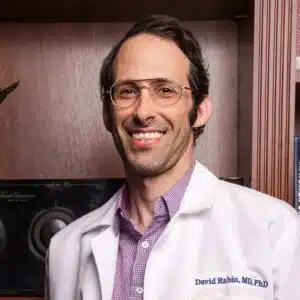
Dave M. Rabin, M.D., Ph.D.
In this conversation, Paul F. Austin speaks with Dr. Dave Rabin, neuroscientist, board-certified psychiatrist, and co-founder of Apollo Neuroscience, about one of the most important questions in psychedelic work: why do some journeys become overwhelming, destabilizing, or difficult to integrate?
Dave explains why safety is not just a matter of set, setting, or a strong screening form. It is a physiological state in the nervous system. Together, Paul and Dave explore how fear, trauma, and dysregulation can shape a person’s ability to receive and process a psychedelic experience, and why preparation must include a deeper understanding of the body.
The conversation also covers pre-session nervous system assessment, vagus nerve activity, HRV, haptic vibration, breathwork, therapeutic touch, consent, and the role of tools like Apollo Neuro in helping clients feel safe enough to surrender, process, and integrate.
Dr. David Rabin, MD, PhD, is a neuroscientist, board-certified psychiatrist, health-tech entrepreneur, and inventor who has studied the impact of chronic stress in humans for more than a decade. He is the co-founder and Chief Innovation Officer at Apollo Neuroscience, and co-founder and executive director of the Board of Medicine, a nonprofit organization establishing evidence-based clinical guidelines for the safe use of unregulated alternative medicines, including plant medicines. His research focuses on non-invasive therapies for treatment-resistant conditions, trauma recovery, psychedelic-assisted psychotherapy, and the neurobiology of belief.
Podcast Highlights
- Why safety is physiological
- Beyond set and setting
- How fear interrupts healing
- Pre-session nervous system assessment
- MDMA and the safety cascade
- Haptic vibration and soothing touch
- HRV as a preparation signal
- Breathwork for embodied regulation
- Consent and therapeutic touch
- Scaling safe psychedelic care
Show Links
This episode is brought to you by The Practitioner Certification Program by Third Wave’s Psychedelic Coaching Institute. To learn more about our flagship 6-month training program for coaches who want to integrate psychedelic modalities into their practice, click here.
The Microdosing Practitioner Certification empowers you to launch a sustainable practice built on integrity, science, and results. Learn Paul F. Austin’s signature San Pedro Microdosing Protocol, master somatic coaching skills, and confidently guide clients toward lasting transformation. Click here to learn more and apply.
Third Wave occasionally partners with or shares information about other people, companies, and/or providers. While we work hard to only share information about ethical and responsible third parties, we can’t and don't control the behavior of, products and services offered by, or the statements made by people, companies, or providers other than Third Wave. Accordingly, we encourage you to research for yourself, and consult a medical, legal, or financial professional before making decisions in those areas. Third Wave isn’t responsible for the statements, conduct, services, or products of third parties.
Podcast Transcript
00:00:01 Paul Austin
What if the reason that some psychedelic journeys go wrong has less to do with the medicine itself and more to do with whether the body feels safe enough to receive the experience? Welcome to the Psychedelic Podcast. I'm your host, Paul Austin, and today's conversation is a special replay from a webinar that we hosted in March 2026, called "Why Some Journeys Go Wrong and How to Prevent It."
00:00:23 Paul Austin
This is a timely and important conversation because as more people seek out psychedelic experiences, the feel needs a deeper understanding of safety—not just screening forms, set, setting, or good intentions—but the actual physiology of the nervous system. Today I'm speaking with Dr. Dave Rabin, who has been on the podcast many times, a neuroscientist, board-certified psychiatrist, health tech entrepreneur, and co-founder of Apollo Neuroscience. Dave has spent more than a decade studying chronic stress, trauma, and non-invasive approaches to healing, which has led him to develop the Apollo. He is also the co-founder and executive director of the Board of Medicine, a nonprofit focused on evidence-based guidelines for the safe use of plant medicines.
00:01:07 Paul Austin
So in this conversation, Dave and I explore why safety is a physiological state, what set and setting still miss, how fear can interrupt healing, why the vagus nerve matters in psychedelic care, how HRV informs preparation, the role of the Apollo Neuro in haptic vibration, and a very simple breathwork practice for coming back into the body. Since this conversation was originally recorded, Dr. Dave's book, "A Simple Guide to Being Alive," has been released. It is a science-backed and deeply human guide to anxiety, nervous system safety, and the simple practices that bring us back to the breath, the body, and ourselves. We'll include a link to that book in the show notes.
00:01:51 Paul Austin
As always, it was a pleasure to have this conversation with Dave—super informative. This did lead into our first-ever cohort for our safety and harm reduction training. We will be making that evergreen and available fairly soon, and we'll run another cohort for it next year if that's something that you want to join with us live.
00:02:09 Paul Austin
All right, before we hop into the episode today, let's hear a quick word from our sponsors. Third wave sometimes shares or partners with outside providers, but we don't control and aren't responsible for their statements, conduct, products, or services. We encourage you to do your own research and consult appropriate professionals.
00:02:28 Paul Austin
Hey everyone, I want to take a moment to share something important with you. At Third Wave, one of our biggest commitments is helping people to explore the power of microdosing safely, intentionally, and with the right support systems in place. That's why I'm excited to introduce you to our go-to company, Golden Rule, one of the most respected names in the microdosing space. Golden Rule crafts premium, ethically sourced microdosing products, including psilocybin single strain and blends, San Pedro, and LSD options, all designed to support clarity, creativity, emotional healing, and performance.
00:03:00 Paul Austin
What really sets them apart is their integrity—honoring traditional plant wisdom while embracing modern science to support real and lasting transformation. Together, Third Wave and Golden Rule are working to make safe, high-quality microdoses more accessible while ensuring you have the education, tools, and community to feel confident on your journey. If you're curious about microdosing and want to try some of my personal favorites, head over to goldenrulemushrooms.com/thirdwave and use code THIRDWAVE at checkout for 10% off. Not just once, but for every future order too. Again, that's goldenrulemushrooms.com/thirdwave and use code THIRDWAVE for a lifetime discount of 10% off.
00:03:43 Paul Austin
All right, let's get into it with Dr. Dave Rabin.
00:04:11 Paul Austin
Here's what we're going to cover today: how to build a pre-session nervous system assessment into your existing preparation protocol, why standard grounding techniques fail with certain nervous systems from a neurobiological standpoint, how haptic vibration reaches the vagus nerve directly when verbal reassurance doesn't land.
00:04:31 Paul Austin
We're going to discuss a manual breathwork technique that produces the same physiological shift as the Apollo wearable.
00:04:38 Paul Austin
And then we have a big announcement. Dave and I, for the last year and a half, have actually been working on a new training around psychedelic safety and harm reduction, and then we'll go into a live Q&A at the end of today's session.
00:04:52 Paul Austin
So, Dave, before I go any further, I just want to welcome you. Thanks for joining us for the training today.
00:04:57 Dr. Dave Rabin
Thanks so much for having me. It's a pleasure to be here with you all.
00:05:00 Paul Austin
Let's get to the crux of it. So let's talk a little bit about safety. So a lot of practitioners think safety means set, setting, and just a good screening form. And I'm curious, what are a lot of practitioners actually missing when they skip the nervous system? And what might it look like when that gap shows up in a session?
00:05:20 Dr. Dave Rabin
So safety is a physiological state in the nervous system. So a big part of the way that we need to be thinking about healing and trauma is that there's a physiological state in the nervous system of learned fear from when we experience traumatic events, one or multiple over time. And then there's a physiological state, a way that the nervous system looks and the body looks, because the nervous system controls the body. It controls blood flow, blood pressure as one example, and metabolism is another that the body gets into when it is in a safe state. And so safety is like the body's receptive state, whereas what we call the sympathetic or the fear state is the body's like doing productivity dominant state.
00:06:13 Dr. Dave Rabin
And so for us to be able to receive healing or to receive new information, like to learn a new habit or to learn a new skill, we have to be safe at baseline, which means physiologically safe. So that means like in our bodies, we know that we are not under a survival threat in that moment. And that is generally represented by increased vagus nerve activity. And we could talk more about all of that and how the nervous system works.
00:06:45 Dr. Dave Rabin
But when we're in a fight or flight state, which could even be just feeling afraid of a new experience, like a psychedelic experience, which is foreign to many people and can even be scary, even if you are experienced with these medicines, the body has to be safe enough to allow the experience to unfold without trying to control it, without trying to analyze it or judge it, just to allow the experience to happen. And that's where most of the healing from these medicines comes from.
00:07:14 Dr. Dave Rabin
And when we're in a fear state, our bodies reject that. Even if our minds are open to the information that's coming in and we say cognitively, I know I want this information. I know I'm ready to receive this information. If our bodies are in a fear state, it will reject the incoming information and automatically treat it as a potential threat.
00:07:38 Dr. Dave Rabin
And so that is really important to understand at baseline, because when you understand how our nervous system works, which is not unique to humans, it goes back hundreds of millions of years to ancient sea snails, we know that there are certain preconditions that help people to have tremendous healing outcomes with psychedelic medicines reliably. And so that's what we're really trying to teach more effectively and, you know, get the word out in courses like this.
00:08:07 Paul Austin
And I think a big, an important point to make here is when the term set and setting was coined in the '60s by Timothy Leary and Richard Alpert in the work that they were doing, there wasn't really an understanding of the nervous system. And what we know in modernity is we have a lot of folks now coming into these psychedelic experiences would really overrun nervous systems or really sort of pressurize nervous systems.
00:08:31 Paul Austin
How might that show up in a session with a client if they're coming in in a really sympathetic state, if they're coming in in a really dysregulated state? I feel like that's a pretty important part to be able to assess, identify, and sort of explore how might we help support them getting back into this place of true safety.
00:08:48 Dr. Dave Rabin
Yeah, it's a great question. And there's lots of ways to do it. Generally speaking, working with patients, working with clients to engage in practices that increase vagus nerve activity and increase vagus nerve functioning, which is the key, the dominant nerve of the rest and digest recovery parasympathetic nervous system that is, you know, opposed to the fight or flight survival system. By training that vagal nerve system, we increase the body's receptiveness and effectively like readiness for recovery because it allows the increasing vagus nerve activity diverts resources like blood flow to organ systems and cells that are cellular functions that are really important for recovery, critical for recovery and healing, even from trauma.
00:09:42 Dr. Dave Rabin
So really it's, you know, when we work with patients and see tremendous outcomes, what we're doing in advance is we're preparing the body to allow the experience to unfold for what it will by feeling safe enough to trust us, the providers, that we are able to hold the container, the space for these, for our clients, and whatever comes up will not be judged. It's just coming up for processing. It's coming up for healing. It's a safe space for anything to come up. And that space, no matter how uncomfortable it might be for the individual or for the provider. And so that container is really like a, it's like a safety bubble that we are creating through a non-judgmental, supportive relationship with the client, which is something that we can all do. You don't have to be, you know, as trained up as I am to be able to provide that to somebody.
00:10:43 Dr. Dave Rabin
So that's like, you know, that's the good news is how easy it is to deliver that. I think on the anecdote side, like I would say when people are in a receptive state, their bodies are like, they feel safe to allow and receive the experience. The experiences are like, you know, what we would call like a Shulgin 4+ experience. So it's like a transcendental experience of experiencing yourself in a healed state. And that is a reliable experience that we can bring people to. And once people have experienced what their bodies feel like in a healed state, then they start to understand that this is a state that they can access because it's a memory that they remember from at some point in their lives. It's not foreign.
00:11:28 Dr. Dave Rabin
It's them remembering what their body feels like in a healed state from that's reminiscent of the past. So the goal is to get people into a safe enough state to be able to receive that kind of information, which is how we see reliable healing transformation. And when people are resistant to that or when they have a lot of apprehension and anxiety, you know, at best nothing happens, which is what happens most of the time. They just white-knuckle the entire experience and resist it. And then it feels really uncomfortable and restless for them the whole time, but they don't really have much of an experience in the medicine at all. Their brain literally shuts it down by trying to control it. And then on the worst-case scenario side, we see people having really negative paranoid trips where they kind of like spiral out into a state that, you know, can mimic paranoia, schizophrenia, and delusional states, which can be very challenging to bring people back from.
00:12:26 Dr. Dave Rabin
So we really do everything we can to avoid that.
00:12:29 Paul Austin
That's a really important point, you know, and I think one thing we emphasize in the lead-up to this webinar is one in 16 people have had a very challenging experience or bad trip that's led to ongoing difficulties, not just in the experience itself, but ongoing difficulties. And so part of the conversation today is how do we as practitioners support clients to ensure that that never happens?
00:12:50 Paul Austin
And it's also what I'm hearing in your responses. It's not only ensuring that that never happens, but it's also ensuring that by creating a really safe space for those clients, we actually improve the overall outcomes. So we make ourselves a more effective practitioner by learning how to ensure that safety is really at the forefront of our practice and everything that we're doing.
00:13:10 Dr. Dave Rabin
Correct.
00:13:11 Paul Austin
And I think an important part of that is a lot of practitioners who start to do this work are trained in checklists, right? Okay, are you on any medications? Okay, have you gone through any adverse childhood experiences? Okay, do you have any prior experience with psychedelics? Okay, if so, what?
00:13:27 Paul Austin
But I think something that hasn't been emphasized as much is how do we actually carry out a pre-session nervous system assessment? How do we understand where our client's nervous system is before we're ever serving medicine or in a medicine space with them? Talk to us a little bit about how you would go about assessing that with a client that you may end up working with beyond just the sort of basic checklist of things.
00:13:50 Dr. Dave Rabin
Yeah, I mean, I think there's several ways to do it. I think the best way is just to ask good questions, right? Again, it starts with creating the non-judgmental container for us to have an honest, open conversation where the person feels they can disclose effectively their deepest, darkest secrets to us, right, without judgment.
00:14:14 Dr. Dave Rabin
I mean, this is not something to be taken lightly. This is like an honor and a privilege to be able to work with people in this capacity. And it is a very delicate thing to work with people in this level of vulnerability. And so there's different outcomes that, you know, there's slightly different things that you can learn.
00:14:40 Dr. Dave Rabin
And I think, you know, the good news is to have an appropriate understanding of the trauma-informed care approach because everyone has trauma. Like this isn't a mystery or a suspicion anymore. Like everyone on the face of the earth has something that their nervous system considers as an intense, meaningful, you know, event where they felt unsafe. And that gets stored as trauma on the body.
00:15:12 Dr. Dave Rabin
And so something's going to come up. If you're doing it right, something is going to come up. So we as the practitioners and the guides and the therapists, like we all need to just be prepared that something is going to come up and to receive it, to create the safe space to contain it so that it can be processed and felt and, you know, moved through.
00:15:39 Dr. Dave Rabin
And so, you know, there's a, I think, remembering that there are certain core foundational, you know, things about how psychedelics work is really important to help us, you know, make sure that we're all getting the education we need to be able to deliver this care effectively and safely as possible.
00:16:01 Paul Austin
For sure. And then I think it leads into the next thing. We've already hinted at it a little bit. The Apollo wearable, this is something that you invented in 2018, 2019. It fully came on the market in 2020. I remember you sent it to me right after COVID. I think it was April 2020 that I first got the Apollo and it was so helpful just to calm and regulate my nervous system when the world was sort of falling apart and we had no idea what was going on. And I think what I love about the Apollo is the sort of notion of haptic vibration. And so I'd love if you could talk a little bit about why is it that you invented the Apollo and more specifically, what is the value or utility of haptic vibration in terms of helping to down-regulate the nervous system, support the vagus nerve, and how have you used this in real sessions with clients?
00:16:52 Dr. Dave Rabin
Sure. Yeah, we can go through all that.
00:16:56 Paul Austin
Did you know that over 4 million people microdose psychedelics last year in the United States and yet so few have real guidance on how to do it safely and effectively?
00:17:06 Paul Austin
That's exactly why I created our Microdosing Practitioner Certification. This is an 18-week professional training where you'll master my San Pedro microdosing protocol for nervous system regulation, learning how to coach clients through it with confidence and integrity.
00:17:20 Paul Austin
Just visit psychedeliccoaching.institute or use the link in the show notes to learn more.
00:17:26 Dr. Dave Rabin
I think the story of how we discovered it is actually one of the most interesting parts. And I think it really helps everybody to understand, you know, the theme of how safety turns into new tools that we can use to help improve outcomes. So Apollo is a wearable device that works with both Android and iPhone that you can see I'm wearing on my chest. Paul has it on his arm that delivers soothing like bass frequency vibrations. So the same kind of vibration, sound wave vibration that comes out of a subwoofer or a stand-up double bass, but it delivers it at very low volume specifically to the touch receptors on the skin. And so you can't hear it, but you can feel it really well through anywhere on your body. And it works through clothing and it is, again, just sound waves that help regulate the nervous system and increase vagus nerve activity because it feels to the body and to the emotional brain like soothing touch. And the reason why we decided to make a wearable technology that delivers some of the benefits of soothing touch to the body. And by the way, if anybody wants to experience this who has an iPhone, we now have a lite version that's free that you can download and experience right now on your iPhone while you're listening to this. Just go to the app store on your iPhone and type in Apollo Neuro to words, A-P-O-L-L-O space N-E-U-R-O. And you will be able to download the app and follow the, as soon as you open it, you can follow the on-screen instructions and feel what the patented Apollo vibrations that we discovered at the University of Pittsburgh feel like because they're not, they don't feel like anything that's ever come out of your phone before. And the wearable allows you to get that benefit passively on the go in and out of sessions when you don't want your phone around in particular or when you're sleeping.
00:19:19 Dr. Dave Rabin
And so the way that we, the reason why we made this is because I was studying how MDMA-assisted therapy was working to achieve these tremendous outcomes with veterans who had the most severe PTSD. And the reason why I was looking into that was because my patients were also veterans with the most severe PTSD. And so the MDMA study was showing results above and beyond anything we had ever seen, the studies that MAPS conducted. And those results are, you know, really just paradigm-shifting for the field of psychiatry where in the phase two trial for the FDA, 55% of people with 17.6 years of treatment-resistant PTSD were no longer meeting diagnostic criteria two months after treatment ended. Without any additional treatment, at one year out, that number went up to 67% without any additional treatment. So that 67% of people at one year out were no longer meeting diagnostic criteria for PTSD. And we have never seen anything like that in the history of mental health and so mental health treatments where the benefits continue to accumulate after the treatment has stopped.
00:20:36 Dr. Dave Rabin
And so I thought we have to figure out how this is working. This is, you know, there's more studies now of MDMA than most other psychedelics that are done in rigorous clinical and laboratory studies. We need to figure out how MDMA is working because if we can figure it out and figure out what pathways it's activating specifically in the brain and what it's doing to the nervous system, then we can develop technology to replicate some of the benefits of it to help people because MDMA is still not legal and we don't know when it's going to be. So there's an access to care problem. And so Rick Doblin became a good friend and I told him about this project idea and he graciously got me trained and a few of my colleagues trained it from the University of Pittsburgh Medical Center in MDMA-assisted therapy with MAPS. And then we went back to the lab after the training, realizing that safety was like one of the most popular words that was talked about in the training and that MDMA, when used with patients, the simplest way to understand how it works is that it helps people feel safe enough by radically amplifying neural firing of circuits in the safety cascade in the emotional brain. MDMA is helping people amplify the safety of the trusting bond foundation with the two providers. And that increases safety enough, like pouring rocket fuel onto a campfire, that people feel safe enough to remake meaning around past traumatic events. And that meaning lasts, embodied meaning. So this is really reshaping the way we see ourselves and the world in one to three sessions with MDMA-assisted therapy.
00:22:22 Dr. Dave Rabin
And when we thought about that, okay, safety is required for people, people need to feel safe enough to be able to remake meaning from past traumatic events, then what if we could give people some of that safety? And when I went back to the lab and looked at the nervous system and how MDMA was activating these safety pathways in the emotional brain and the amygdala and how soothing touch, deep breathing, you know, certain kinds of yoga, meditation, mindfulness, all of these techniques are actually activating the same part of the brain in a very similar way. And they're completely natural. And soothing touch, it turns out, is one of the fastest pathways into that safety response system in our bodies that also increases vagus nerve activity. And so we thought, well, if we can activate the same pathways that MDMA is activating to induce these radical healing safety states with soothing touch, then let's try to make a wearable that makes soothing touch wearable and give it to people and see what happens. And so this technology started with trying to understand how MDMA worked and emerged out of that understanding from psychedelics' effect on the body.
00:23:39 Dr. Dave Rabin
And then coming full circle, we're now using Apollo as the first and only wearable to actually be integrated into psychedelic treatments. So we have treated, you know, thousands of ketamine patients since 2020 around the country who have used Apollo in their ketamine experiences and reported better outcomes with Apollo than without. And we're the first technology to be integrated into the MAPS trial to improve integration after MDMA-assisted therapy and improve the long-term remission rates after one year. And then we're also working with a group in Canada that's looking at combining Apollo with ketamine for traumatized first responders. So this is really exciting because we now have an additional tool that is showing evidence in the general population and in the clinical space.
00:24:33 Dr. Dave Rabin
And also with respect to the general population, we just published a white paper on our website this past year that showed that in over 500 people, again, like 80 to 90% of people are reporting better psychedelic experiences, easier times dealing with challenging subject matter in the experiences, and better, longer-lasting integration afterwards, combining Apollo with their psychedelic care, whatever that care might be, whatever medicine they might be using, whether there's a provider or not involved. So that's really interesting. And so I think, you know, it's exciting to know that we now have, you know, affordable, accessible tools that we can give to people that make our lives as clinicians easier because they can be in the hands of the client, right? The client has control over how it's working and what it's doing. And that control goes a long way in terms of them feeling safe.
00:25:26 Paul Austin
For sure. Yeah. The willful choice or the agency in that is a huge element of feeling safe. Self-directed healing is something we hear a lot about when it comes to psychedelic therapy.
00:25:37 Paul Austin
Okay, Dave, so we have about five minutes left. And so the question for you is just if more practitioners were trained in this physiology-first approach, this safety-first approach, this nervous system-first approach, how might that change outcomes for clients and the trajectory of healthcare and psychedelic medicine overall?
00:25:54 Dr. Dave Rabin
That's a really great question. I think the major way is that it creates an evidence-based structure around how we can relatively simply and affordably deliver this kind of care to people at scale, right?
00:26:15 Dr. Dave Rabin
And like right now we have a, you know, thanks to in part the FDA, we have a shortage of training opportunities and certification opportunities for clinicians to be able to learn how to do these treatments. And thanks to the CME, you know, we have even less trainings that are getting approved for psychedelic medicine every year. And this is a huge catastrophe.
00:26:38 Dr. Dave Rabin
You know, like this is the forefront of mental health and arguably the most exciting, you know, new discovery in mental health ever. And trainings that are accredited trainings are very, very challenging to find. And I don't think we're going to see that change anytime soon.
00:26:55 Dr. Dave Rabin
So we have to understand that our system is not adequately set up to disseminate this knowledge and training right now, but our patients desperately need it, right? There are millions of people with now what is considered treatment-resistant PTSD, depression, and other disorders that would benefit.
00:27:19 Dr. Dave Rabin
But just those two alone, we're talking like tens of millions of people nationwide. We can't wait and shouldn't wait to teach people how to deliver this care safely when we already know how. And so, you know, we're really, what we hope to see and what we will see by more people getting trained is that we'll see the cost of care come down, we'll see, you know, the access to care increase dramatically, and we'll see that people are overwhelmingly having better outcomes from these medicine experiences that right now many people are going to untrained providers for, people who are just doing like what they figured out themselves, right?
00:28:05 Dr. Dave Rabin
And a lot of the underground providers, there are some good ones, but there are also many who don't really have much, you know, training experience in this at all. And so in terms of the work we're doing and how we see that impacting mental illness on the whole in the next five to ten years, I mean, we could talk about this more another time, but I think the data are showing, like the data I mentioned from that MDMA study earlier, I mean, it's really stunning data that has come out of that work.
00:28:34 Dr. Dave Rabin
And so when we think about that and we think about disseminating the ability to safely deliver this care at scale, we're also talking about dramatically accelerating the opportunity to start to realize cures for mental illness. And I don't think anything could be more exciting than that.
00:28:52 Paul Austin
Dave, we have a lot of questions. We don't have much time, unfortunately. So can you give a quick rundown of HRV and how it plays a role in preparation and kind of what the relevance of HRV is in terms of psychedelic preparation and all that?
00:29:06 Dr. Dave Rabin
Yeah, so it's relevant. We need to be careful about how we think about interpreting the data because the data about HRV, which is the rate of change of our heartbeat over time, which is a metric that represents vagus nerve activity, is important and useful, right? Because we're talking about how safe, like the signature of safety in the body is reflected by high levels of vagus nerve activity.
00:29:30 Dr. Dave Rabin
So if your HRV is low or lower than usual, that means that's a sign that your vagus nerve activity is lower than ideal and maybe, you know, 20 or 30% lower than your typical HRV. And that might mean that you are 20 or 30% less recovered that day, right? So that's kind of how I would think about heart rate variability and interpreting it.
00:29:54 Dr. Dave Rabin
The trick and what it means, rather, with respect to interpreting it, it's a little bit tricky because wearable devices do not track HRV as accurately as where the studies come from, which is in the lab with an EKG machine. So there are certain wearables that track it very well, like Oura Ring, Apple Watch is okay, and some of the devices that have like stickers or patches, things like that can track it pretty well.
00:30:17 Dr. Dave Rabin
But you need to really, with HRV, you're looking at like a week-over-week basis. And sometimes the data from wearables like Oura can be accurate on a daily basis, but you need to establish a baseline first. So using HRV, when you're doing a psychedelic experience, for instance, when somebody's HRV has dropped by 20 to 50% on a given day, might be a sign that you want to postpone, right?
00:30:42 Dr. Dave Rabin
It might be a sign that they're about to get sick or that their bodies are under-recovered or decompensated, or maybe they just had a fight with their spouse the night before and slept terribly, right? And so they're going to be more likely if their HRV has declined and you can see that in that day or a couple of days, you can see that that might be a sign to postpone.
00:31:03 Paul Austin
Got it. Now, Dave, one thing we did talk about, which I forgot to weave into the main thing, was just a simple breathwork technique that you use during sessions to help folks sort of re-regulate and come back fully into their body. I'm wondering if you could just talk us through that or even guide us through that. What are some, you know, what's a simple breathwork practice or technique that you might use in session to help a client come back into themselves or even before a session?
00:31:32 Dr. Dave Rabin
So there's many. I can walk you through one or two of them. I think the most, for the sake of time, the best one that I think is the best because it's the easiest is what I call like a 5-1, 5-1 breathing pattern. But you don't need to worry about counting because the counting doesn't really matter. What matters is that you just choose to take a breath, right? And so we just say like, okay, close your eyes and just choose to take a breath. Take a breath by choice and just fill your lungs as much as you can. And just notice the air coming into your lungs. And then exhale and try to empty your lungs as much as you can. And when you start, that's usually about five seconds in and a hold for one and then a five seconds out and a hold for one. And then with each subsequent breath, you just try to fill your lungs a little bit more than the first time, the time before. And you can do it like Paul through pursed lips, which is probably the easiest way to start doing this practice. And you're just gently breathing in and filling your lungs and holding for a second and then just exhaling through pursed lips or through your nose. Pursed lips are easier when you start and just try to get a little more air out each time you exhale. And each time you do that, you just try to extend the inhale and the exhale, just even if it's just a tiny bit, just try to extend it just a little bit more each time. And usually within about 90 seconds, we can. Of walking somebody through this exercise, just of noticing the feeling of the air and nothing else. Feeling of the air, filling your lungs and rising, your chest rising and the feeling of air leaving your lungs and your chest falling, right? And that brings us back into the body almost immediately. So the body is, another common misunderstanding is that our bodies are not in the present, but our bodies are always present. Our bodies are always in the here and now. They never leave. Our minds can be anywhere. So by doing this practice, we rapidly restore our mind-body connection and center the mind back into the body through drawing our awareness to the breath and the lungs. And that's it. And then other techniques are like humming, singing are really great. Those are some of my favorites because they feel good, they sound good. It's multisensory. And then, of course, soothing touch, right? Like giving yourself a hug, snuggling a pet, doing something that's like sensual for yourself is good, right? Like pleasure is actually healing. So, you know, that's something that shouldn't be ignored as well. I mean, ideally, we try to teach people this before they get into session so they can start practicing at home. And we just sort of say like, try this for 60 seconds a day, right? Like it doesn't need to be five minutes or 10 minutes or 30 minutes. Just try it for like 60 seconds a day this week. And then next week, try it for 60 seconds a day in the morning and 60 seconds at night. And then the next week, try it for like, you know, you get the idea, right? And then we try to build up to, you know, as close to like five minutes a day as possible before they actually get into the session. And if you combine that with Apollo, especially Apollo and breathwork really like synergize together and help the body, you know, just be more vaguely dominant, more in a recovery state more of the time. The more recovered we are going into a session, the greater the likelihood of having not just a good session, but a great session, right? And that's even with just, this is just the same with regular old psychotherapy. This is like psychedelic medicines just add an extra layer of complexity on top of the baseline, which is that for regular old psychotherapy, the rules are the same.
00:35:22 Paul Austin
Right.
00:35:23 Dr. Dave Rabin
And I do use that in session if I generally speaking with people as well who may need some grounding. But I think the in session, it's very non-directive. And oftentimes it's really like, you know, we establish that there's often, and this is what we'll talk about in the training, where there's like certain kinds of consensual soothing touch that are really important to ground people very quickly that work faster than you telling somebody to do something. And so in advance of the session, we'll ask like, is it okay if I put my hands on your feet or my hands on your hands or my hands on your shoulders? And that's really like the only places that we will use therapeutic touch in a session and ask for consent for that in advance. And if the patient says that's okay and they feel they seem to be struggling in the session, then, you know, 30 seconds of putting your hands on the bottom of somebody's feet can rapidly shift their state back into a grounded present state when they feel like they might be sort of going off there. But again, the consent piece is really, really critical. And having somebody else there also is, you know, as a dyad is an ideal situation to make sure that, you know, people feel safe in those situations.
00:36:36 Paul Austin
Well, I love these little tips and tricks because I just learned two new things, bottom of the feet and the 5-1, 5-1, which. It says a lot about, you know, if we have three months together in a training, what's going to be the quality and depth that Dave is going to be able to bring us into. So this is helpful. And Dave, you just had a book launch as well in New York, I think, right?
00:36:57 Dr. Dave Rabin
I have a book launching on June 1st, which is my first book that's for the general public. And it really talks about kind of a lot of what we talk about here in the psychedelic context, but this is in sort of the general context of my research on safety and trauma and healing and how we heal as individuals simply and also how we heal as a species.
00:37:20 Dr. Dave Rabin
And it's called A Simple Guide to Being Alive. You can check it out at asimpleguidetobeingalive.com.
00:37:27 Paul Austin
All right. Thank you so much for your generosity. Thank you so much for stepping up and offering this training alongside us in psychedelic safety and harm reduction. I'm really excited to be part of this with you and to offer it as a certification and training. It's been so great just to be collaborating with you over these last several years. And this just feels like a deepening in that. So thank you, Dave. Thank you, everyone. We'll see you next time.
00:37:53 Dr. Dave Rabin
Pleasure. Take care.
00:37:55 Paul Austin
Hey, folks, thanks so much for tuning in today. I genuinely hope this episode was helpful. If it was helpful, please share it with someone who cares about safe psychedelic work.
00:38:05 Paul Austin
Follow the Psychedelic Podcast wherever you listen. And please rate and review the show if you're listening on Apple or Spotify.
00:38:12 Paul Austin
You can subscribe to Third Wave on YouTube at youtube.com/thethiardwave. Follow us on social. Follow me personally on socials. I'm pretty active, especially on LinkedIn and X these days. And as always, thanks for tuning in. We will see you next week.