Episode 358
Jason Grechanik
In this episode of The Psychedelic Podcast, Paul F. Austin welcomes Jason Grechanik, master tabaquero and host of The Universe Within Podcast, for a deep exploration of sacred tobacco as Amazonian plant medicine.
Sacred tobacco is usually understood in the West through the lens of cigarettes, addiction, and commercial misuse. But in Amazonian traditions, Nicotiana rustica is understood very differently: as a master plant, a protector, and a powerful medicine that requires lineage, discernment, and right relationship.
Drawing from nearly a decade of Amazonian immersion and more than 1,000 people guided through plant ceremonies, Jason shares how tobacco is worked with in dieta, ayahuasca ceremony, energetic protection, and direct relationship with plant spirits. Paul and Jason also discuss cannabis, indigenous cosmologies, safety, and what tobacco’s history can teach the modern psychedelic movement about power, humility, and proper containers.
Jason Grechanik is a master tabaquero trained in the Mamankunawa tradition under curandero Don Ernesto Garcia Torres. With nearly a decade of Amazonian immersion and more than 1,000 people guided through plant ceremonies, Jason spent many years at the renowned Shipibo healing center Temple of the Way of Light. He is the host of The Universe Within Podcast, with 180+ episodes and 20K+ monthly listeners, co-founder of the Nicotiana Rustica project, and has been featured in DoubleBlind Magazine.
Podcast Highlights
- Jason’s path into Amazonian tobacco medicine
- Tobacco beyond commercial cigarettes
- Why tobacco is considered a master plant
- Dieta as direct plant relationship
- Tobacco as portal and protector
- Ayahuasca, diagnosis, and plant doctors
- Safety, toxicity, and proper containers
- Jaguar and hummingbird tobacco archetypes
- Cannabis, dreams, and plant relationship
- Lessons for the psychedelic renaissance
Show Links
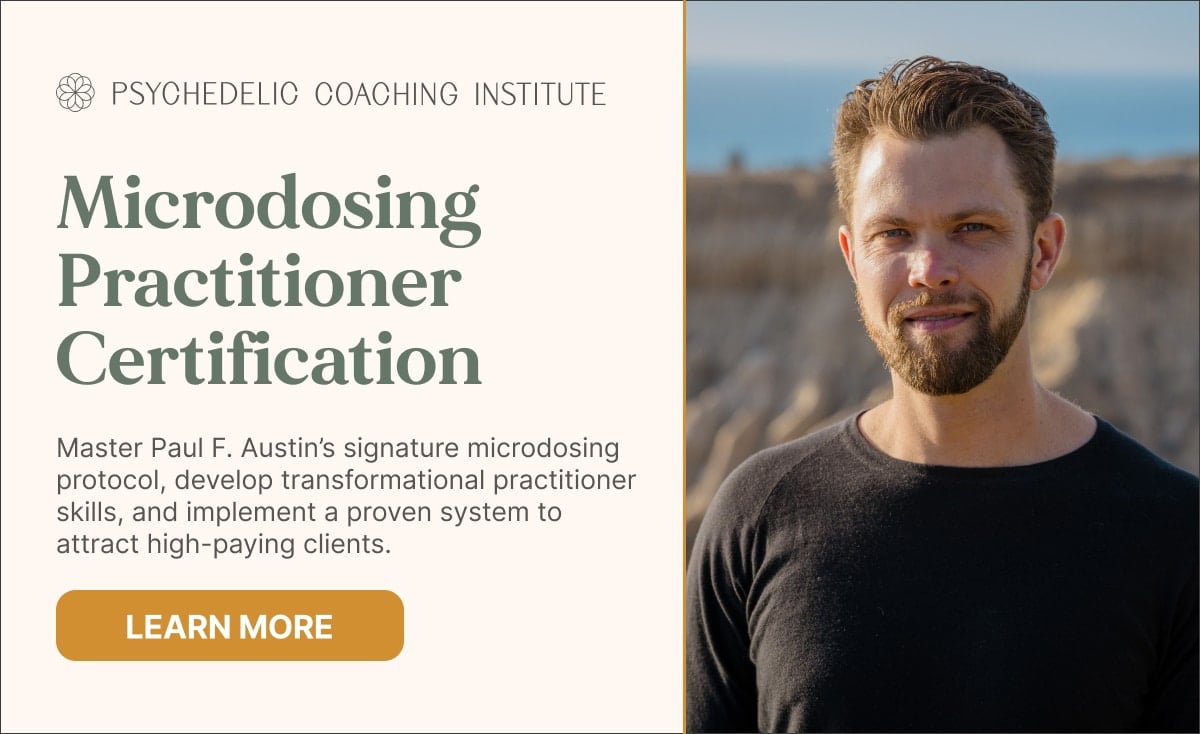
The Microdosing Practitioner Certification empowers you to launch a sustainable practice built on integrity, science, and results. Learn Paul F. Austin’s signature San Pedro Microdosing Protocol, master somatic coaching skills, and confidently guide clients toward lasting transformation. Click here to learn more and apply.
Third Wave occasionally partners with or shares information about other people, companies, and/or providers. While we work hard to only share information about ethical and responsible third parties, we can’t and don't control the behavior of, products and services offered by, or the statements made by people, companies, or providers other than Third Wave. Accordingly, we encourage you to research for yourself, and consult a medical, legal, or financial professional before making decisions in those areas. Third Wave isn’t responsible for the statements, conduct, services, or products of third parties.
Podcast Transcript
00:00:00 Paul Austin
What if one of the most misunderstood plants in the modern world is also one of the most important medicines in Amazonian tradition? For most of us in the West, tobacco means cigarettes, addiction, commercial misuse, and cancer. But in many indigenous and Amazonian contexts, sacred tobacco is understood as a master plant, a protector, and a bridge into relationship with the wider plant kingdom.
00:00:24 Paul Austin
Welcome to the Psychedelic Podcast. I'm your host, Paul Austin. A few years ago, we explored the relationship between tobacco and ayahuasca with Dr. Jeremy Jeremy Narby, largely through an anthropological lens. Today's conversation goes deeper into the Practitioner's perspective. What does it actually mean to work with tobacco as a medicine? How is it used in the context of a dieta? Why does lineage matter? And what can this plant teach us about power, humility, discernment, and right relationship?
00:00:52 Paul Austin
Today's guest is Jason Grechanik, a maestro Tabaquero trained in the Mamonkunawa tradition. With nearly a decade of Amazonian immersion and more than 1,000 people guided through plant ceremonies, Jason spent many years at the renowned Shipibo-Conibo Healing Center, Temple of the Way of Light. He is the host of The Universe Within Podcast, which has released more than 180 episodes, and he is also the co-founder of the Nicotiana Rustica Project and has been featured in many publications including Double Blind.
00:01:22 Paul Austin
His work focuses on sacred tobacco dietas, Amazonian wisdom, somatic healing, introspection, and helping people understand tobacco as a powerful medicine that requires respect, discernment, and proper lineage. So what we're going to sort of navigate through today is Jason's first encounter with tobacco as a medicine, not simply a harmful or addictive substance, why sacred tobacco is considered a master plant in Amazonian traditions, how tobacco functions as a portal, protector, and amplifier in relationship to ayahuasca and other plants, what a tobacco dieta involves, including isolation, fasting, and direct relationship with one plant, why proper containers, lineage, and dosage matter when working with powerful plant medicine, how tobacco relates to cannabis dream space and the question of right relationship, and what the modern psychedelic movement can learn from tobacco's history of sacred use and commercial misuse.
00:02:18 Paul Austin
I love tobacco. It is tricky. Mapacho has been an ally in my work in dieta with ayahuasca. You'll hear me talk a little bit about that on the podcast and We have to be mindful that every plant has its shadow side, and tobacco is no different.
00:02:34 Paul Austin
All right, before we get into it, let's hear a word from our sponsors.
00:02:38 Paul Austin
Third Wave sometimes shares or partners with outside providers, but we don't control and aren't responsible for their statements, conduct, products, or services. We encourage you to do your own research and consult appropriate professionals.
00:02:50 Paul Austin
Hey everyone, I want to take a moment to share something important with you. At Third Wave, one of our biggest commitments is helping people to explore the power of microdosing safely, intentionally, and with the right support systems in place. That's why I'm excited to introduce you to our go-to company, Golden Rule, one of the most respected names in the microdosing space. Golden Rule crafts premium, ethically sourced microdosing products including psilocybin single strain and blends, San Pedro, and LSD options, all designed to support clarity, creativity, emotional healing, and performance.
00:03:22 Paul Austin
What really sets them apart is their integrity, honoring traditional plant wisdom while embracing modern science to support real and lasting transformation. Together, Third Wave and Golden Rule are working to make safe, high-quality microdoses more accessible while ensuring you have the education, tools, and community to feel confident on your journey. If you're curious about microdosing and want to try some of my personal favorites, head over to goldenrulemushrooms.com/thirdwave and use code THIRDWAVE at checkout for 10% off, not just once, but for every future order too. Again, that's goldenrulemushrooms.com/thirdwave and use code THIRDWAVE for a lifetime discount of 10%.
00:04:05 Paul Austin
Off. All right, let's hear directly from Jason Grechanik.
00:04:32 Paul Austin
Jason, welcome to the show. It's good to have you.
00:04:34 Jason Grechanik
Thank you, Paul. It's a pleasure. Thank you very much for having me on. I've already enjoyed catching up with you a little bit before we started.
00:04:41 Paul Austin
So I mentioned before we went live that many years ago at this point, I think it was 2021, Jeremy Narby had published a little short compendium exploring this overlap of ayahuasca and tobacco, and we had him on the show to talk about the power of tobacco, especially in conjunction with ayahuasca as a master plant. That's really the only time, as far as I can remember, that we've talked about tobacco.
00:05:06 Paul Austin
So this, I think, is, is another opportunity to go deeper into understanding tobacco, not so much from the frame of an anthropologist, which is what Jeremy is, but more so from the frame of a Practitioner, someone who's really been in the work, who is holding space for people as they get into this.
00:05:22 Paul Austin
But before we do all of that, I'd love to just hear a little bit about, you know, your first experience with tobacco as a medicine. How were you introduced to tobacco, not as this, you know, sort of addictive and harmful substance, which is how many of us perceive it in the West, but as actual medicine that we can work with that has healing properties?
00:05:43 Jason Grechanik
Yeah, it's a good question. I mean, my, my father was actually a smoker of, of commercial cigarettes, and I, I hated it. He would smoke in the car. It's probably dating me a little bit, but I even remember a time when on airplanes you could smoke and I couldn't stand it.
00:06:01 Jason Grechanik
At the same time, I grew up in Virginia, so there's a, there's a deep history of tobacco use. And even my grandparents' land where I spent a lot of time, that land before they purchased it used to be a tobacco farm and that there was still a tobacco barn on there and I just remember as a young child, and it's interesting because I don't even remember exactly where, but going into tobacco barns and smelling tobacco, and there was something very intoxicating about it, which was strange kind of that vis-à-vis cigarettes, which I knew.
00:06:42 Jason Grechanik
And then kind of fast forward to when I originally had the call to go to the Peruvian Amazon and as you mentioned, work at this ayahuasca center called the Temple of the Way of Light, I became very familiar with tobacco as a medicine because most of the Shipibo-Conibo people who I was working with, they were smoking pipe, tobacco pipes. They were working with tobacco.
00:07:04 Jason Grechanik
And also this idea of dieta, which I would imagine some of your audience is familiar with, is this kind of more traditional Amazonian practice of learning healing experientially from one plant. And through that process, I also became to know that tobacco was one of the plants you could diet, and it was considered a very, very strong plant, very high-level plant, a master plant, it could be said. And for whatever reason, I had a very deep calling to diet that plant.
00:07:36 Jason Grechanik
The bio was maybe slightly incorrect in that I did a lot of diets with Shipibo-Conibo, but I actually went outside that system when I found Mestizo Tabaquero and something about him really resonated with me. I think who he was, how he presented himself, his knowledge, even though interestingly, I've had very few conversations with him, even in the many years that we've met.
00:08:04 Jason Grechanik
It's— I think there's something more in his presence as being, and this may sound a bit strange, but almost something telepathically that's been communicated. That deeply resonated with me. And that's— that's— you asked me when I became aware of maybe this more experiential rather than a knowledge-based idea of tobacco. And it was very much through my, my initial encounter of tobacco through him.
00:08:30 Jason Grechanik
And it was very, very difficult for me. And even at that time, I had done quite a lot of medicine work, but that was extremely challenging, almost to the point of death, which isn't necessarily a very common experience. But I think there was something in that for me that was very profound. And and then that led me eventually beyond my better judgment to come back to him and continue learning from him. And and that was kind of the beginning of my, my experience of, of tobacco as a medicine.
00:09:00 Paul Austin
So we all know tobacco in commercial cigarette form, Marlboro and Camel and American Spirits and these sorts of things. There are also more, you know, I've, I've looked into tobacco in, in more boutique form. There's a really nice place here in San Diego called Racing in Laramie. They do really, really nice tobaccos that are, that are sort of custom-made, organic, you know, still smokable. There's cigars, of course. We
00:09:27 Paul Austin
have Cuban cigars, and then we have mapacho, which you reference. You know, the Shipibo-Conibo will often have a pipe, and they'll work with mapacho during dietas. Or if people go on ayahuasca retreats, they may, they may smoke mapacho.
00:09:41 Paul Austin
But the way we can work with tobacco and the way I imagine you've worked with tobacco goes beyond just smoking it. And I'd love if you could share a little bit about, you know, when you had that first experience with tobacco as, you know, like deep, deep experience with tobacco as a medicine, what was the form of it? How were you working with it? What was the con— you know, was this part of an ayahuasca dieta or was it really strictly just working with tobacco as a medicine? Talk to us a little bit more about the details around that near-death experience. Experience with, with tobacco.
00:10:15 Jason Grechanik
Yeah, I mean, probably to start as I learned from, from my, my channel and podcast, you should probably put a legal disclaimer that, that we don't disagree with the fact that nicotine is an addictive substance. Well, let's be very clear about that. I probably do disagree with that, but officially I don't disagree with that. Nicotine is an addictive substance.
00:10:40 Jason Grechanik
You know, in the Amazon, I mentioned this idea of a master plant, and it's a bit controversial that there's different ways of looking at things. But it is a fairly common saying that people will use that certain plants are master plants, teacher plants. Other people say that all plants are teacher plants. But certainly there's this idea that there can be a hierarchy of plants. And so you have things like ayahuasca or in other parts of the world, peyote or iboga. Towe, datura, brugmansia, mushrooms, the not necessarily a plant, but these substances that act as a gateway, a portal to the world of spirit. And tobacco is considered one of those plants in the Amazon. Interestingly, probably traditionally, if you were to look at all of the different Amerindian groups, tobacco was the most widely used master plant, the most commonly used master plant, even above something like ayahuasca.
00:11:36 Jason Grechanik
But in most of these cultures, it's seen as something equal to a plant like ayahuasca or Burugmansia toe. They're, they're very powerful plants. They're portals, they're gateway again into the spirit world, into this ability to connect with the essence of an individual plant, to our connection to the divine, our connection to what in a lot of traditions they would say the root cause of human suffering is, which is that we've forgotten who we are and where we come from. And so tobacco is also a very interesting plant in that it can be worked with and administered in many different ways. We were familiar usually with smoking as one form, but traditionally that was not the most commonly used way.
00:12:25 Jason Grechanik
Even where you're coming from and where I'm from in the US, you know, smoking is more of a recent phenomenon. It used to be chewed for a long time. I mean, people probably, if you watch old baseball games, everyone was chewing tobacco, spitting. I think like some of the early French people who came over, they looked at Washington, D.C. and they said, if you look out, it's the most beautiful city in the world. But if you look at the ground, it's the most disgusting city in the world because it's just full of tobacco spit. Even before that, when the Europeans first came over, it was very common to snuff, to inhale, which nowadays people are probably familiar with this idea of rapé, rapé, snuff. But tobacco is very unique in that way, in that there's many ways that it can be applied.
00:13:07 Jason Grechanik
So it can be snuffed in its powder form, can be inhaled as a liquid form. Usually when you're speaking of having this more direct relationship with a plant, these more initiatory or diet experiences through ingesting it in its liquid form, much like ayahuasca or any sort of sacrament that you would be taking in that way. It can be smoked, it can be like as we showed earlier, taken as a paste and licked. It can be applied topically, it can be applied through an enema. So there's many different ways. I mean, basically any orifice in your body to tobacco can be, can be put in. And they all interestingly have very unique effects. So it's, it's very much a panacea in that way, in the same way that many of these master plants are considered a panacea. Like they have the ability to treat many, many ailments of the body, of the mind, and of the spirit.
00:14:03 Jason Grechanik
So, yes, as you said, many people know tobacco through the form of smoking. Which is a very legitimate way of working with it. As you said, many— if you go to an ayahuasca ceremony, I mean, it's often said that tobacco can be worked with without ayahuasca. Ayahuasca can't be worked with without tobacco because in many traditions tobacco is actually seen as the first plant in many of these indigenous cosmovisions. It's the plant that allowed humans to dream like God dreamt the universe into creation. And so it's also seen that tobacco is, as I said, like a portal, a portal that allows us to connect to the entire plant kingdom or to the spirit kingdom, but to that which is beyond the senses.
00:14:51 Jason Grechanik
So traditionally, you could diet or you could work with tobacco in and of itself as a master plant, but tobacco would also be used to act as this portal to the medicine or the knowledge of another plant. So very often traditionally, when you dieted a plant, when you worked with an individual plant in this way to heal and learn from it, it would be via the medium of tobacco. So ingesting the tobacco and the plant together to amplify its effects.
00:15:22 Paul Austin
I love what you said about how you may work with tobacco without ayahuasca, but you won't work with ayahuasca without tobacco necessarily. Why is that? What is it about tobacco that's so essential as part of the process or unfolding and working with a master plant like like ayahuasca.
00:15:44 Jason Grechanik
Well, from, from this more traditional or indigenous, you know, all these words are a bit problematic in how we use them, but, but for lack of better words, in these more traditional cosmovisions, tobacco was seen as the first plant. So it's seen as the plant that connects us to the entire plant kingdom, to the world of spirits.
00:16:06 Jason Grechanik
So For example, in an ayahuasca ceremony, they're often using tobacco to connect them to the world of spirit in the same way that they're using ayahuasca to connect them. You could use tobacco in conjunction with another plant, again, to amplify that connection, to deepen that connection.
00:16:26 Jason Grechanik
Some people may not be familiar, but even in an ayahuasca ceremony, ayahuasca is also seen as a portal, as a diagnostic tool that allows the the healer, the shaman, the curandero, to access all of the plants that they've worked with, which are considered their doctors. So they're using ayahuasca or tobacco to connect to the spirits of those plants, to the medicine of those plants, so that those plants can come through, through this medium, through this portal of ayahuasca tobacco to, to do the work, to do the healing. So tobacco and ayahuasca can be used in very similar ways.
00:17:07 Jason Grechanik
Very often, because you asked in an ayahuasca ceremony why it wouldn't be worked with without tobacco, is because also tobacco is very often used as a very, very strong ally, as a very strong protector. So often when they're smoking the plants or sorry, when they're smoking the tobacco, they would say it's feeding the plants, it's feeding the energy, it's feeding the spirit. They would say that the spirits of plants feed on tobacco. So
00:17:32 Jason Grechanik
It's literally feeding, and this may be going a bit deep, but it's even this idea of like mariri, it's bringing up this energy, this power, this strength inside that's been harnessed through the process of dieta, through this process of initiation. It's used as a very strong cleanser.
00:17:52 Jason Grechanik
So if there's energies or things that need to be moved or cleaned or ordered or transmuted, tobacco is a very strong ally to do that.. It's used at cleaning the energy of oneself, cleaning the energy of other people, of strengthening oneself, of protecting oneself from these potential negative energies.
00:18:14 Jason Grechanik
And it's a very particular worldview. It's a very particular cosmology. But, but a lot of that idea is that there are energies that need to be called in and there's energies that need to be cleaned or removed. And so tobacco is very often the plant that allows one to do that in that in that ceremonial space where in that case ayahuasca is the diagnostic tool to allow people to, to see and experience that.
00:18:42 Paul Austin
If you've been wanting to turn your passion for psychedelics into a meaningful and profitable practice, then check this out. Enrollment is now open for our Microdosing Practitioner Certification Program, and in just 18 weeks you'll become a certified microdosing practitioner mastering my signature San Pedro microdosing protocol for nervous system regulation while developing the somatic coaching and business skills to launch or expand your practice. This isn't just another theoretical course. It's hands-on, high-touch training that helps you integrate our microdosing protocol, refine your practitioner presence, and graduate ready to start enrolling clients right away. If you're ready to help others move from dysregulation to balance and build a thriving business doing work that matters, I'd love to see you in our next Microdosing Practitioner Cohort. Just follow the link in the episode description or visit psychedeliccoaching.institute to learn more and apply.
00:19:39 Paul Austin
So the, the first time I heard about tobacco dieta was from someone who I worked with through Third Wave. He was our copywriter for, for many years and was very deep in dietas and medicine work. And, and he told me that he went and did this tobacco dieta, right, where he actually drank the tobacco liquid as a way to really clean and clear out his channels and heal some very deep sort of wounds that weren't necessarily able to be healed just by a standard dieta, meaning with, you know, marusa or with bobonsana or with guayusa or some of these other, you know, master plants that may be dieted as part of an ayahuasca dieta.
00:20:27 Paul Austin
So I'm curious if we think about this practically, because you also offer Retreats as part of this and folks who may come and work with it this way. So for the folks listening at home who feel like, oh man, this sounds A, very intense, and B, quite unique, why might someone be interested or called to a dieta with tobacco in particular? What would be sort of the curiosity or the interest in working into that level of depth with this type of plant?
00:21:01 Jason Grechanik
Yeah, it's a good question. Again, it's seen that every plant has its medicine. So marusa would have its medicine, waiusa, bobinsana. Sorry, marusa, I think you said. So all of those have their medicine. It would be in the same way if we went to a pharmacy, like there's many different medications that you can take for certain things that you're working with. And in that same way, there's many different plants that we can take.
00:21:27 Jason Grechanik
So if we're maybe dealing with something with the heart, something like marosa could be very beautiful, or bobinsana or wayusa. If we're looking to open or connect to the heart, to connect to love, to connect with self-worth, those could be beautiful plants to work with.
00:21:46 Jason Grechanik
Tobacco, interestingly, is seen as a plant that has a lot of light. Interestingly, often these plants that have what would be seen as a lot of light can often be used as remedies for darkness. And so in these cosmovisions, this idea of brujería, black magic, or maybe what we could say in the West, like very deep trauma, very deep negative patterns, things that come from our lifetime or depending on our cosmovision, other lifetimes, intergenerational.
00:22:20 Jason Grechanik
Sometimes we need very strong plants to be able to go deep, to bring those things up. That's why there can often be a lot of fear around these plants like ayahuasca or tobacco or brugmansia, because they are very strong. And so there's a natural fear, a natural respect, because all of these plants have a toxicity. Ayahuasca has a toxicity, tobacco has a toxicity, datura has a toxicity.
00:22:45 Jason Grechanik
So even pharmacologically, if not worked with in the proper dose, there is the real possibility of death. But even that is maybe a more kind of Western cosmovision because there's also not only the dos, but the actual manner in which these are worked with. Like, how is that space held? What is the ability of that person to begin to work with, to move, to clean, to clear these energies, to bring order to them? And if that's not done properly, then negative things can happen.
00:23:20 Jason Grechanik
And I would imagine people are becoming more aware of that. Even plants that have a lot of light like ayahuasca, if not worked with properly, like people can have psychotic episodes and go into states of psychosis. It's rare. So it's not to necessarily put fear into people. I mean, pharmaceuticals probably kill far more people, do far more damage than any natural substance. But there is a real— concern to think about with that.
00:23:51 Jason Grechanik
And why would someone come to work with tobacco? Well, one is, as I said, this idea that it's a teacher, it's a master plant. So it's seen that the spirit of tobacco has a tremendous amount to teach us. So very often in our more Western worldviews, we look at things in a very physical reality that if I have some disease of my body, it's something purely physical or some chemical imbalance. I'm too much of this or not enough this, I need to eat more of this or not do as much of this.
00:24:22 Jason Grechanik
Usually in these more traditional worldviews, which includes things like traditional Chinese medicine or Ayurveda at its deeper roots and certainly these shamanic paths, it's usually seen as the inverse that all of our ailments originate in the world of spirit. And if that's in disease, if that's out of balance, eventually that's going to affect our mind. We're going to have some sort of mental emotional imbalance. And if that's left in a state of disorder for too long, eventually a physical ailment will, will become manifest.
00:24:53 Jason Grechanik
Now, obviously, we're talking about things that are chronic ailments. I mean, if I, if I fall and break my leg, I don't necessarily need to maybe work on the realm of spirit, although some people may argue conversely as well. But so certainly as a teacher, tobacco is a very, very strong teacher and Usually if we were to diet tobacco, there would be the three levels that we're working on. There's a very powerful physical purification, which can be challenging. There's a lot of work being done in the mind and body. So also a lot of thoughts and reflections about the past, thoughts about the presence, a state of presence, possibilities of the future. And this idea of spirit is being worked on, this deepest essence of who we are, what we long for, this process of remembering. And tobacco is a very strong medium of being able to do that.
00:25:52 Jason Grechanik
Also, also, like, as I alluded to earlier, the majority of our work is— how to say this— we do very— we don't— the majority of our work is not specifically with tobacco, like people working with tobacco. That's one diet that people can do. But the majority of our work is working with plants. Like you said, these plants, marosa or waiusa, most of the work that I do, or I say we because I work with a colleague, is predominantly trees. And so we diet trees, but we do it through the medium of tobacco because again, tobacco is what allows that much deeper connection.
00:26:38 Jason Grechanik
So it's the difference of even if I was to go into isolation and fast and drink Oak as a tea or willow tea, there would still be a lot that could be received and worked on. But if you were to amplify that with tobacco, it's a deeper connection. It's a much more profound connection. And especially then if you're working with someone who, as you said, very interestingly, this guy who worked with tobacco, that his channels were open because then that becomes an open channel to allow even a deeper connection to take place. So it's twofold. One, there's the very direct and experiential healing and learning of tobacco as a plant. And then there's the work with tobacco that allows us to connect in a deeper way to the entire plant kingdom, which for us specifically, we work mostly with trees.
00:27:34 Paul Austin
And so how do you create containers for that type of work? The dieta that I did a few years ago, it was a 10-day a dieta with these 3 Shipibo-Conibo maestras, Yanez, Laura, and Laila. I dieted Lila. Yeah, you know them.
00:27:55 Jason Grechanik
Yeah, I worked with them for many years. Yeah.
00:27:58 Paul Austin
Beautiful. I dieted Guayusa. And, you know, we opened the diet. We had 4 ceremonies in silence and then a 5th ceremony after we had closed the container of silence. Every morning I drank and sang to the tea. The guayusa tea.
00:28:16 Paul Austin
And and there were a couple other people much more advanced who had— who have done multiple dietas who were dieting trees. And from what I remember, the, the core distinction between dieting guayusa and dieting a tree— I forget what it was, but you, I'm sure, would, would recognize the name— is that for dieting with guayusa, after that 10-day period of silence, it was another 4 weeks of no sex, no other substances, being mindful of, you know, media being mindful of just the sort of cleanliness of the energetic container. That was for the guayusa. For the trees, it was 6 weeks after the close. So there was a little bit more depth or spaciousness to really allow that process to resolve and clear.
00:29:03 Paul Austin
So when you're talking about tobacco dietas, potentially with trees, how are you setting up those containers? Are people coming in for a month? Are they coming in for 2 weeks? Is there any sort of ayahuasca work that's done within that process, or is it only tobacco and the tree? Talk to us a little bit about the practicalities of that container.
00:29:28 Jason Grechanik
Yes, a good question. I think when you look at a lot of traditions all around the world, you, you have very similar pillars that can be focused on things like isolation. So whether that's going off into the forest or a desert or a cave or a house, but being isolated because one of the fundamental ideas of a dieta is you're entering a direct relationship with one plant. So isolation is very important in that way because anything else that's coming in, then the dieta becomes about that. So if I'm having conversations with someone, that's not necessarily bad, but it does mean that now that conversation is part of my dieta. And so now I can't distinguish, well, Is what I'm learning the conversation or is it the plant that I'm working with?
00:30:21 Jason Grechanik
If I'm reading a book, there's nothing bad about reading a book, but now that's what my dieta is about. And so the idea by isolating ourselves is the only contact we have is the plant. Now that's the only thing essentially we're ingesting, which is also why we either begin to restrict our food or even to potentially cut food because again, the idea is, to just have enough strength to be able to, to, to be able to meet the medicine. So if one is able to completely not take in food, that's amazing because then obviously the only information coming into you is the plant. But for most people, that's, that's challenging. And especially if the diet is a long period of time, it's not doable. It's not possible. So we need some food to be able to have the energy to, to simply be able to continue. You.
00:31:12 Jason Grechanik
So that's another pillar. And then the third pillar is also this idea of just being in relationship to one plant. So the tobacco acts as something that amplifies that. It's also interestingly because tobacco becomes in a way sustenance for us. It's like a spiritual food, but also a physical food. Probably many people are familiar with this idea that you mentioned you lived in New York for a while. I mean, many of the diet of models, stereotypically is coffee and cigarettes. Why? Because it actually does give them a lot of, a lot of sustenance. Like they're very phytochemically rich plants. The coffee bean, the tobacco plant, the cacao plant, the coca plant, like you can live a long time off of those. Even in the Andes where I spent a long time, traditionally people would just take a little pack of coca when they were going on these very long journeys because it would give them the sustenance to be able to survive.
00:32:18 Paul Austin
5. So,
00:32:19 Jason Grechanik
so I'd say those are, those are the main pillars: the, the, the isolation, the fasting, and the direct ingestion of one plant. And also, to answer your question, that the way we work with is, is simply through tobacco. So we work with tobacco as the, the, the portal, the, the amplifier. We, we don't work with ayahuasca. There's been sometimes where we do, but it's, it's very rare. Like tobacco is sufficient to do our work.
00:32:48 Jason Grechanik
In terms of the time, in an ideal world, for sure, if we had 6 months, a year, these are amazing amounts of time to be able to diet. But for most people, that's simply not a realistic possibility. So usually we work in 1-week increments. It's also a bit different from some dietas because again, everything is in balance. So if you, if you add on something, maybe you have to take out something. If you take out something, you have to add on something. So there's many ways to do a dieta, many, many lengths of time. Usually the longer the time, potentially the less intense it would be because it's spanned out over a much longer period.
00:33:31 Jason Grechanik
So we're drinking usually the medicine, which consists of tobacco, every single day. So it's quite an intensive process. And then we'll usually cut that for a day, 2 days, and then begin a second dieta. So usually we work in spans of 2 well, let's say like 15 days or 1 month. So people can come for some duration of that time. And we find that to be a good amount of time. Any more time than that, we actually find to not be beneficial. Like there's an importance to allowing the body to rest, to de-intensifying that process and then taking time to integrate what one has done as well.
00:34:16 Jason Grechanik
And having said that, people react very differently and we dose people very differently. I mean, some people are not able to take tobacco, and so the dieta may be much more smooth or much more easy in a way, gentle. Some people need a very big dose to, to take them to a certain place. And so physically it may be more challenging.
00:34:43 Jason Grechanik
And interestingly, there there was two animals that were often associated with tobacco. One was the jaguar and the other was the hummingbird. And for me, it's very interesting archetypes because I think tobacco can have both of those qualities. It can be very, very strong. Like when I mentioned I almost died, I mean, for me, that was that jaguar energy. It was completely like, that's the apex predator. And when it wants to kill, it kills. Like there's no, you know, Funny, when I was working at the Temple of Way of Light, people would often ask, have you ever seen a jaguar? And I said, nope, and I don't want to, because if you see a jaguar, that's probably the last thing you're going to see. I mean, they are magnificent specimens, truly magnificent.
00:35:29 Jason Grechanik
So tobacco can have that energy and it can have the energy of a hummingbird. It can be very gentle, very sweet, very beautiful. How that interacts with us is dependent on many, many factors. So it doesn't— just to say, it doesn't necessarily have to be intense. You know, maybe an unpopular opinion, but I'd say in general for men it tends to be more intense and for women it tends to be less intense.
00:35:59 Paul Austin
So spliffs are one of my great loves. For any American listeners who may not be familiar with spliffs, that is cannabis and tobacco together. It's a much more sort of European thing. And what I've found in some of my deep medicine work, whether it's with psilocybin or ayahuasca, is I don't have a lot of the sort of visions that open up.
00:36:27 Paul Austin
And sort of one of the hypotheses that's been presented to me as a reason why is because is for better or worse, I have smoked quite a bit of cannabis in my adult life. And in fact, when I was, when I was coming in for this dieta, one of the things that I really wanted to clean up was the energetic imprint of the cannabis. And so I guess my question for you is, what's this relationship between tobacco and cannabis as perceived maybe by Indigenous peoples who work with ayahuasca, who work with tobacco, maybe even who work with cannabis.
00:37:03 Paul Austin
There are a lot of Brazilian tribes that do weave cannabis in. Is tobacco something that you would perceive as something that could help to clear out maybe a sticky addiction or a sticky plant like cannabis? I just, I'd love to hear you riff a little bit on that in terms of what you've seen in your practice, or, you know, what you've learned through the many years of working with
00:37:27 Paul Austin
After a decade of professional experience in the psychedelic space, I've learned that direct experience with these medicines is essential. And that's why our Practitioner Certification Program includes something rare: a week-long immersive intensive at Brave Earth, a regenerative community and healing art center in the lush jungles of Costa Rica. This is more than an online certification, it's a comprehensive learning journey that combines iboga lines, psilocybin experiences, daily yoga and meditation, atemes call ceremony, in-person coaching, and hands-on leadership development all set against the backdrop— oh, volcanic hot springs and cloud forests.
00:38:07 Paul Austin
The intensive is fully included in your tuition as part of our six-month program that uses cutting-edge psychedelic education with practical coaching skills. You'll learn directly from me, our world-class faculty, and other leaders who are shaping the future of psychedelic practice. Join a global community of coaches at the leading edge of this Third Wave of Psychedelics and walk away with the confidence, clarity, and credibility to guide others safely and effectively. If you're ready to elevate your practice, learn more and apply for our next cohort at psychedeliccoaching.institute. Again, that's psychedeliccoaching.institute, or check the link in the description.
00:38:46 Jason Grechanik
Yeah, it's a very good question. Again, this is where language becomes a little tricky because, you know, I like, I think we all understand what we're saying when we mean indigenous, but it would kind of be like saying, like, what do Asians think? You know, there's many, many different worldviews, many different cosmovisions, very similar.
00:39:07 Jason Grechanik
Like, you could certainly say Asia as a whole has some similar cosmovisions, but within that you have very different cosmovisions. So in the Amazon,
00:39:23 Jason Grechanik
It's a very interesting question and one I've often pondered because I don't think marijuana is native to the Amazon. And yet, as you said, there are Brazilian tribes, Colombian tribes that work with it. In my very rational mind, which I've tried to get away from a bit, you know, there was a point where I was very curious about that. How do you work with the plant if it's not indigenous? Was it introduced? And The answer was usually very unclear, and I've kind of given up on trying to understand that.
00:39:57 Jason Grechanik
But one of the beautiful answers I received by a very dear teacher of mine whose name is Emeka, he comes from a group of people called the Tubu in the Colombian Amazon, is that they connected to the spirit of the plant. And that's usually an answer that you'll receive quite often. And obviously that brings up a whole can of worms for the Western mind. But that it's possible to work with the plant and spirit and not just the physical matter of it. But certainly they do have a very long tradition of working with, with, with cannabis. And in their language, they would call it jemaru.
00:40:35 Jason Grechanik
And for example, the Toubou have this very beautiful story, and I'm not going to do it any justice. And then we probably don't have time to, even if I could do it a smidgen of justice. But they said eons ago, humans were suffering, which I think is very interesting too, because we usually look at our present time as being like somehow unbelievably imbalanced or something. But they were saying even eons ago, humans were suffering. And interestingly, these star beings, very specifically from the star being Sirius, heeded this call of the suffering of humans, which the Shipibo-Conibo also have that same cosmovision specifically of the star system Sirius, heeded this call and they transcended the 12 dimensions of time and space on this primordial anaconda canoe. And on this canoe, they brought with them all of these master plants to help people to remember who they are and where they came from, because these Syrian beings viewed that that was the root of the primordial ailment of humanity, is we've forgotten in the deepest essence who we are and where we come from. And so all suffering is simply a manifestation of that in some, you know, 6 degrees of separation or however we want to look at it.
00:41:47 Jason Grechanik
Interestingly, so the first plant in that canoe was tobacco, which was, as I was saying, like the first plant, the primordial plant. The other end of that canoe, which brings balance to that, they would call the queens of knowledge. And those are, those are ayahuasca, yopo, which is, could be considered a similar medicine, and gemeru, marijuana. And they would call those the queens of knowledge. And so they have a very deep respect and reverence of marijuana.
00:42:18 Jason Grechanik
You know, maybe what you're referring to is something I've often heard from many of the Shipibo-Conibo who I worked with, where they view marijuana as this kind of sticky energy. They would say it has a jealous energy, that it clouds the mind, it clouds the judgment. I think there's many reasons for that. And again, we could probably do a whole podcast just on that subject. I would say one, because they don't work with it. And again, this is just my view. So, you know, ideally you'd have to speak to someone who has that worldview. But one, they don't work with that plant, so it is something that's foreign to them. And so I think their introduction to that plant has been through people who perhaps have an unhealthy relationship with it. And so like anything, if that's all you see, you're going to begin to have a negative view of that plant.
00:43:11 Jason Grechanik
I think also many people would probably say or recognize that if they are working a lot with marijuana, their dream space, for example, they become very disconnected to that. And the dream space for the shamanic work is essential. Like, they wouldn't differentiate your dream space and the space, this mediación, this dizziness that a plant like tobacco or ayahuasca or datura puts you into. It's the same place. It's the dream space because that's the space of pure potentiality. That, that's the space where everything can be made manifest. That's the space where true healing can happen on all three levels. So in that regard, if marijuana is being worked with and it's disconnecting us from our dream space, then it could be said that, that there's, that there's a negative aspect to that, that it's, it's not allowing us to see the world as it actually is.
00:44:10 Jason Grechanik
You know, interestingly, they use that word marihuana, like probably when you were in the jungle, you probably heard that word. Like if, if someone is working with ayahuasca and they're really high or stumbling or vomiting. They're mareado, mareación, like from the sea. So they're seasick, they're dizzy. But they also use that word to describe the natural state of humanity, or maybe not the natural state, the learned state of humanity. So in essence, we're all dizzy. We're dizzy from the mareación of life, from the dizziness of life. And on a deeper level, these plants help us to see.
00:44:45 Jason Grechanik
So to answer your question, it's very varied. People have different views of it. You know, for me, all plants are medicine and it's simply coming into right relationship with it, right practice. Even if you think of like a Buddhist point of view, the right relationship with something, that's the first principle of a dharmic path. And even And like this teacher who I mentioned, Emeka from the Toubou, every plant has a story, every plant has a dance, every plant has a song. And they would say if we forget those, then we become merialo by the plant, we become lost in its dizziness, we become lost in its darker side. But if we remember the story, we remember the song, we remember the dance, we're rooted in that, we— the plant becomes medicine and we honor the plant. We give reciprocity to the plant. We give thanks to the plant. And then the plant amplifies that. It mirrors what we're giving to it. So that's maybe kind of a convoluted, long-winded answer to your question, but it's a very good question and it's very, very, I think, complex. But, and I think there's many ways of looking at that. You
00:46:04 Jason Grechanik
know, interestingly, as you said, Tobacco can be worked with, with marijuana in, in a similar way to amplify that connection to marijuana, even though marijuana is also a master plant in and of itself.
00:46:18 Paul Austin
So my, my next question, we could probably spend a whole podcast on, and it's going to sort of build on some of the complexity that we just started to unpack. And I'll do my best to, to communicate the question, and if it's unclear, please ask.
00:46:35 Paul Austin
You know, we're at this really exciting point now in 2026 where psychedelics are now legal in Oregon and Colorado. They may be approved fairly soon for medical use. There are containers around them and structure around them, and yet people have concerns that what happens when you introduce a sacred plant medicine into the United States or Western culture, modern Western culture in, in general.
00:47:04 Paul Austin
We've seen what's happened with tobacco in terms of how it's been abused. We've seen what's happened with cannabis, I would argue, with recreational cannabis, in terms of how that, that medicine has been abused. And so I'd love to hear any reflections you have on what can we learn from the medicine of tobacco and how it's used within these more, again, traditional or indigenous contexts.
00:47:28 Paul Austin
What are some great lessons and learnings that we can take with us as psychedelics become introduced to the sort of Western, modern Western lens?
00:47:40 Jason Grechanik
Mm-hmm. Yeah, it's another good question and I think a very complex question. Like, very often people who are proponents of plant medicine, I think, are very happy with this legalized movement of them. And I understand that. At the same time, I think there's, for me, there's something even a bit energetic about that. Like, for example, I would probably say that something being legal is superior to it being illegal. At the same time, we're, we're giving away a power to something like once something is either legalized or illegalized, we've given away a certain power to someone else, to something else that has that ability to dictate something. And I think even in that paradigm, there's already confusion.
00:48:36 Jason Grechanik
It's also very challenging because traditionally, while there may not be a certificate of someone who's, for example, allowed to practice ayahuasca or tobacco or some other plant, there was very deep rites and rituals and initiations. And there was a very clear path of how that could be worked with in a way that was healing rather than harming. And then again, in these traditional worldviews, both of those are seen as realities, like these plants can be used to heal and they can be used to harm. So
00:49:15 Jason Grechanik
also, if we go back to this, this idea of this primordial anaconda canoe, which may seem quite crazy to some of your listeners, but this idea that certain plants are considered very sacred and they hold a special place in this canoe, it also means that they they all have their, their medicine. Like, there's a reason each of those plants is in the canoe. They serve a purpose.
00:49:40 Jason Grechanik
If you die at marosa, you're going to have a different experience than if you die at shibuwaku, which is a big Amazonian jungle tree. It's two very different experiences, two very different medicines. And it's not to say that one is better or worse than another. They're just very different medicines.
00:49:56 Jason Grechanik
They're, they're much like if you went to a university, like, which is better, chemistry or biology, or biology or economics or economics or mathematics. I mean, it would be very difficult to answer that question. They're just very different, very different things.
00:50:13 Jason Grechanik
Also, these master plants, as I mentioned earlier, really can be panaceas, meaning they can, they can work on all levels. Like, potentially, I think they could cure anything. I mean, I think tobacco could cure anything if given the right circumstances. That doesn't mean it will, it certainly will not. But given the right circumstances, it could, in the same way that a word could potentially heal something or a glass of water or a handshake or a hug, or there's many things that have that potentiality.
00:50:51 Jason Grechanik
Again, having said that, there do tend, I think, to be archetypal qualities that these plants induce. So again, going back to that primordial anaconda canoe, like I mentioned, that idea of the queens of knowledge, they would say that those plants have this ability to allow us to transcend these 12 dimensions of time and space, to connect to spirit, to receive knowledge, to receive wisdom, to receive guidance, to connect to something that's very high.
00:51:21 Jason Grechanik
Tobacco being on the other end of that, interestingly, almost if you kind of like an aurora or that infinity symbol, it also has the ability to do that. But I think one of the really interesting things about tobacco is I think if you were to ask like a bunch of people like, what did you get from tobacco? You would find certain similarities. And I think some of the things people would say is a sense of groundedness, a sense of connection, a sense of power, a sense of strength, a sense of clarity, a sense of knowing on a deeper level what's right and what's wrong. And even these ideas of good and bad and light and dark. There's something very primordial about that medicine that's very rooted.
00:52:10 Jason Grechanik
You know, even— and this is going to be controversial, but it's the first thing that came to mind. And maybe with some distance now, it won't maybe have such a charge to it. But even during COVID I knew a lot of people who practiced ayahuasca medicine, who from my point of view still fell under the mediación of that, the dizziness of it, and lost principle, lost this idea of what is good and what's not good.
00:52:42 Jason Grechanik
What are things that connect people and what are things that separate people? What are words and actions that harm and what are words and actions that heal? The people I know, and there's not a lot, you know, So it's maybe a bit biased that there's certainly, I think, a lot more ayahuasca practitioners and people working with it. But the people who I know who've gone on a deep path with tobacco, from my perspective, had a much more grounded view of that, a much stronger view, a much more principled view. And I think that's, that's again, very much part of the medicine of tobacco.
00:53:18 Jason Grechanik
You know, you interestingly mentioned that you had Jeremy Narby on, and if I remember correctly in the book, I don't remember his teacher of tobacco, but But I do remember because it resonated to me as very true. One of the things that that man said is that tobacco allows you to see things as they actually are. And I think that's very, very true. And tobacco is often even associated very much with this warrior energy, this warrior of light. And it reminded me of a quote by a very beautiful samurai named Miyamoto Musashi. And he said, and I hope I get this right, but he said, "Reality is not what we want it to be. It is what it is, and we must bend to its will or live a lie." And to me, that very much summarizes for me and from what I've seen working with people, part of the essence of tobacco.
00:54:16 Paul Austin
Well, and there's a humility in that, which I appreciate because the flip side is you hear, you know, out of Silicon Valley about Steve Jobs' reality distortion field, and there's a lot of conversation around how psychedelics, for example, can provide this level of power. We can actually shape and mold reality to how we wish it to be. And in some ways, both are true. We have agency, we have the capacity to create, we have the capacity to facilitate change, And yet I think time and time again, we overstate that at our demise. And so this ability to be both powerful and humble, holding the polarity of what exists between that feels like one of the key teachings that tobacco, if provided the right context, can provide.
00:55:10 Jason Grechanik
I think that's a beautiful way of putting it. And just to further that idea of tobacco being the first plant, that's why it's often referred to as the grandfather plant. Although for me it's neither masculine nor feminine, but it has a lot of this vital energy. I mean, it's not one of my interests, but I often find these things just interesting tangentially. But from what I understand, tobacco in men has a lot of— it helps men to produce a lot of testosterone. That goes hand in hand with a more traditional worldview that tobacco has power, it has vitality, it has that primordial life force, and that's the life force of creation. So even if we take a Christian worldview that, that man or humans are created in God's image, God is the creator. It's the creator of life. And so we, as reflections of God, the highest thing, the highest gift, the highest reciprocal act that we can do is to create.
00:56:15 Jason Grechanik
And but that vital energy, that vital life force is what helps us to create. And very much as you said, we do have that power. I think it's something that, you know, many, many philosophical people will have that debate of do humans have free will? But from my experience in these traditional worldviews, the answer is a very clear yes. And it's a, it's a great power that we have and it's a great responsibility that we have, but that we absolutely can and do shape reality.
00:56:47 Paul Austin
Beautiful. Well, folks, It was a pleasure to have Jason on the podcast. Jason, I know there's some dates and details. I'm on the page right now, nicotianarustica.org. You can probably pronounce that better than I can. We'll drop a link to that. On nicotianarustica.org is the calendar of dietas that Jason is helping to support and facilitate. We'll drop a link to that in the show notes.
00:57:14 Paul Austin
Jason also has his own podcast. The Universe Within Podcast. His personal website is Jason Grechanik. G-R-E-C-H-A-N-I-K. Okay, Jason, is it Grechanik? I'm going to ask you again.
00:57:33 Jason Grechanik
That's good.
00:57:34 Paul Austin
Yeah, that's good. .com. So we'll drop links to both of those. JasonGrechanik.com. Nicotiana— how do you say that? How do you say that the other website?
00:57:45 Jason Grechanik
Nicotiana, that, that's the, what the family of tobacco is. Usually the, the, the variety that we work with is rustica, rustica as opposed to Tabaquero, which is the, the more commonly used tobacco that you usually find.
00:57:58 Paul Austin
Nicotiana rustica.org. Like I said, we'll drop links to both of those. Any other places that folks, you might want to send folks or for folks to check out after this, this podcast episode?
00:58:08 Jason Grechanik
I think that's it. Nicotiana rustica is probably the best site. And I also have an Instagram. It's just at my name, @JasonGrechanik. We keep that pretty updated with our work too. But yeah, that and the website are probably the best bet. And yet people are curious about the podcast, Universe Within. It's on all the big platforms.
00:58:27 Paul Austin
Great. Well, Jason, thank you. Thank you for the work that you've done with tobacco. Thank you for bringing a little bit of that medicine and that spirit into this conversation today. It was a real pleasure to have you on the Psychedelic Podcast. So thank you.
00:58:41 Paul Austin
All right, folks, if you enjoyed the episode today, follow, rate, and leave a review wherever you're listening. You can share this episode if it was meaningful or impactful, you think a friend or family member would benefit from hearing about it. Subscribe on YouTube. We post all of our long-form videos on YouTube at youtube.com/thethirdwave. You can follow us on social. And also I personally am fairly active on social these days on X, LinkedIn, and sometimes Instagram, depending on whether or or not Meta has chosen to ban me.
00:59:09 Paul Austin
All right, thanks for tuning in, and I'll see you next week.