
Episode 356
Dr. Lauren Macdonald
In this episode of The Psychedelic Podcast, Paul F. Austin speaks with Dr. Lauren Macdonald, a clinical trial physician and psychedelic therapist, about the evolving role of community in psychedelic-assisted therapy.
Lauren shares insights from her work at Imperial College London, where she contributed to research on psilocybin for anorexia and fibromyalgia, as well as DMT for treatment-resistant depression. She reflects on the limitations of purely individual therapeutic models and explores how group-based approaches can foster deeper healing through connection, shared experience, and what she describes as communitas.
The conversation also touches on the contrast between clinical and ceremonial settings, the role of group dynamics in emotional processing, and the challenges of access and affordability as psychedelic therapy expands.
Dr. Lauren Macdonald has a background in psychiatry, psychedelic-assisted therapy, and group retreat facilitation, working at the intersection of science, soul, and spirit. At the Centre for Psychedelic Research at Imperial College London, she has served as a clinical trial doctor and psychedelic therapist on studies exploring psilocybin for anorexia and fibromyalgia, and DMT for treatment-resistant depression.
Podcast Highlights
- Psilocybin therapy in clinical research
- Limits of individual therapy models
- Why group work deepens healing
- Communitas and shared experience
- Bridging science and spirituality
- Psychedelics in palliative care
- Relational safety in altered states
Show Links
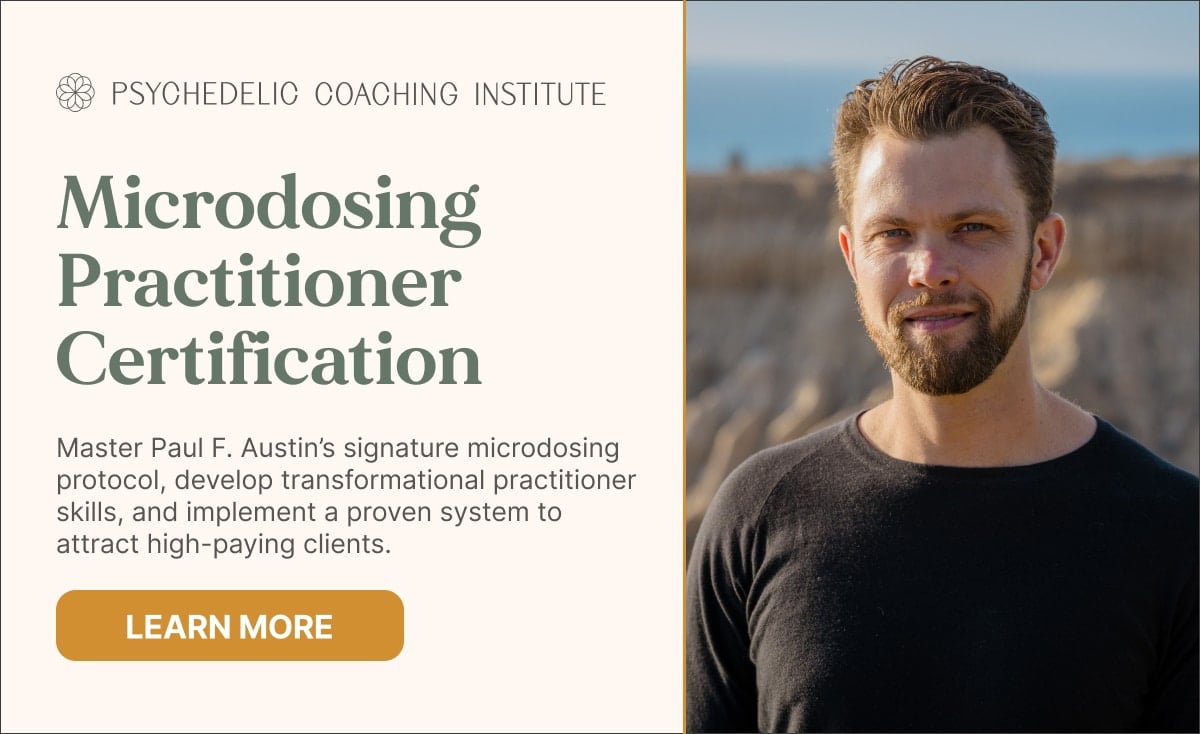
The Microdosing Practitioner Certification empowers you to launch a sustainable practice built on integrity, science, and results. Learn Paul F. Austin’s signature San Pedro Microdosing Protocol, master somatic coaching skills, and confidently guide clients toward lasting transformation. Click here to learn more and apply.
This episode is brought to you by The Practitioner Certification Program by Third Wave’s Psychedelic Coaching Institute. To learn more about our flagship 6-month training program for coaches who want to integrate psychedelic modalities into their practice, click here.
Third Wave occasionally partners with or shares information about other people, companies, and/or providers. While we work hard to only share information about ethical and responsible third parties, we can’t and don't control the behavior of, products and services offered by, or the statements made by people, companies, or providers other than Third Wave. Accordingly, we encourage you to research for yourself, and consult a medical, legal, or financial professional before making decisions in those areas. Third Wave isn’t responsible for the statements, conduct, services, or products of third parties.
Podcast Transcript
00:00:01 Paul Austin
What if the future of psychedelic healing isn't about going inward alone, but actually learning how to heal together? Welcome to the Psychedelic Podcast. I'm your host, Paul Austin, and for decades psychedelic therapy has largely followed an individualistic model: one client, one or two therapists, and one deeply personal journey. But as this field continues to evolve, there's a growing recognition that healing doesn't just happen within us; it happens between us. It is a relational process.
00:00:28 Paul Austin
My guest today is Dr. Lauren Macdonald, a clinical trial physician and psychedelic therapist at Imperial College London, whose work focuses on bridging science, spirituality, and community-based healing. Now, what we talk about today is the sort of efficacy of group work and relational work and whatnot. So we're going to discuss what clinical research is revealing about psilocybin for complex conditions like anorexia and fibromyalgia, why individual therapy models may be missing a key dimension of healing, how group psychedelic experiences can create deeper connection and shared meaning, what communitas is and why it plays such a powerful role in transformation, how retreats can be designed to support safety, trust, and relational healing, the role of psychedelics in end-of-life care and psychospiritual support, and what the future of psychedelic therapy may look like in the coming decade. Dr. Lauren Macdonald has a background in psychiatry, psychedelic-assisted therapy, and group retreat facilitation, working at the intersection of science, soul, and spirit. At the Center for Psychedelic Research at Imperial College London, she served as a clinical trial director and psychedelic therapist on studies exploring psilocybin for anorexia, fibromyalgia, and DMT for treatment-resistant depression.
00:01:40 Paul Austin
Alongside her clinical work, she facilitates retreats and experiential trainings that support safe, ethical, and embodied psychedelic practice, including co-hosting The Reconnection, a 12-week women's psilocybin and somatic program. Her work centers on group and community-based models of healing. Following her own experience with stage four cancer, she co-founded Essence Medicine and NY's organizations focused on psychospiritual care and expanding access to psychedelic-assisted therapy in palliative contexts. All right, folks, before we get into this episode, let's hear a quick word from our sponsors. Third Wave sometimes shares their partners with outside providers, but we don't control and aren't responsible for their statements, conduct, products, or services. We encourage you to do your own research and consult appropriate professionals. Hey, everyone, I want to take a moment to share something important with you.
00:02:33 Paul Austin
At Third Wave, one of our biggest commitments is helping people to explore the power of microdosing safely, intentionally, and with the right support systems in place. That's why I'm excited to introduce you to our go-to company, Golden Rule, one of the most respected names in the microdosing space. Golden Rule crafts premium, ethically sourced microdosing products, including psilocybin, single-strain, and blends, San Pedro and LSD options, all designed to support clarity, creativity, emotional healing, and performance. What really sets them apart is their integrity, honoring traditional plant wisdom while embracing modern science to support real and lasting transformation. Together, Third Wave and Golden Rule are working to make safe, high-quality microdoses more accessible while ensuring you have the education, tools, and community to feel confident on your journey. If you're curious about microdosing and want to try some of my personal favorites, head over to goldenrulemushrooms.com/thirdwave and use code THIRDWAVE at checkout for 10% off, not just once, but for every future order, too. Again, that's goldenrulemushrooms.com/thirdwave and use code THIRDWAVE for a lifetime discount of 10% off.
00:03:45 Paul Austin
And without further ado, I bring you this episode with Dr. Lauren Macdonald.
00:04:14 Paul Austin
Lauren, it's great to have you on the show. Welcome to the podcast.
00:04:17 Dr. Lauren Macdonald
Thank you so much, Paul. Lovely to be here with you.
00:04:20 Paul Austin
So you trained as a medical doctor in the UK, and more recently, you've worked within psychedelic research at Imperial College London. And I'd love if you could just help sort of talk to us about the gap between becoming a medical doctor and starting to work on that research. What pulled you towards wanting to be involved at Imperial College London with some of the clinical trial research that they've been doing there in the UK?
00:04:47 Dr. Lauren Macdonald
Yeah, so I had a very long, convoluted journey to get to working in psychedelic research. To be honest, I was never really, really keen to be a researcher. It's not my huge passion, but I found my way into psychedelics and then realized, actually, the way to help bring around change, especially at the time working in the UK, was to actually go for the research, lead with science, and then hopefully that the legislation would follow that.
00:05:14 Dr. Lauren Macdonald
So my journey into psychedelics really began a decade ago, and it was due to my own personal crisis. Like so many people come into this space through a personal journey, and mine was in the shape of a stage four cancer diagnosis when I was 30 years old. So I was a newly qualified doctor at the time, hadn't been practicing for long, and received the diagnosis of cancer, and over a few years, progressed from stage two to stage three to stage four. And as you can imagine, this was a huge initiation and a really challenging time of my life.
00:06:00 Dr. Lauren Macdonald
And it felt like I was just on the brink of adulthood and really starting life, and then suddenly it was cut short, and I was being told that there was potentially no further treatment for me, that we'd maybe come to the end of the road, and that potentially I only had about a year left to live. So that was all happening in around 2015. And I started looking for practices that would help support me, to really just center me and resource me.
00:06:35 Dr. Lauren Macdonald
So I found my way to integrative medicine and holistic practices, meditation, yoga, all of these beautiful modalities that are out there. And yet, there was still this sense that there was something incredibly deep that I was really struggling with, essentially huge existential questions around, what's this all about, life and death, and has my life had meaning? Have I loved enough? Have I let myself be loved enough? Am I going to be leaving a legacy?
00:07:09 Dr. Lauren Macdonald
So really big questions that I don't think that the average 30-year-old is necessarily thinking about on a day-to-day basis. And I was also struggling with what I now know to be existential anxiety. So I'd be waking up at 4:00 AM nearly every day and feeling terrified at the thoughts I was having around the dying process and death. And there was this real sense that I was incredibly alone in the experience. I had wonderful friends and family all around me, and yet the experience itself felt really, really isolating and lonely. And
00:07:53 Dr. Lauren Macdonald
fortunately, this is nearly, well, yeah, nearly over 10 years ago now, I was able to get access to immunotherapy and had an incredible response and was actually in remission four months after starting immunotherapy. So I really had the most incredible, miraculous recovery.
00:08:15 Dr. Lauren Macdonald
And at the same time, it's a really interesting process when you go through something like stage four cancer. There's a sense that on the other side, you're almost meant to just pick up life where you left off pre-diagnosis. And my medical team had been incredible. My physical care had been excellent.
00:08:36 Dr. Lauren Macdonald
But I really had this sense that my psychospiritual care had been lacking. My kind of emotions hadn't been really processed. I was still carrying a lot of grief, an awful lot of fear about cancer coming back. I'd had so many recurrences over those years.
00:08:57 Dr. Lauren Macdonald
And it was a really fortunate thing that I stumbled upon the TED Talk by the late Professor Roland Griffiths. And this was in around 2016, 2017. And as soon as I watched his talk around psilocybin therapy for cancer-related anxiety and distress, I just realized this was exactly what I'd been looking for for the years that had just gone prior.
00:09:27 Dr. Lauren Macdonald
So I took myself off to the Netherlands and had the most incredible psilocybin experience there. And that really put me on the path to work in this space through my own healing journey, but really also, more than anything, wanting to help other people in similar situations get access to psilocybin therapy, but also going back to psychiatry as well, just seeing how much potential these medicines could have in our modern healthcare system.
00:09:56 Paul Austin
That's miraculous. And I'm so glad to hear that. I have a really dear friend whose wife was recently diagnosed with stage four, I think, stomach cancer. Was also told she had a year to live, and he got news about a month ago that they can't seem to find it anymore.
00:10:15 Dr. Lauren Macdonald
Incredible.
00:10:16 Paul Austin
And it seems to, I mean, crossing our fingers, it seems to have gone. I think it's not quite done, done yet. So there are these sort of miraculous stories. But also what I'm hearing in your story is psilocybin came afterwards, right? It wasn't that you were working with psilocybin when you were in the throes of the existential distress. It was the response, the immunotherapy, which helped to heal the cancer. Coming out of that, you came across Roland Griffiths' TED Talk and then brought yourself into that psilocybin experience.
00:10:48 Paul Austin
And yet, this might be a little edgy to say, but we think of time as very linear, and yet time is not necessarily always linear. So I'm sort of curious to just hear any reflections that you have, because I've had folks on this podcast before, who Catherine Tucker is a good example. I just had her.
00:11:06 Paul Austin
She's a lawyer in the States who's been advocating for the DEA to move psilocybin to schedule two for end-of-life anxiety. So people who are on their deathbeds can have access to this. Yet she herself has never been on her deathbed. But she's still advocating for this, and she's passionate about it, and it's beautiful.
00:11:24 Paul Austin
So I'm just curious to sort of, since you've been in that situation, you've been on your deathbed and had sort of this miraculous comeback from it, why is it that you believe psilocybin is such an essential component in helping to navigate that process of existential distress? What does it facilitate for our psyche and our sort of soul and spirit that appears to be very moving and powerful for how we approach death?
00:11:53 Dr. Lauren Macdonald
Well, first of all, as you said, I actually had my first psilocybin experience after I was in remission. But I wish I'd had access. I wish I'd known about it earlier. And in an ideal world, I feel maybe in the future, our healthcare systems, when they give somebody the diagnosis, it will be brought up straight away as something in the toolkit that you can potentially explore as a way to help you to navigate the enormity of the situation that you're going through. Because I really feel the quality of my life in the years that I was going through all of the cancer treatments would have been so much better.
00:12:36 Dr. Lauren Macdonald
I had so much peace and acceptance and a huge reduction in fear of recurrence on the other side of my psilocybin experience. And it was a really deep knowing that there's something after death. Our physical body dies. That's the end of us in this form. And at the same time, something continues, whether it's our essence, our soul. But because I was struggling so much, as I said, at 4:00 AM in the morning with this deep sense of loneliness and also finality of life, that was the one thing that I just couldn't wrap my head around, that we come into this world alone, and then we live, and we do whatever we do here, and then we die, and then that's it. And it's just this ending.
00:13:33 Dr. Lauren Macdonald
And actually, in my psilocybin experience, I had the most beautiful, beautiful, mystical experience where I was able to connect with people who I'd met on the chemotherapy unit over the years and who had since died. And in their essence, energy, they were able to let me know that even though they died, even though their physical form wasn't any longer here on this earth, that they were still very much in the cosmic realms, their spirit still very much with all of us, and that if I did die, that it was going to be okay. Yes, it was going to be sad, but that it wasn't something to be so fearful around. And just that sense of curiosity that the mushrooms helped me to really kind of deepen into was incredibly, incredibly healing and really enabled me to just leave that retreat with such a sense of peace that I hadn't felt for years.
00:14:35 Paul Austin
What's also, I think, really interesting and compelling about your story is you're probably the first person who is a medical doctor. You're definitely the first person who's a medical doctor who's gone through a cancer diagnosis, right? So you're familiar with the medical system. You've gone through the medical system. You understand the medical system relatively well. You've also now supported clinical trials through Imperial College London. And you're doing what I would consider to be real-world retreats and experiences with psilocybin.
00:15:07 Paul Austin
So there's sort of a depth of experience that you can speak from as it relates to both the subjective experience of, oh, wow, this is what I'm noticing it's doing for me, both from an existential distress, but also from a general psychological and physiological health. This is what I'm noticing it's doing for clients in the real world. And this is what I'm noticing it's doing for people who are really struggling, who are coming in for these clinical trials.
00:15:33 Paul Austin
So you have a lot of depth and context and, yeah, understanding of both the system, but also what the system is lacking. And so I'm curious to hear your sort of hard, edgy truth, since you've been very involved in the medical system, now with psychedelic research, also with psychedelic retreats. What do you think is maybe the hard, edgy truth that people don't want to sort of hear about psychedelics, especially the medical establishment when it comes to the utility or usefulness of psychedelic medicine?
00:16:14 Speaker 3
Did you know that over 4 million people microdose psychedelics last year in the United States? And yet so few have real guidance on how to do it safely and effectively.
00:16:24 Speaker 3
That's exactly why I created our Microdosing Practitioner Certification. This is an 18-week professional training where you'll master my San Pedro microdosing protocol for nervous system regulation, learning how to coach clients through it with confidence and integrity.
00:16:38 Speaker 3
Just visit psychedeliccoaching.institute or use the link in the show notes to learn more.
00:16:44 Dr. Lauren Macdonald
So I do feel it's been a really interesting journey because I've had one foot in either camp. So very much, like you said, working on the psychedelic trials at Imperial, and then alongside that, facilitating retreats, mainly in the Netherlands, but other places around the world as well. And it's so interesting how different these spaces are.
00:17:08 Dr. Lauren Macdonald
I learned so much working at Imperial College London and worked with incredible co-therapists, really learned a lot about the therapeutic side of working with psychedelic medicines, often with very unwell populations as well, and just the importance of the process and the containment, the protocols, safety. And at the same time, the more time I was spending in retreats and in ceremonies, in group settings, and then coming back to work on the psilocybin trials, it just didn't feel quite right to be holding space for people in a windowless room that we had done our best to make as beautiful and welcoming as possible, but ultimately really disconnected from nature in central London in a very sterile, it's quite sanitized setting, really, compared to the beauty and just that sacredness that you get in the ceremony setting.
00:18:18 Dr. Lauren Macdonald
And it became incredibly clear to me as well that the group setting, the group model, was a key part of the healing. And of course, this is not new. Indigenous cultures have known this forever. But actually being in group, being witnessed, sharing the process, that sense of communitas was really, really key. And then I'd come back to the clinical setting, and it just felt like such an individual process.
00:18:52 Dr. Lauren Macdonald
And I think that's the issue with psychiatry and Western medicine, really, is that so often it is individual. There's occasionally group programs. So people maybe with addiction, other indications, they can get access to some group programs, which is great. But for the most part, people in the medical system are going through it in a very individual way. And it just really felt strange to be coming back to this very clinical world and then bouncing between the two. And then eventually, I just felt, actually, I really want to commit to working with groups and learning more about ceremony, more about ritual, really deepening into the sacredness of this work, and then hopefully coming back to really try and be a bridge between the two.
00:19:36 Paul Austin
Yeah. What's coming up for me is we talk so much about set and setting in the psychedelic world, right? This goes back to Timothy Leary popularizing the phrase. I had a great conversation with Timothy Leary's son, Zach Leary, a few months ago where we talked about set setting and sustainability, right? That this isn't just about set and setting, but it's also about the integration afterwards. And we do a lot of our practitioner intensives in Costa Rica, literally in the jungle, right? Where we're staying in kind of huts, and very nice huts, by the way, but huts that are made out of natural materials where there's no air conditioning, they're open flow. So we're literally in the jungle. And there's something there. And I'd love if you could maybe help me articulate that from a setting perspective to start with.
00:20:30 Paul Austin
Why is it? Do you believe that it's so much more beneficial to work with these entheogenic substances in nature or natural environments compared to clinical settings where there's artificial lighting and you are indoors and it just feels a little, as you said, sterile? Because one sort of area of study that I've become more interested in, and I think has a direct relevance to even this topic, is the study of bioenergetics. And there seems to be something in my perspective about when we take mushrooms or LSD or drink ayahuasca or work with wachuma or some of these medicines in nature, there's a frequency, there's an energy that is much more nourishing than in a sort of sterile environment. And so I'd love to just sort of hear, kind of as we explore this, kind of how do you feel about that distinction and that difference in terms of
00:21:41 Paul Austin
the way it sits in our system?
00:21:44 Dr. Lauren Macdonald
Yeah, I love you brought this up. I really feel that in the future, I hope that more spaces are going to be connected with nature. And especially just having big windows, even if you can't get outside to connect with the land, but to at least have some sense of being held by the land. And actually, what was coming up for me was a beautiful image of a lady I supported in ceremony a few years ago. And she asked if she could go outside. So I went outside with her. She'd been struggling a little bit in ceremony.
00:22:21 Dr. Lauren Macdonald
And she ended up having such a huge process outside on the land, really screaming, giving it so much. Her process was so, so deep and powerful. And I stayed with her outside for about an hour and a half. And she was on all fours and was just screaming and screaming and just kept saying, "The land can hold that. The land can hold it." And there really was this sense that the intergenerational trauma that was moving through her, that was being released, that the land was just holding it for her and taking it from her. And afterwards, I reflected on whether maybe could she have had that same process in a clinical setting?
00:23:10 Dr. Lauren Macdonald
I don't think so. I really feel that so often in the clinics, people are on the bed. Yes, they have their eye shades and their headphones. And there is always an invitation that if you want to move, you can. If you want to stand up, you can. But for the most part, I think because you've got two therapists on either side of you and you are in this confined space, that it doesn't really encourage a sense of, "We are nature," allowing yourself to be part of nature and to really just trust your instinct. This lady that I was supporting, she was just trusting.
00:23:49 Dr. Lauren Macdonald
There was something deep inside her that knew what she needed to do this deep processing work. And it was truly incredible to witness. And I've never seen processes like that happen in the clinical setting. So I think there's something about the way the expansiveness of nature, the vastness of the landscape, the solidness of the earth beneath your feet, if you want to put your face in the soil, if you want to lie on the land, and also the way it helps regulate us. So many people, if you lie down on the earth, there is this sense of co-regulation with the earth, which I think as well just really supports these processes.
00:24:26 Paul Austin
Yeah, it's a great reflection. What it brings up for me is I read this tweet the other day, maybe a few weeks ago. It talked about the difference in working in a space that has very high ceilings versus working in a space that has lower ceilings, with the distinction or difference being when you're in, for example, a cathedral, as an example, right? Where it's beauty and the ceilings are tall and there's a lot of light. There's an expansiveness that comes in. And so the sort of tweet was about, "Okay, when I work in a room with very high ceilings, I feel more creative. If I want to have more focused work, I'll go into a room that feels much more contained where I'm staring at a wall." So if you look at a lot of good studies, the difference between a study and a church is pretty substantive in terms of what it engenders as a subjective experience. And I feel like there's a similar sort of parallel or, yeah, parallel metaphor with clinical experiences versus experiences in the wild, where in clinical experiences, there's, for better or worse, a lot more containment. And that containment, the sort of structure, environment in which those clinical experiences happen, probably not consciously, but just because of how it's set up, encourages someone to go much more within and not necessarily be as expressive. When you're in a big environment, right? Where you can see the horizon and there are tall trees and maybe the sun or the moon, there is this greater sense of you can open up and expand a bunch more, which I think is a really good point because what we're realizing through psychedelic research, especially when it comes to the therapeutic process, is that catharsis is a pretty fundamental mechanism as to why this healing happens. And so if we have spaces or environments that facilitate greater catharsis, which that's kind of what I'm hearing in your anecdote, right? That these outdoor settings, these natural settings actually facilitate greater catharsis. My speculation would be that we would also see greater sort of clinical results from that.
00:26:51 Dr. Lauren Macdonald
Yeah. And I think as well, for me, what I've seen is the group setting also really supports the cathartic process. And it's interesting because I work a lot as a medical screener, psychological screener for retreat companies. And often people I'm screening will ask the question, "How will the group affect me? Will I feel able to express? Will it in some way kind of stop my process?"
00:27:17 Dr. Lauren Macdonald
And actually, what I've seen again and again is that, and it also goes down to the facilitation team, you need a good team holding this group space as well to ensure that it is safe and things don't become too much for the field. But generally, when one person has an incredibly deep cathartic process, it moves something in the other people in the room. If somebody is really deeply connecting with their grief, it will activate something else in the other participants. And then it just seems to deepen the process of the group.
00:27:52 Dr. Lauren Macdonald
And similarly, of course, working with psilocybin, when one person starts laughing, it is quite beautiful when that laughter just erupts around the room and that real shared sense of joy and connection that comes through. So I find the group space much more expressive. So it's almost the opposite of, I think, a lot of people's fears and worries. And of course, the group space is not suitable for everybody, but for those people who it does work for, it's really powerful.
00:28:20 Paul Austin
After over a decade of working professionally in the psychedelic space, one thing has become clear to me. If we want to guide others through this journey, there is no substitute for doing our inner work.
00:28:31 Paul Austin
At the Psychedelic Coaching Institute, we train people to guide others through transformation ethically, effectively, and with integrity. Our six-month certification combines science-backed education with coaching mastery, culminating in a legal psychedelic experience at our in-person intensive in Costa Rica. You'll gain practical skills, leadership training, and get to connect with a supportive community grounded in compassion, rigor, and efficacy. If you're a coach, clinician, or conscious professional ready to serve at a higher level, we'd love to meet you. You can learn more and apply at psychedeliccoaching.institute. Again, that's psychedeliccoaching.institute, or simply see the link in the description.
00:29:13 Speaker 3
Well, I'm glad you're bringing this up because I've been hosting and facilitating group retreats for, I don't know, eight years now, right? It started with Synthesis in the Netherlands, and those are smaller groups of up to 15 people. And now for our practitioner training, there'll be sometimes 45 people in ceremony. And not everyone is sitting in medicine that includes the facilitator team, but there might be up to 35 people who are taking a fairly high dose of mushrooms, three to four grams, lemon tact, and gumming in, right?
00:29:45 Speaker 3
As part of the preparation process, this is, again and again, by far the biggest question that people have. And it's very much an art, both on the facilitator side, but also on the participant side, especially for those who are more new to the group experiences. I often talk about ceremonial etiquette, which is a bit more of an advanced thing, right? In terms of, as a participant, when you're deep in medicine space, how do you hold yourself in such a way where you both can allow what needs to move through to move through without it
00:30:23 Speaker 3
negatively impacting your neighbor or the group space? And it's a balance, right? Because we've had situations where one person laughs and then another person laughs, and then the laughter sort of ripples. And for a lot of people, it's a great catharsis, but for one or two people, it maybe has disrupted a process that they've been going through.
00:30:45 Speaker 3
And they're like, "Why are these people laughing? I'm crying." Which, if it's handled well, can often be a really great opportunity for deeper reflection and perspective and things like that. So I'm glad that you touched on that because that balance of containment and expressiveness is, I think, especially for those who are facilitating group journeys, is one of the more sort of advanced techniques that you have to learn how to hold and support.
00:31:14 Speaker 3
Because, like you said, if it gets too crazy and too wild, it can really go off the rails pretty quick. But if people feel like, "I can't express anything," then after the ceremony, and we've had this, they're going to be like, "Well, I felt like I couldn't even move from my mat because I might get in trouble for disrupting my neighbor or whatever else it might be." So what I've learned firsthand is it's a tricky line to sort of threat.
00:31:46 Dr. Lauren Macdonald
It definitely is. I think it really requires a different skill set and understanding to working in psychedelic therapy as a therapist. And one of the things I found most helpful in the group space is actually working with music to help kind of have a little more control over the group field and what's kind of unfolding. So obviously, in the clinical setting, we're using the playlists. And they're beautiful playlists. And it's so nice.
00:32:15 Paul Austin
I mean, what playlists? I'm curious. Is it mostly classical, like Bach and Brahms and?
00:32:19 Dr. Lauren Macdonald
Not at all. I don't use a.
00:32:21 Paul Austin
That was like the Johns Hopkins approach which I'm a big fan of. I love Bach and Brahms.
00:32:27 Dr. Lauren Macdonald
Are you? Okay. I think for some people, they love it, but no, for the most part, we.
00:32:30 Paul Austin
I played violin for years, so that's probably why.
00:32:34 Dr. Lauren Macdonald
We had some great playlists that Mendel made for Imperial. And then quite a few of the different retreat companies I worked for had some great playlists. And then I've made my own as well. So I often use playlists, but more and more working with live music.
00:32:49 Dr. Lauren Macdonald
And I feel in the group space that can be incredibly powerful when there's a huge process happening in the room, when maybe you need to bring a little bit of containment to what's happening. Even just coming back to silence for a while, it's incredible how much of an impact that can have on the group space. And then introducing maybe a different song or, yeah, a different tempo and allowing that to just see how the music responds, see how the group responds to the music.
00:33:21 Dr. Lauren Macdonald
And we've definitely had ceremonies where, for some reason, every time the live music came on, the group just erupted. And it was like igniting something in the space. And we ended up having to go back to mainly playlists and silence just because, obviously, you are, as a group facilitator, really having to manage the space, to kind of connect with the space, to see what the group needs.
00:33:45 Dr. Lauren Macdonald
And we always have some breakout spaces as well, just in case. For example, the lady that I was outside with when she was having that huge process, that wouldn't have been appropriate for her to be having inside. I think it could have actually been really quite scary for some of the participants. So it's an art, I think, while I'm still learning and very much in an apprenticeship.
00:34:05 Paul Austin
Yeah. Music is sort of like the invisible hand that is guiding a lot of the group experience. And
00:34:18 Paul Austin
it's funny because I worked with a main musician for some time for a lot of our intensives, probably eight or nine of them. And she had a very, I would call it, soft lullaby approach to medicine music because she had largely trained with the Shipibo. I mean, she was also one of, if not the most talented vocalists that I've ever worked with and listened to. And I noticed, for me, there was always a little bit of because she had a particular way that she felt these experiences should go. And my way was a little bit different, right? And so I always noticed a little tension within myself where I'd be like, "This feels like a little too lullaby-y, like falling asleep lullaby-y."
00:35:05 Paul Austin
And then I've had other experiences where I tried to bring in a didgeridoo as live music, and
00:35:16 Paul Austin
it went off the rails. It got real wild, real fast. It was too strong of a masculine presence. And so I think it's really helpful.
00:35:28 Paul Austin
I mean, thankfully, I do have a background in music. I played classical violin for 12 years, right? I understand music theory. I understand sort of the feeling of it and the impact of it in a space. And I feel like knowing and understanding music beyond just playlists is a really important skill for an advanced facilitator because
00:35:50 Paul Austin
learning how to attune to this relationship between the live music and what's happening in the space, when it's important to sort of ramp it up a little bit more and when it's important to settle it down, when silence may be appropriate, right? Versus a guitar or a didgeridoo or some of the other instruments that can be woven in. I've found that that's also how you choose and curate the flow of that will often be a determining factor in the sort of quality of the experience that people have in a group space.
00:36:25 Dr. Lauren Macdonald
And I feel as well, once you had live music in a space, it is hard to go back. It really just adds the most incredible element to the whole setting. And I think you're so right. I feel like I'm still on a journey.
00:36:39 Dr. Lauren Macdonald
I'm not a musician. I don't have a background in music, but I work with some incredible facilitators that do. And the skill it takes, it really is an art to be able to attune to the group field and to see what's needed in the moment. And you do get quite quick feedback when you don't quite get it right. It's interesting to watch what happens and then have to kind of course-correct.
00:37:04 Paul Austin
Well, and it feels like with music as well, like live music in particular, the vibration or the frequency of that music in a ceremonial space, especially when people are on a high dose of mushrooms, there's a sensitivity that's opened up. So I've even seen research that shows that music just by itself can be soothing, especially live music, because of the harmonics that are played.
00:37:27 Paul Austin
And so I would imagine coming back to our conversation around clinical settings versus ceremonial settings, I think another distinction, as you pointed out, is in a clinical setting, there's a playlist. In a ceremonial setting, there's often live music. And the sort of harmonics that are present, the physiology feels that. The nervous system feels that. There's something that is really anchoring and grounding in live music that I think allows for a deeper and more profound experience.
00:38:01 Paul Austin
Because when the nervous system is calmer and more soothed, and I think this is also a critical aspect of the group ceremonial work in nature, when the nervous system is more calm and more smooth, there's a deeper sense of safety. And from that deeper sense of safety, there's more of an opening that can occur as well.
00:38:19 Dr. Lauren Macdonald
Yeah. And for me as well, I run a lot of women's retreats. So we have female musicians, female vocalists. And for me, as soon as they start singing, there's something very ancient as well. It's like a remembering. I'm not a singer. I rarely sing, but I do in ceremony. And so many of the participants also will start humming along or maybe towards the end of ceremony singing. And there's something, again, about just the shared beauty of sharing that experience, song, music as a group. So it's working on so many levels, I feel, the live music.
00:39:00 Paul Austin
There's a coherence, right? A field of coherence that will emerge from that. And that shared ecstatic experience, right, is often one of the most powerful things that we can experience as a human being, right? It's kind of, in my opinion, one of the few things that makes life worth living is that
00:39:21 Paul Austin
shared experience of ecstasy, which is what church or what ancient mysteries or what
00:39:37 Paul Austin
even ceremonial practices and Shivin with Huachuma, I think that's a huge, huge element of it, is there is an elevation in that process, in that experience. That makes us feel like we are going beyond our individual ego itself and merging with the Godhead in many ways.
00:40:03 Dr. Lauren Macdonald
Yeah. I love that. It really is. It does lift you in a way that the playlist doesn't quite get to.
00:40:09 Paul Austin
Right. Yeah. It does. It does. Okay. So one thing we haven't touched on yet is
00:40:17 Paul Austin
just practically some of the work that you're up to in Australia, which I would love to get into. So you trained as a UK. You worked on some of these clinical trials in Imperial College. You've been spending a lot more time in Australia now in Melbourne, or I hope I said that right, Melbourne. And I hope you're drinking great coffee while you're there because I've heard the coffee is amazing.
00:40:42 Paul Austin
And one thing you've been involved with is some of the now medically approved psilocybin work in Australia. And I'd love if we don't have a lot of folks who are doing this work on the ground in Australia. What is happening in Australia right now? I mean, it's 2026. The TGA in Australia moved psilocybin from Schedule 9 to Schedule 8. It's now available for treatment-resistant depression.
00:41:05 Paul Austin
It is at least a little hint of what the United States may experience if psilocybin is approved for treatment-resistant depression, although from what I understand, insurance does not currently cover psilocybin. And please correct me if I'm wrong in Australia. So give us a lay of the land. What's happening in Australia with psychedelics? What are you noticing and observing as it relates to the clinical use? Kind of what's happening?
00:41:27 Dr. Lauren Macdonald
So I started coming out to Australia a few years ago. David Nutt recruited me to come over and teach. And I just finished at Imperial, and he knew I was looking for other roles, ideally in the group space, but also I like teaching. So he asked if I'd come over here. So I've now been, I think I've taught about 14 cohorts of doctors and therapists, being mainly part of the in-person residential training here. So I've really been able to watch what's happening kind of from the ground, just through hearing what they're doing after the course and what they're going on to kind of set up.
00:42:07 Dr. Lauren Macdonald
But it has been a really slow rollout. The TGA, July 2023, it's been available, psilocybin for treatment-resistant depression and MDMA therapy for PTSD. And today, I think that there's only been about 80 patients treated with psilocybin and 120 with MDMA therapy. I might have got those numbers a little wrong, but it's somewhere in those ballparks. And in some ways.
00:42:37 Paul Austin
Which is crazy. I mean, just in comparison, in Oregon, which legalized it in the same time period, 2023, in Oregon, 18,000 people have now used psilocybin. So just.
00:42:45 Dr. Lauren Macdonald
Isn't it wild, the difference in numbers? And in some ways, I think it's a real positive because the model is totally different to Oregon. Here, it's very much within the medical model and treating quite unwell patients. I'm not sure. I think in Oregon, you don't need to necessarily have a diagnosis. Is that right? You can have depression. You can have PTSD. But for the most part, it's also a well-being community model.
00:43:12 Paul Austin
It's now framed as medical treatment, and you can't call it medical treatment is one of the rules. But those who have depression or addiction can certainly work with psilocybin, for sure.
00:43:21 Dr. Lauren Macdonald
Absolutely. And I think that model is wonderful, to be honest. The numbers speak for it. But here in Australia, it has been a slow rollout. It's very cautious. I think because it's within the medical model, there's a lot of fear and concern about risk. And it's been very much kind of gatekeeping by psychiatrists who, for the most part, this is all new to them. It's not like they've been sitting in ceremony for decades and really understand these medicines deeply. So I can completely understand the caution and wanting to just look at the data as it's coming through, get a sense of safety, feel more confident that this is suitable for their patients.
00:44:03 Dr. Lauren Macdonald
There was also a bit of a bottleneck with authorized prescribers, so psychiatrists with ability to prescribe, and then also the therapists as well, which I think is starting to shift. But to be honest, the main issue in Australia is the cost. It is huge, $25,000 to $30,000 for three sessions, three dosing sessions.
00:44:27 Paul Austin
Wow.
00:44:28 Dr. Lauren Macdonald
Yeah. So in Australian dollars. But that's still huge compared to, I'm sure, what people are paying in, say, Oregon. And the concern is at the moment that you're right, it's not funded by the healthcare system.
00:44:43 Dr. Lauren Macdonald
I believe there's an insurance provider, Medibank, who are currently just looking at starting to allow people to access it through them. And also the Veterans Fund have said that they will fund so many places for people as well. But it's still a very medical model. And it's really interesting having these two comparisons in Australia and Oregon and other places around the world.
00:45:10 Paul Austin
Well, and I think the other note that I'll make here, because people hear that cost just like I heard it and I knew it, but it's still a jaw-dropper, right? Especially when insurance won't cover it. And there has been, in the States at least, in the sort of "psychedelic community," a lot of criticism around Compass Pathways medicalizing psilocybin for treatment-resistant depression.
00:45:32 Paul Austin
What a lot of people don't realize, though, is the downside to a government just rescheduling psilocybin without a business really driving innovation in a place like Australia is no one really took on the responsibility of figuring out how insurance could cover it. Whereas in the United States, because Compass Pathways has been able to raise hundreds of millions of dollars, you're seeing this with now Definium Therapeutics, which was MindMed for LSD. We're seeing this with Atai Beckley. We're seeing this with Usona.
00:46:02 Paul Austin
Because innovation is so central to what we do here in the States, the biggest problem that these biotechs have to solve for is making sure insurance covers it. Because if insurance doesn't cover these treatments when they roll out, the share price for a company like Compass Pathways will plummet because it's going to be like the numbers we see in Australia, meaning 1% to 2% of the people who would otherwise have done it if insurance would cover it, meaning you're going to have a way less adoption curve if people have to pay $15,000, $20,000, $25,000 out of pocket just to get this treatment.
00:46:49 Dr. Lauren Macdonald
Yeah. And it's really concerning because so many people feel it's their last hope.
00:46:54 Paul Austin
Exactly. Especially with treatment-resistant depression, right?
00:46:57 Dr. Lauren Macdonald
Absolutely. And you're paying these huge amounts. And I'm hearing people are pulling money out of their pensions to pay for it. And I just think there's something actually quite ethically and morally wrong about that because there's no guarantee, as we know. And a few dosing sessions with psilocybin or MDMA aren't necessarily going to be the cure that I think so many people are putting onto this. So yeah, it's a real issue.
00:47:22 Dr. Lauren Macdonald
And I'm actually in discussion with the Olivia Newton John Cancer Center and potentially starting a role with them. And we're looking at actually setting up a psilocybin service in the public healthcare system. So seeing if we could actually bring it in in a way that will almost be free for.
00:47:42 Paul Austin
Covered by taxpayers.
00:47:43 Dr. Lauren Macdonald
Covered by taxpayers. Yeah. And it will be a slow rollout there as well. But I think it'll be so wonderful if we can do that in the public system. I don't know. In the States, do you call it the same? Is it kind of public health when it's free?
00:47:56 Paul Austin
Honestly, I'm not the best person to ask. From what I understand, we have.
00:48:03 Dr. Lauren Macdonald
Every system's very different, isn't it?
00:48:04 Paul Austin
Yeah. We have public-private partnerships. So it'll be private insurance that will actually provide it unless it's Medicare or Medicaid. So if someone is very low-income, then they can have certain things covered, not everything, but certain things covered. Or if they're over the age of 65, they can have certain things covered. But the vast majority of people are getting insurance through private providers. And a lot of people don't have insurance.
00:48:28 Paul Austin
I mean, I don't have insurance, as an example. And I'm actually using this platform called CrowdHealth, which is sort of crowd health insurance, although it's not officially insurance. But that's because I'm super, super healthy. And the only thing I would need insurance for is if I got in a car accident or I broke a leg or I had some really bad emergency happen to me.
00:48:51 Paul Austin
But it's a big topic of conversation right now with what's going on with Compass Pathways because it's not black and white. It's not either the insurance will cover it or they won't cover it. There could even be a situation where insurance will only cover it if you have the top-tier health insurance, which fewer and fewer people have because they can't afford it, because health insurance has become insanely expensive in the United States now.
00:49:18 Dr. Lauren Macdonald
Yeah. And I think that's why we're seeing the underground booming retreats becoming so successful. I think people are seeking it elsewhere. And that's, in some ways, a positive. But of course, there's less kind of protocols.
00:49:33 Paul Austin
Oversight, regulation.
00:49:34 Dr. Lauren Macdonald
Yeah. Yeah. So I think there's positives and negatives to that way it's going. So I'm not sure how this is going to play out, to be honest. I think it's an interesting time. We've had that huge hype of psychedelics, psychedelic therapy. And now actually the bigger questions of how is this actually going to work? Who's going to be able to access it? Does it even work within the medical model?
00:49:57 Dr. Lauren Macdonald
Or does it just become so cost-prohibitive that for the most part, people can't access it? Which, again, is why I'm so passionate about the group model because I feel that it's not going to be suitable for everyone. But for many people, actually, if we could set up group therapy connected to hospitals, connected to clinics, that will actually be a way to make it more affordable and accessible as well.
00:50:20 Paul Austin
And we are starting to see some early-stage clinical research on that. I believe NYU and Tony Bossas, who was very involved with the existential distress research with psilocybin, he's been involved in some group psilocybin clinical trials that have recently finished phase one and are now going into phase two. So I know there's been some also group ketamine-assisted psychotherapy trials that have started to go on. So there at least is some of that.
00:50:48 Paul Austin
And I think at the end of the day, and for some people, this is easier said than done, especially those who have clinical diagnoses of treatment-resistant depression or even regular depression, a lot of it comes down to agency and education. And this is why we've done what we've done at Third Wave for so long and why a lot of our content is totally free. Because a lot of people, it's just how do we become educated about this? And how do we learn and discern between a great facilitator and a not-so-great facilitator or a great retreat and a not-so-great retreat or a great clinic and a not-so-great clinic, right?
00:51:20 Paul Austin
I think what is a positive is at least those options now exist. The sort of educational context and options exist to make that decision. And we need to be addressing this from all angles, right? It is a matter of providing people the choice, the education to make an informed decision. And we need structural changes to make it accessible and affordable for everyone who wants to utilize it.
00:51:49 Paul Austin
And this isn't going to be a, as you said, this isn't a quick fix. This isn't necessarily a quick rollout. This is something that's going to take a generation to build. But I'd say it's been really fun to see how much building has been done just in the last decade. And I think how much building is to be done in the next decade, it's going to be an exciting time to be involved in this line of work, for sure.
00:52:11 Dr. Lauren Macdonald
Yeah. And you just reminded me, I was part of a team called End Wise that put an application into the TGA here in Australia last year asking to expand the indication for psilocybin therapy to existential anxiety and distress. Because at the moment, again, the indications are TRD and PTSD. And of course, there's so many other conditions.
00:52:37 Dr. Lauren Macdonald
I worked on the anorexia nervosa trial at Imperial College London. I worked on a fibromyalgia trial and other conditions like OCD, addiction. So it's actually very narrow here in Australia at the moment, the people that can access it. So I really hope that the structures will just keep being built, the infrastructure, the confidence in the medical practitioners, the therapists, just to enable more and more people to access it in a safe, affordable way.
00:53:05 Paul Austin
Yeah. That's essential. Well, Lauren, it's been great to have you on the podcast. This has been a lot of fun to explore and dive in.
00:53:14 Paul Austin
One thing we didn't talk a lot about was Bridging Worlds. So Bridging Worlds is Lauren's practitioner training program. We'll provide a link to that in the show notes. So if you really enjoyed this conversation with Lauren, I'd encourage you to go and learn more about what she's doing from a training lens and training perspective with Bridging Worlds.
00:53:32 Paul Austin
She's also doing retreats for women with psilocybin, I believe, which is the Reconnection. So we'll provide a link to the Reconnection as well, which is the women's psilocybin retreats that she's up to in the Netherlands. Anything we missed in terms of what you're up to or if folks want to learn more about your work, where they can go?
00:53:56 Dr. Lauren Macdonald
So one offering I would love to share about is a retreat in the Netherlands in August happening in collaboration with Drug Science, so David Nutt's organization. And Drug Science have kindly offered to fund a retreat for people affected by cancer. So we're running a psilocybin retreat in August. And we'll be announcing it very soon. I'm sure by the time this podcast comes out, it will be live on the Drug Science website. But just really encouraging anyone who is going through cancer at the moment or potentially in remission but still struggling with the challenges that come after such an experience to get in touch, to look at that website. And potentially, we'll see you in the Netherlands in August.
00:54:42 Paul Austin
Beautiful. So we'll drop a link to that as well in the show notes. So if that is something that you're navigating or someone you know is navigating and you may be interested in that, go to Third Wave and go to the page for this podcast. And we'll drop a link to all those things. So Lauren, thank you again for joining us for the podcast. It was a real pleasure to have you on today.
00:55:03 Dr. Lauren Macdonald
Thank you so much for having me.
00:55:06 Paul Austin
Hey, folks. Thanks so much for tuning in today. If you enjoyed this episode, found it to be compelling or interesting or insightful, please consider sharing it with a friend. And follow Rate and leave a review wherever you're listening, Spotify, Apple, or any other platform. Subscribe on YouTube at youtube.com/thethrdwave. You can follow myself on social, on X, LinkedIn, Instagram, Paul Austin. Thanks so much for tuning in. And we'll see you next week.