
Episode 353
Kathryn L. Tucker, JD
In this episode of The Psychedelic Podcast, Paul F. Austin speaks with Kathryn L. Tucker, JD, a leading civil rights attorney and advocate for end-of-life autonomy, about the legal effort to expand access to psilocybin-assisted therapy for patients facing serious illness.
Kathryn shares how decades of work in right-to-die litigation led her to recognize a critical gap in palliative care, addressing psychological and existential suffering at the end of life. Drawing from emerging clinical research, she explains why psilocybin may offer meaningful relief for anxiety, depression, and distress in terminal patients.
The conversation explores the legal pathways being pursued to make this treatment accessible, including Right to Try laws, federal litigation with the DEA, and efforts to reschedule psilocybin. Kathryn also reflects on the broader cultural and ethical implications of allowing individuals greater choice in how they approach death.
Kathryn L. Tucker, JD, is a nationally recognized leader in advancing improved care for seriously ill and dying patients. She has held leadership roles across multiple nonprofit organizations, including the National Psychedelics Association, the End of Life Liberty Project, and Compassion & Choices. Tucker has litigated landmark cases before the U.S. Supreme Court, including Washington v. Glucksberg and Vacco v. Quill, and has played a key role in both end-of-life litigation and psychedelic policy advocacy.
Podcast Highlights
- Right to Try laws explained
- Psilocybin as investigational medicine
- DEA barriers to patient access
- Litigation strategies for psychedelic access
- Rescheduling psilocybin efforts
- Palliative care gaps in mental suffering
- Legal vs underground psychedelic use
- Ethics of end-of-life autonomy
Show Links
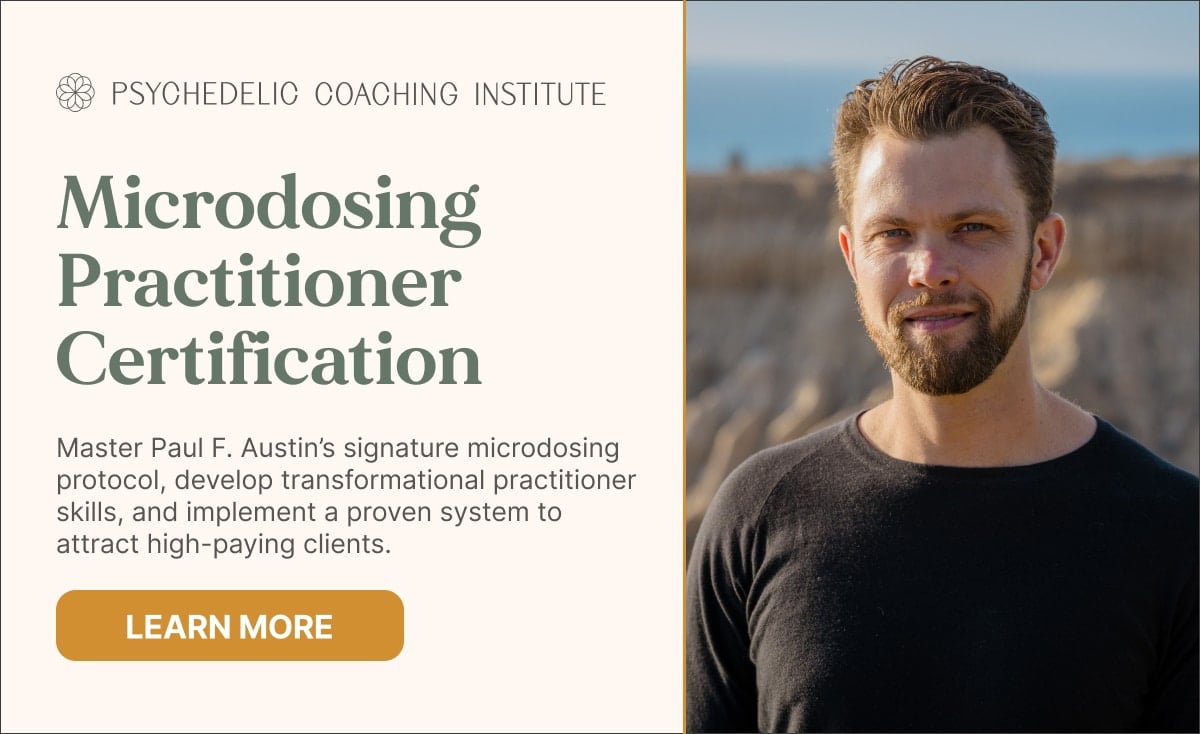
The Microdosing Practitioner Certification empowers you to launch a sustainable practice built on integrity, science, and results. Learn Paul F. Austin’s signature San Pedro Microdosing Protocol, master somatic coaching skills, and confidently guide clients toward lasting transformation. Click here to learn more and apply.

This episode is brought to you by The Practitioner Certification Program by Third Wave’s Psychedelic Coaching Institute. To learn more about our flagship 6-month training program for coaches who want to integrate psychedelic modalities into their practice, click here.
Third Wave occasionally partners with or shares information about other people, companies, and/or providers. While we work hard to only share information about ethical and responsible third parties, we can’t and don't control the behavior of, products and services offered by, or the statements made by people, companies, or providers other than Third Wave. Accordingly, we encourage you to research for yourself, and consult a medical, legal, or financial professional before making decisions in those areas. Third Wave isn’t responsible for the statements, conduct, services, or products of third parties.
Podcast Transcript
00:00:01 Paul F. Austin
What does it mean to have a choice in how you die, not just medically but psychologically, emotionally, and even spiritually? Welcome back to the Psychedelic Podcast. I'm your host, Paul Austin, and today's conversation explores how that question is beginning to take shape in real, legal terms, and what it might mean to expand access to new forms of care at the end of life. My guest today is Kathryn L. Tucker, a leading civil rights attorney and advocate for end-of-life autonomy who has spent decades working at the intersection of law, medicine, and patient rights.
00:00:35 Paul F. Austin
Now, I first heard about Kathryn through some of the media that was around this Right to Try Act in relationship to psilocybin. Kathryn has been at the leading edge of this for many years. She is well-spoken, has a big heart. I really think you're going to enjoy this episode. So what we talk about is how decades of right-to-die litigation led Kathryn to psychedelic advocacy, why current palliative care often fails to address existential and psychological suffering, how psilocybin is being positioned as an investigational treatment under right-to-try laws, what happens when federal agencies like the DEA block access to that care, the legal strategies being used to challenge these barriers, the tension between underground use and regulated medical frameworks, what it really means to die with dignity in today's healthcare system, and how psychedelic medicine may reshape end-of-life care in the years ahead.
00:01:27 Paul F. Austin
Kathryn L. Tucker is a nationally recognized leader in advancing improved care for seriously ill and dying patients. She has held leadership roles across multiple nonprofit organizations, including the National Psychedelics Association, the End of Life Liberty Project, and Compassion and Choices. Kathryn has litigated landmark cases before the United States Supreme Court, including Washington v. Glucksburg and Vacco v. Quill, shaping national conversations around end-of-life rights and pain management. She also played a key role in defending Oregon's Death with Dignity Act. More recently, her work has focused on expanding legal access to psilocybin-assisted therapy through right-to-try laws, federal litigation, and policy advocacy. She has also contributed to the development of state-level psychedelic legislation, including Oregon's Psilocybin Services Act.
00:02:19 Paul F. Austin
All right, before we hop into the episode today, let's hear a quick word from our sponsors. Third Wave sometimes shares or partners with outside providers, but we don't control and aren't responsible for their statements, conduct, products, or services. We encourage you to do your own research and consult appropriate professionals.
00:02:37 Paul F. Austin
Hey, everyone, I want to take a moment to share something important with you. At Third Wave, one of our biggest commitments is helping people to explore the power of microdosing safely, intentionally, and with the right support systems in place. That's why I'm excited to introduce you to our go-to company, Golden Rule, one of the most respected names in the microdosing space. Golden Rule crafts premium, ethically sourced microdosing products, including psilocybin, single-strain, and blends, San Pedro and LSD options, all designed to support clarity, creativity, emotional healing, and performance. What really sets them apart is their integrity, honoring traditional plant wisdom while embracing modern science to support real and lasting transformation. Together, Third Wave and Golden Rule are working to make safe, high-quality microdoses more accessible while ensuring you have the education, tools, and community to feel confident on your journey. If you're curious about microdosing and want to try some of my personal favorites, head over to goldenrulemushrooms.com/thirdwave and use code THIRDWAVE at checkout for 10% off, not just once, but for every future order, too. Again, that's goldenrulemushrooms.com/thirdwave and use code THIRDWAVE for a lifetime discount of 10% off.
00:03:52 Paul F. Austin
Without further ado, I bring you this conversation with Kathryn L. Tucker.
00:04:20 Paul F. Austin
My first question is, what originally drew you into legal advocacy around patients' rights and end-of-life autonomy?
00:04:28 Kathryn L. Tucker
Yeah, so that would be a three-week discussion, but for our purposes, you know I've been for 35 years focused on advocacy to protect and expand the rights of people with terminal illness. I came into that work as a young lawyer, coming out of law school, wanting to do some meaningful public interest work.
00:04:50 Kathryn L. Tucker
And I had begun practicing with a large law firm based in Seattle, and Washington State was getting ready to have the first-ever citizen initiative on the ballot about what was then called Death with Dignity. And I volunteered to be a pro bono lawyer for the campaign and worked on that. And we came close but did not succeed in passing what was called the Washington Death with Dignity Act that year.
00:05:22 Kathryn L. Tucker
But we did then springboard in the state of Oregon to pass such a law in 1994. And then I just was very interested in these issues around individual liberty and autonomy for people at end of life. And so I then went on really to spend the rest of my career looking for how could we push the envelope to ensure that dying people have choices that enable them to have a dying experience most consistent with their preferences and their values and their beliefs.
00:05:55 Kathryn L. Tucker
And so I did a series of cases about whether there was a federal constitutional right to make those kinds of choices. I litigated those matters also in state courts. I worked on legislative campaigns, both state and federal, that relate to these issues.
00:06:13 Kathryn L. Tucker
And then about five or six years ago, maybe seven, I started to see the modern-era clinical trials with psilocybin and people with advanced cancer. And I knew from my work in the end-of-life arena that while we had made a lot of strides toward empowering dying people with more and better choices, there was a gap in the palliative care toolbox. And that was a good tool for relief of non-physical suffering, for relief of anxiety, depression, existential distress.
00:06:52 Kathryn L. Tucker
And so those trials that were coming out of UCLA and Johns Hopkins showing immediate, substantial, and sustained relief caught my attention, and I turned to working to open access to psilocybin-assisted therapy for this population.
00:07:12 Paul F. Austin
I want to spend most of our conversation focused on psilocybin for terminally ill patients, right? And I think this conversation is also happening within a broader context because you mentioned the work that you had done initially in the early '90s. If I'm not mistaken, that was probably around the same time that Jack Kavorkian was sort of bringing this to the public awareness in Michigan, which is where I'm from. And I'm sort of curious, before we dive into the psilocybin specifically, why is it that you think there's so much resistance in the United States, in particular, to supporting people in the dying stages to have more autonomy? We've seen this now in Canada. We've seen this in many places in Europe, but it feels like in the United States, in particular, there's been a lot more resistance to that process. Why is that?
00:08:04 Kathryn L. Tucker
Yeah, well, I mean, I guess I would say the good news is that we have made a lot of progress. So many, many states across the United States now do empower dying patients with the choice for a more peaceful death through what is now called medical aid in dying, where the patient can obtain a prescription for medication that will precipitate a peaceful death. And that's started with Oregon, but most recently, just last legislative session, the states of New York and Illinois joined a very large and growing list of states. So the choice is more widely available.
00:08:42 Kathryn L. Tucker
The pushback had been largely from the Catholic Church and the Conference of Catholic Bishops, where that religion does not support that choice. And so that's been a difficult opponent. But I think now we've really seen, and especially with so many years of practice in Oregon and then the following states, showing that there's no danger when this choice is available. There's no danger to people in vulnerable populations or people with disabilities, et cetera. And so I think generally, the legislative campaigns have been easier to win in recent years.
00:09:25 Kathryn L. Tucker
I think when you raised the name of Jack Kavorkian, it did remind me that in the early years, I think the effort was hampered by having such an underground practitioner who did not appear to respect the boundaries that we were advocating for. So I think that we have to be a little bit worried about that, too, in the psychedelic arena. And maybe Timothy Leary was something of a Jack Kavorkian, right, where you have a very sort of charismatic spokesperson that causes some people alarm, and it makes it difficult for those arguing for the practice to come out of the underground and to be carefully regulated in a safe way.
00:10:16 Kathryn L. Tucker
So my work back in those early days around end-of-life liberty was to say, let's have a legal, regulated, and safe practice. And my work now in advocacy for psilocybin is, let's have a legal, regulated, and safe practice. Everyone knows there's a big underground for psychedelics. But the kind of patients that my career has focused on, which is people with advanced illness and the healthcare providers who serve their care, clinicians who specialize in hospice and palliative care, they generally and I would say I've never met one who wants to go into the underground. They want a safe, legal, regulated practice within the bounds of medical practice.
00:11:06 Paul F. Austin
So I think my next question is just to get to the heart of it or the sort of nut of the educational lens, because a lot of people listening probably aren't familiar with the right to try path and the argument for psilocybin. So I'm curious if you could just explain that in a little more detail. What is this right to try path? And what's been going on over the last five, six, seven years as you've looked at the potential to reschedule psilocybin as part of this right to try argument?
00:11:35 Kathryn L. Tucker
Right. So right to try laws, which have been adopted by a supermajority of states, 41 states, and also the federal Congress adopted a federal right to try law, these are very simple laws that recognize that people with advanced and terminal illness don't have the time to wait for the long, slow process of new drug approval to wend its way to completion. So for people with life-threatening conditions, they are to be allowed access to certain investigational drugs. Those investigational drugs must have successfully completed a phase one clinical trial and remain under investigation. Now, that is true for psilocybin.
00:12:19 Kathryn L. Tucker
So when I began this work, I looked first to seeing access under the duly enacted federal and state right to try laws. I began working with a Seattle area palliative hospice and palliative care specialist physician, Dr. Sunil Agarwal, who has an integrative oncology clinic, the Ames Institute. And on behalf of Dr. Agarwal, we approached a manufacturer of psilocybin and pointed out that it was an eligible drug under right to try and that Dr. Agarwal wanted to obtain it for therapeutic use with his patients. That manufacturer was willing to supply. However, because psilocybin is on schedule one, the most tightly controlled of the scheduled substances under the Controlled Substances Act, that manufacturer needed a DEA approval.
00:13:21 Kathryn L. Tucker
So we went over to the DEA and made that request, which DEA denied access. So with that denial, we had no recourse but to bring a lawsuit, a federal lawsuit, asking the court to require the DEA to accommodate duly enacted right to try law. We actually had to have two rounds of litigation. The first round, the DEA tried to avoid reaching the merits by saying that its refusal was not a final refusal. That required us to get bounced out of court and go back to the DEA to elicit a sufficiently final refusal, which we did. And then we had a second litigation.
00:14:07 Kathryn L. Tucker
But when we got first bounced out of court, we did two things. One was to go back and ask for the final agency action that would open the door to the merits review. But we also filed a petition to reschedule psilocybin off of schedule one. And we did that in part because in the course of the lawsuit, the DEA had said to the court, if Dr. Agarwal wants access, he should seek to reschedule. So taking the DEA at its word, we filed a rescheduling petition. So then we had that rescheduling petition moving forward, and we had the right to try merits litigation moving forward.
00:14:47 Kathryn L. Tucker
On the right to try merits litigation, the way that the court resolved it is it clearly didn't want to have to compel the agency to comply with right to try. And so what the court did is it said, on the record before us, we don't find that the agency violated the right to try act. So what that means in practical terms is the court did not compel the agency to create a right to try path to access. It did create some groundwork should we need to go back to court and seek to take that across the finish line. So I think there was a lot of utility in that litigation.
00:15:32 Kathryn L. Tucker
But in the meantime, because we had also filed the rescheduling petition, we decided to follow that path. And what ended up happening there was the agency denied the petition, and we, again, were required to go into federal court now for the third time. And we won that lawsuit. And the agency did say the court did say to the agency, you failed to handle this petition appropriately. Go back and handle it appropriately. And what has happened since then is, with considerable delay and we can come back and talk about that with considerable delay, the agency finally did what it was required to do, and that is send the petition over to HHS for medical and scientific evaluation.
00:16:26 Kathryn L. Tucker
Now, remember, DEA is a law enforcement agency. It has no medical and scientific expertise. The medical and scientific expertise is with HHS and its subagency, FDA. So in August of 2025, the petition was transferred from DEA to HHS. Since August, we've been waiting for movement at HHS. Now, a couple of things to be said there. You might have noticed that there's a lot going on with federal government agencies. Their staffs have been cut. We don't know how many people are at desks doing the daily work of those agencies. And there's just been a lot of chaos in the federal government in general. So it's hard to know what's happening at these agencies.
00:17:20 Kathryn L. Tucker
Having said that, a couple of things would support prompt movement of our petition. And one is that psilocybin had previously been granted what's called breakthrough therapy status by the FDA twice. What that means is that the FDA took a close look at psilocybin and made the determination that it had benefit to it had potential to benefit patients above and beyond what approved drugs were offering. And so it granted that very special status. Having granted that status quite recently, it would be reasonable to imagine that FDA and HHS could quickly act on our petition and send it back to DEA with a favorable recommendation for rescheduling.
00:18:15 Kathryn L. Tucker
And yet, it's now February. So between August and February, six months have gone by. And so where is the petition? And we do follow up. We're very tenacious, as I hope this conversation suggests. And we continue to follow up with these agencies to inquire what is the status of our petition.
00:18:39 Kathryn L. Tucker
Now, should we see a favorable recommendation emerge from HHS with a rescheduling recommendation, I want to alert everyone to the fact that that would open an opportunity for any stakeholder to participate in a public comment period. Because if the HHS recommendation is to favor rescheduling, what the DEA should do is put a notice of proposed rulemaking into public and publish it in the Federal Register and open a period for public comment. So people can be on the edge of their seat waiting for that. That would certainly be a very newsworthy development. And I would expect that we would see researchers and advocates come in with public comment related to the proper placement of psilocybin. I should say we asked for movement from schedule one to schedule two. There are certainly highly respected researchers who believe the placement should be much lower. And they could come in at the public comment period with those suggestions.
00:19:56 Paul F. Austin
Did you know that over 4 million people microdose psychedelics last year in the United States? And yet, so few have real guidance on how to do it safely and effectively. That's exactly why I created our Microdosing Practitioner Certification. This is an 18-week professional training where you'll master my San Pedro microdosing protocol for nervous system regulation, learning how to coach clients through it with confidence and integrity. Just visit psychedeliccoaching.institute or use the link in the show notes to learn more.
00:20:26 Paul F. Austin
So essentially, there's been a petition that's been submitted. The DEA has been more or less a pain in the ass, as everyone would expect. You've been very tenacious in the follow-up that's been passed along to the HHS. They haven't really touched it at all.
00:20:38 Paul F. Austin
And yet, I think the other component of this is we're seeing a lot of publicity and momentum around Compass Pathways and then giving approval for psilocybin for treatment-resistant depression. And when I'm looking at this, I'm looking at this from I mean, there's a lot of these people who are suffering both from treatment-resistant depression and end-of-life distress, more or less. Why is it that you think that the Compass Pathways news has gotten so much more publicity and traction and awareness compared to this focus, which feels like it's been going on a lot longer? And it feels like it's sort of a no-brainer in many ways.
00:21:15 Kathryn L. Tucker
Right. Well, I think several things. Compass Pathways is focused on the traditional route of FDA approval leading to rescheduling. And that is one path. And it's the well-trod traditional path. And it's the safe and cautious path. And they are trying to travel that path. And some credit, obviously, is due for doing so.
00:21:49 Kathryn L. Tucker
Right to try was offering a different path. It was the considered judgment of both state and federal legislators that there should be a different path that would open access prior to FDA approval, which everyone knows is long and slow.
00:22:06 Kathryn L. Tucker
So keep in mind that if our rescheduling petition, say, today, the HHS sends it back to the DEA with a favorable review and recommendation, and DEA begins that rescheduling process, and lo and behold, psilocybin is moved to schedule two, it would not have FDA approval, but it would be sitting on schedule two. And what that would mean is access could immediately open for clinicians like Dr. Agarwal, who hold schedule two registrations and who treat people with life-threatening conditions across the country. And they could begin to access psilocybin for therapeutic use with those patients even prior to FDA approval.
00:22:50 Kathryn L. Tucker
That's a big deal. That could bring relief to hundreds of thousands of dying people who are otherwise going to die with unrelieved anxiety and depression. So I do think it's worth keeping a close look and watch on. And I do think it's worthy of support.
00:23:08 Kathryn L. Tucker
I'd like to bring awareness to something that's a bit in the weeds. And I don't know how many of your listeners are legal beagles. But the approval that Compass is seeking is of a particular formulation of a synthetic drug for marketing through kind of a big pharma approach. It is pushing for approval of that one synthetic formulary, which it is.
00:23:38 Paul F. Austin
Like a polymorph, I think, is what they're calling it, right? Like a polymorph.
00:23:41 Kathryn L. Tucker
And very carefully guarding that formulation from an intellectual property perspective. So it wants to be able to do a traditional big pharma marketing and receive profit for doing so. And if its formulation receives FDA approval and is moved off of schedule one as a result of that approval, that would result in what's known by lawyers as bifurcated rescheduling, meaning that most all of psilocybin would remain on schedule one except for that formulation, which would now be on schedule two and approved by the FDA.
00:24:24 Kathryn L. Tucker
That leaves many quite dissatisfied. And bifurcated rescheduling is something that deserves a lot of attention because there are those who don't believe it's legal and who have publicly written about the fact that nothing in law supports bifurcated rescheduling, including Matt Zorn, who is currently sitting at HHS as Deputy General Counsel. But prior to his elevation to that position, he was a very noted litigator, lawyer, scholar, publishing articles, publishing a substack in which he did deep drill down into the legal issues around these psychedelic drugs, including quite critical of bifurcated rescheduling.
00:25:17 Paul F. Austin
It's a very good in-depth dive. And I think my we were talking about this before we went live. My naively optimistic persona hopes that with people like Matt Zorn and Jim O'Neill and even someone like RFK Jr., who has been very vocal about psychedelics and the power of them I mean, we even saw this with Compass Pathways where their timeline was moved up 9 to 12 months. We've seen rescheduling of cannabis from schedule one to schedule three.
00:25:45 Paul F. Austin
There is this sort of optimistic side where I'm hopeful that rescheduling will happen across the board for psilocybin. But I think a lot of folks don't have that level of optimism. I'm curious, kind of where do you stand on that? Are you optimistic at all? Or are you basically at the point where you're kind of like, OK, let's just focus on the right to try. Let's make sure that's at least an established path. And that gives you some level of sort of hope or agency in the sort of clusterfuck of federal policy.
00:26:17 Kathryn L. Tucker
Well, I think the as this conversation, I hope, has indicated, these things are all somewhat interrelated. As for optimism for rescheduling, there are several reasons to be optimistic. One, I alluded to earlier in the breakthrough therapy designation. That should certainly inform the rescheduling consideration that's now happening at HHS and FDA. They're already on record granting breakthrough status. And so that very much supports an optimistic view that there will be a favorable evaluation.
00:26:57 Kathryn L. Tucker
The other thing that one might deduce supports optimistic outlook is that all the agency leaders of all the relevant agencies, including RFK, who you mentioned, but also the leader of the VA and let's remember that psilocybin has been shown very useful in relief of PTSD in veterans and as a tool to avoid the high rate of veteran suicide, which is a national crisis. So we've seen the leader of the HHS, the leader of the VA, the leader of FDA. We've seen the Surgeon General. All of these agency leaders are on record with public statements saying, we want to move this forward as quickly as possible.
00:27:41 Kathryn L. Tucker
Well, if they had the intent to back up those words, they could act on this pending petition. It's sitting there. It's queued up. It's ready for action. The breakthrough therapy review also could propel speedy action. So I think there is reason for optimism. And yet, we're still sitting here. And we're seeing dying patients die without relief. We're seeing veterans die by suicide. And it's really frustrating. Those people will never, ever have the justice to which they're entitled. So we press on. You do what you can do. And we are fighting this fight.
00:28:24 Kathryn L. Tucker
I will say I've also been involved in the burgeoning interest in the states. The states, as you know, are not waiting. And I was involved in the campaign to enact the Oregon Psilocybin Services Act, which happened in 2020 and was the first state effort to create a legal regulated program. Now, of course, states can only change state law. They can't change federal law. So all of the actors that are participating in the Oregon Psilocybin Services Act are in violation of federal law.
00:29:03 Kathryn L. Tucker
There has been no federal enforcement in Oregon. And we don't know why. There has been no adoption of a policy that would create any sense of safety, as eventually happened with cannabis. So we don't know why there's been no enforcement. And so the bold, courageous pioneers in Oregon have gone forth in the face of federal risk.
00:29:28 Kathryn L. Tucker
One thing I'll say about the Oregon law that has also led to a matter that's now pending in federal court is that the Oregon law did not provide for access to psilocybin services for homebound patients. And of course, the population that I focus on, people close to death, they can't leave their home to go to a service center. They are homebound. So we did approach the Oregon Health Authority about reasonable accommodation, which is mandated by federal law under the Americans with Disabilities Act. And the OHA declined to provide reasonable accommodation.
00:30:08 Kathryn L. Tucker
So we are litigating that in federal court in a case known as Cusker versus OHA, brought on behalf of Oregon psilocybin facilitators who have a special interest in serving dying patients who could benefit from psilocybin services but need those services in their home. So that case is pending. But I will say a good thing about our bringing that case forward is that none of the other states that have followed in Oregon's footsteps and here, I'm speaking of Colorado and New Mexico, which have passed laws following Oregon, have made that same mistake. And they both provide for the person to be provided services in the setting that is appropriate for them.
00:30:58 Paul F. Austin
And I just want to make sure that's very clear for our listeners. Essentially, what Kathryn is saying is for folks who live in Oregon, in terms of the legal structure of Oregon and how psilocybin can be provided, they have to go into a licensed service center, meaning they have to travel to that place. Oregon has made it illegal to actually come to their homes and serve them psilocybin, which is necessary when you're in hospice and suffering from it's very difficult to move. And so I think this is a really important and essential point.
00:31:27 Paul F. Austin
And also, what I heard you say is that Colorado and New Mexico have not made that same mistake, so to say, that they are allowing for that in those states, which is great, to step in the right direction.
00:31:39 Kathryn L. Tucker
Yeah. And you know it's so interesting because, of course, when the states, when there first became the effort to see a state adopt a state legal program, a state must go first. And so Oregon was that pioneer. And of course, Oregon adopted its law through initiative, which means that the measure that was it was approved by the voters. It was not drafted by legislators. It did not go through legislative counsel's office, who would have caught such an oversight. And so Oregon, I think everyone has the benefit of learning from the Oregon experience. And it's been really great to see that the follow-on states have learned and have crafted their measures in a way that respects people with disabilities and homebound dying people.
00:32:37 Paul F. Austin
Yeah, I think that's a really important point because the Oregon model has been criticized extensively. And I think those sort of criticisms fail to take into account that every first mover, especially for something as sort of cataclysmic or monumental as legal psychedelics or legal psilocybin, at least, every first mover is going to not get things perfectly right. And I know there has been a lot of work behind the scenes. I've been in conversation with folks like Sam Chapman, who's been trying, at least, to see, OK, what can get shifted and moved as a result. And once something is in structure and in place, it can be a little bit more difficult to change.
00:33:17 Paul F. Austin
And I know there's also, in the Oregon model, it's been hard to make it feasible for a lot of folks to participate, whether that's on the quote unquote "consumer side" or "patient side" because it's too expensive or even on the clinic side because of the licensing fees and various other fees that are associated with it. So it has been an experiment. It's really opened the door. But it certainly isn't a perfect model in terms of its current structure.
00:33:45 Paul F. Austin
After over a decade of working professionally in the psychedelic space, one thing has become clear to me. If we want to guide others through this journey, there is no substitute for doing our inner work. At the Psychedelic Coaching Institute, we train people to guide others through transformation ethically, effectively, and with integrity. Our six-month certification combines science-backed education with coaching mastery, culminating in a legal psychedelic experience at our in-person intensive in Costa Rica. You'll gain practical skills, leadership training, and get to connect with a supportive community grounded in compassion, rigor, and efficacy. If you're a coach, clinician, or conscious professional ready to serve at a higher level, we'd love to meet you. You can learn more and apply at psychedeliccoaching.institute. Again, that's psychedeliccoaching.institute, or simply see the link in the description.
00:34:38 Kathryn L. Tucker
Yeah. And I think another thing that's worth sharing in this conversation is that the psilocybin that has been used in clinical trials up till now, the psilocybin that has successfully completed a phase one clinical trial, is synthetic. And so for the moment, when you think about right-to-try law, that requires that the drug have successfully completed a phase one clinical trial. So at this moment in time, it's only the psilocybin that is synthetic that would be an eligible drug under right-to-try. But there is an intrepid researcher, maybe known to your listeners, Dr. Sue Sisley at the Scottsdale Research Institute. She's quite well known for her long research in cannabis and also now in psilocybin. And she has an approved an FDA-approved phase one clinical trial ongoing now with fungal psilocybin. So I understand that is close to completion. And she's ready to pursue the later stage trials with fungal psilocybin. And that's really exciting because when the phase one trial completes, that would make fungal psilocybin an eligible drug under right-to-try. So again, our effort with seeking to compel the DEA and the HHS to move forward on the petition to reschedule is important because if we can see psilocybin moved to schedule two, the eligible forms of psilocybin under right-to-try law could be both synthetic and fungal. And then I think we start to see that the cost could be much less because you wouldn't have just big pharma with a synthetic formulation. You would have a much wider array of psilocybin available. So keep an eye on the Scottsdale Research Institute and Dr. Sue Sisley and the really good work happening there.
00:37:00 Kathryn L. Tucker
Another thing to keep an eye on and again, so many things interrelate here. But if you're keeping an eye on what's happening in the federal Congress, you may have noticed that our work with the right-to-try litigation has stimulated now three different federal congressional bills, one of which remains active. So the first one was called the Right to Try Clarification Act. And that bill would have done nothing more than make abundantly clear, beyond any dispute, that substances on schedule one are within the ambit of the Right to Try Act. It's quite clear from the way that act is written that there is no exclusion of schedule one substances. But because the DEA might have tried to argue such exclusion, that federal bill was introduced. It didn't move forward, even though it had bipartisan support and was a bicameral introduction. The next bill was called the Breakthrough Therapies Act, also bipartisan and bicameral. And that bill would have toggled it had a mechanism to toggle a substance from schedule one to schedule two if it received breakthrough status, which, of course, as mentioned, is true for psilocybin. Although it was supported in both houses, both House and Senate and by both Republicans and Democrats, it did not move. And the most recent introduction and the one I draw your attention to because it's still an active measure is called the Freedom to Heal Act, bipartisan, bicameral. And this law essentially would require the DEA to create a special registration for a drug that was an eligible investigational drug under right-to-try. So you can see these are three different ways of all trying to move the DEA to comply with right-to-try law. I certainly think the Freedom to Heal Act is something worthy of support. And so to your listeners, if you haven't been following it, lean in to try to move this measure forward. It has very broad support by the Veteran Mental Health Leadership Coalition, which is kind of the umbrella group of veterans who are trying to move psychedelic therapy into accessible practice. And so I hope people will lean in on that.
00:39:46 Paul F. Austin
So one thing we really haven't touched on, which I think would be helpful to at least talk about even briefly, is you sort of hinted at seven, eight years ago, you started to see the efficacy of psilocybin for end-of-life, right? We've seen trials at NYU, Johns Hopkins, UCLA. Michael Pollan's first ever article in The New Yorker about psychedelics was about end-of-life. This was in February 2015, 11 years ago now, which is pretty wild.
00:40:13 Kathryn L. Tucker
I love that you mention I love that you mention that article because I'll just tell a tiny backstory. I was in my pajamas in bed at night reading My New Yorker. And I read the article, The Trip Treatment. And I nearly fell out of bed. It was that moment that really got my interest and kind of led to all of my work. I had forgotten it was that long ago. But yes, and then, of course, that article became the full-blown book, How to Change Your Mind, which so many of us have read and really stimulated a lot of the grassroots interest.
00:40:54 Paul F. Austin
And so my question was just going to be, what is then so special about psilocybin as an end-of-life treatment? We could talk about the numbers. And they're pretty significant.
00:41:04 Paul F. Austin
But just from your lens, why is it that you feel such a dedication and devotion to amplifying this and putting the effort in and dealing with the DEA, who's just a nightmare to deal with?
00:41:17 Paul F. Austin
What is it to you that is so special about psilocybin as a treatment for those who are suffering from existential distress?
00:41:24 Kathryn L. Tucker
Yeah. Well, I have kind of two very different answers. I mean, one is the answer you might expect, which is the answer of myself as a lawyer, an advocate, a law professor. And that is when you look at the landscape of end-of-life care and you know there's this gap in the palliative care toolbox. And here's the tool that fills the gap. You get very excited about bringing that tool to the bedside. And the clinical trials all show the same thing. A single guided session with psilocybin with people with advanced cancer suffering debilitating anxiety and depression brings immediate, substantial, and sustained relief. Enough said. That's my sort of standard answer.
00:42:09 Kathryn L. Tucker
But I also like to say that in my work outside of law and advocacy, I'm a 30-year practitioner in the Ashtanga Yoga tradition. And I know from that practice that being able to achieve elevated and expanded states of consciousness, to think about the self and the meaning of the self and the meaning of this incarnation is incredibly important and useful when one contemplates mortality, which, of course, in that practice, in that tradition, we do every day because in Ashtanga practice, which includes the physical posture practice, the last posture is always Shavasana, which is corpse pose. And the reason why we practice corpse pose every single day is to make ourselves more comfortable with the reality of mortality. And so if you have a longstanding dedicated practice in a contemplative tradition, you probably are working with the same things that are accomplished with psilocybin experience. And one of the things I really like to remind people is you don't need to take psilocybin to achieve those states. You can achieve those states through a dedicated yogic practice.
00:43:30 Kathryn L. Tucker
But not everyone has 30 years to cultivate. And if you haven't done it and you find yourself in that bed with that terminal illness, having access to the drug is important. But I just came back from a really wonderful retreat on Maui with the Ram Dass Institute for Psychedelic Studies with the Dying. And one of the things, of course, that we talked about there is that what Ram Dass found out and, of course, your listeners will remember that before Ram Dass had that name, he was Richard Alpert. And he was at Harvard. And he was doing a lot of studies with psychedelics where he was ingesting them. And his students were ingesting them. And he really appreciated the benefit. And yet he always came down. And it was his frustration with the experience of always coming down that led him to his spiritual seeking, took him to India. Now, of course, his trip to India was catalyzed by being fired from Harvard for the practices that were going on. But when he was in India and he met his spiritual teacher, what so led him to respect that teacher was that that teacher never came down. That teacher occupied that state of expanded and elevated consciousness at all times. And so Richard Alpert began that practice that led him to being recognized as Ram Dass. And he practiced all the way until his last breath as a spiritual teacher and very respectful of what psychedelics can offer, but also very mindful that one need not ingest psychedelics to receive the benefit of that altered state of consciousness.
00:45:25 Paul F. Austin
And I'm glad you brought that up because we know there were a lot of or there are a lot of mainstream my orientation is more towards meditation. I'm very familiar with Jack Kornfield's work and Sharon Salzberg and Tara Brock. That tends to be more my contemplative tradition.
00:45:42 Paul F. Austin
We know that a lot of these very prominent public figures in meditation in particular, many of them started their path with psychedelics. I would include I'm not a prominent public figure in that way. But I also started my path in meditation because of psychedelics for the very reasons that you mentioned, because that state of openness and awareness cannot be fully integrated just by drugs alone.
00:46:08 Paul F. Austin
And yet I think the point you make is essential, which is people who are dying, who haven't made that same decision necessarily because of whatever the circumstances of their lives dictated, they at least should have that opportunity to experience that state because of the profound and pragmatic benefit that it can have in those last weeks or months or maybe year of their life.
00:46:30 Kathryn L. Tucker
Yes, yes, absolutely. And to come again sort of to your question of what is it about psilocybin that if you take a look at what's reported in the clinical trials of the patient experience, is for patients who were really trapped in a loop of depression and anxiety about their mortality, the psilocybin experience let them step out of that loop and to have a larger frame in which they saw their life and whatever their belief was of what comes before and/or after this incarnation was held in a larger frame. And that for those people was incredibly meaningful. And so yes, that's why we sit on our cushion because we contemplate that.
00:47:22 Kathryn L. Tucker
Now, of course, in the Ashtanga tradition, the teaching would be you don't come to your cushion cold. You potentiate your time on the meditation cushion by doing the asana practice, by doing the work with the breath. And we weave all of that together. So by the time we land on our cushion, we're already quite elevated. And then we springboard into the beyond. But those are all conversations for another time.
00:47:51 Kathryn L. Tucker
But I do think recognizing that not everyone is invited to engage a discipline practice for whatever reason, there's nothing in this culture that really encourages people to undertake these practices. And people sort of find their way there somewhat randomly. And so we should have something for people who haven't found their way to these practices.
00:48:19 Kathryn L. Tucker
And I often think of the Russian novella Leo Tolstoy's novella, The Death of Ivan Illich. And if you haven't read it, I commend it to everyone. I read it every year. And poor Ivan Illich has a really horrific dying experience for a variety of reasons. But one of the reasons is it only occurs to him as he is in his final phase of dying that he might not have led the life he ought have led. And when that occurs to him, he turns toward the wall. And he starts screaming. And he screams for three days until he dies. And no one wants to be in that situation. And so whether it's a psilocybin experience, whether it's an experience through contemplative practice that enables you to think about your life in that larger frame and ask yourself these questions about, am I living the life I ought be living? That's really important work to do and hopefully sooner rather than later.
00:49:25 Paul F. Austin
And that brings me to my final question, just to sort of bring this full circle from our opening with all of the advocacy work that you've done for those in death and dying to die with dignity, right? And I just would love to hear kind of as we close, to you, what does it mean to die with dignity or to die in a way that feels like it really does a service to not only ourselves but to our lives, to our family, to our communities in general?
00:49:56 Kathryn L. Tucker
Yeah, that's such a great question. Having thought a lot about that, I'm mindful that it's important so it's important to think about that and to do some deep visioning and exploring. And retreats like the one I mentioned with the Ram Dass Institute of Psychedelic Studies with the Dying, I offer a workshop I call Preparing for the Final Asana: Law and Medicine at the End of Life and What the Yoga Tradition Has to Offer. I think finding a safe space to drop into pondering that question is really important for everyone.
00:50:44 Kathryn L. Tucker
And I think as we evolve our visioning of what we hope for ourselves, that that's really useful and will be sustaining for us when we come to that moment where we understand that we have a non-curable illness. I also like to caution, as many have pointed out, that creating an idealized version of what a good death looks like can be its own restrictive and sort of punishing thing. So I think it's important to learn and vision and contemplate and try to draw some idea of what you hope for and plan for that, but to not cling too rigidly to a particular plan because you don't know what will really unfold. And so holding it lightly, again, holding everything lightly is one of the teachings and practices. And that will be true there, too.
00:51:49 Paul F. Austin
And it's a practice then as well, which is what I've heard you talk about in this last half of the podcast. So much of the work that we do leading up to that moment is to prepare ourselves to really let go.
00:52:00 Paul F. Austin
I'm reminded of Eldis Huxley, very famously, on his deathbed, went into the great unknown with 100 micrograms of LSD, which is fantastic. And I think what I'm taking away from this conversation is what a beautiful gift that would be if everyone had that same opportunity in many ways.
00:52:19 Kathryn L. Tucker
Right. I love that you mentioned Eldis Huxley. I just came from leading a workshop down at Rancho La Puerta in Tecate, Mexico. And Rancho La Puerta is the oldest wellness retreat center in North America. And Eldis Huxley wrote a number of his books while on that campus. And so when I was at that workshop, I have a nice slide of Eldis sitting outside of his casita where he was doing some of his writing. But yes, that story is quite well known in the psychonaut world.
00:52:53 Kathryn L. Tucker
And you do like to imagine that one day people will be empowered at the end of their life to have a broad array of choices. And it would be lovely that if it seemed appropriate for you to have that dose of psychedelic as you are actively dying, that it would be available to you.
00:53:18 Kathryn L. Tucker
Now, interestingly, of course, Oregon is the first state to have a legal psilocybin program. And it was the first state to have a medical aid in dying program. So I think it is very possible and perhaps likely that some people in Oregon are obtaining their medication for medical aid in dying and going through that process and then are thinking about ingesting those medications while they are having a psilocybin experience. I know that people are thinking about that. And that may come to be something that people choose to do.
00:53:57 Paul F. Austin
Well, beautiful. Well, Kathryn, I want to, first of all, just honor and acknowledge all the work that you've put in these last five, six, seven years to push this forward, the adversity that you faced, the tenacity that you have, the devotion that you've sort of exemplified in this process. Sometimes the task can feel like Sisyphus in the ball pushing up the hill. So I just want to appreciate and acknowledge that.
00:54:28 Paul F. Austin
And also just provide a little bit of a space for folks who are listening to this who are inspired or who want to support your work or the work of Right to Try, where might you point them to go from here and support that?
00:54:40 Kathryn L. Tucker
Yeah, I so appreciate that because all of the work that I spoke about on this podcast has been supported by donations. So of course, I do not charge Dr. Agarwal or his dying cancer patients. And I'm not charging the facilitators in Oregon. All of this is done by donation, by philanthropy. And I like to say, no donation too large or too small. So if you're moved by any of this work, if you think it's important, please support it. And the donations go to the National Psychedelics Association Foundation, which is a 501(c)(3). So they're charitable donations. If you sit on a board of philanthropy, if you're in a position to make a donation, I hope that that will happen so that we can take this work across the finish line.
00:55:26 Paul F. Austin
Beautiful. And we'll get the link from Kathryn. We'll drop it in the show notes. So if you're listening to this on the go, just go to the website. We'll have a link directly to the donation page for the National Psychedelics Association. And we'll wrap up there. Kathryn, I really appreciate you joining us today. Thank you so much for coming on and sharing a little bit. This is really beautiful. Thank you.
00:55:48 Kathryn L. Tucker
Take good care. Appreciate you.
00:55:50 Paul F. Austin
Hey, folks, if this conversation brought something up for you, if it inspired something in you, consider who else in your life might benefit from hearing it. These are conversations that don't happen super openly, but they matter. So share this episode with a friend, a colleague, or someone navigating questions around care, autonomy, or end-of-life decisions. Follow Rate and Leave a Review wherever you're listening.
00:56:10 Paul F. Austin
You can subscribe on YouTube at youtube.com/thethrdwave. And you can follow me personally on social, Paul Austin on X, LinkedIn, Instagram. I'm pretty active on all of those.
00:56:21 Paul F. Austin
All right, thanks for tuning in. And we'll see you next week.