
Episode 370
Robert Whitaker
In this episode of The Psychedelic Podcast, Paul F. Austin speaks with journalist and Mad in America founder Robert Whitaker about the evidence behind psychiatric prescribing and what psychedelic medicine can learn from that history. Whitaker revisits the chemical imbalance theory, long-term antidepressant outcomes, withdrawal, and the social conditions that shape mental health. He also reflects on peyote and ayahuasca while questioning whether commercialized psychedelic care could repeat psychiatry’s mistakes by prioritizing drugs over context, community, and personal agency.
Robert Whitaker is the author of five books, three of which tell of the history of psychiatry. In 2010, his Anatomy of an Epidemic: Magic Bullets, Psychiatric Drugs, and the Astonishing Rise of Mental Illness won the U.S. Investigative Reporters and Editors book award for best investigative journalism. He is the founder of madinamerica.com, a website that features research news and blogs by an international group of writers interested in “rethinking psychiatry.”
Podcast Highlights
- What long-term psychiatric outcomes reveal
- How the chemical imbalance story took hold
- How psychiatric drugs alter brain function
- Antidepressant withdrawal and recurring depression
- When SSRIs help, and at what cost
- Peyote, ayahuasca, and ritual context
- Medicalization versus psychedelic community
- Social determinants, agency, and healing
Show Links
These show links may contain affiliate links. Third Wave receives a small percentage of the product price if you purchase through the above affiliate links.
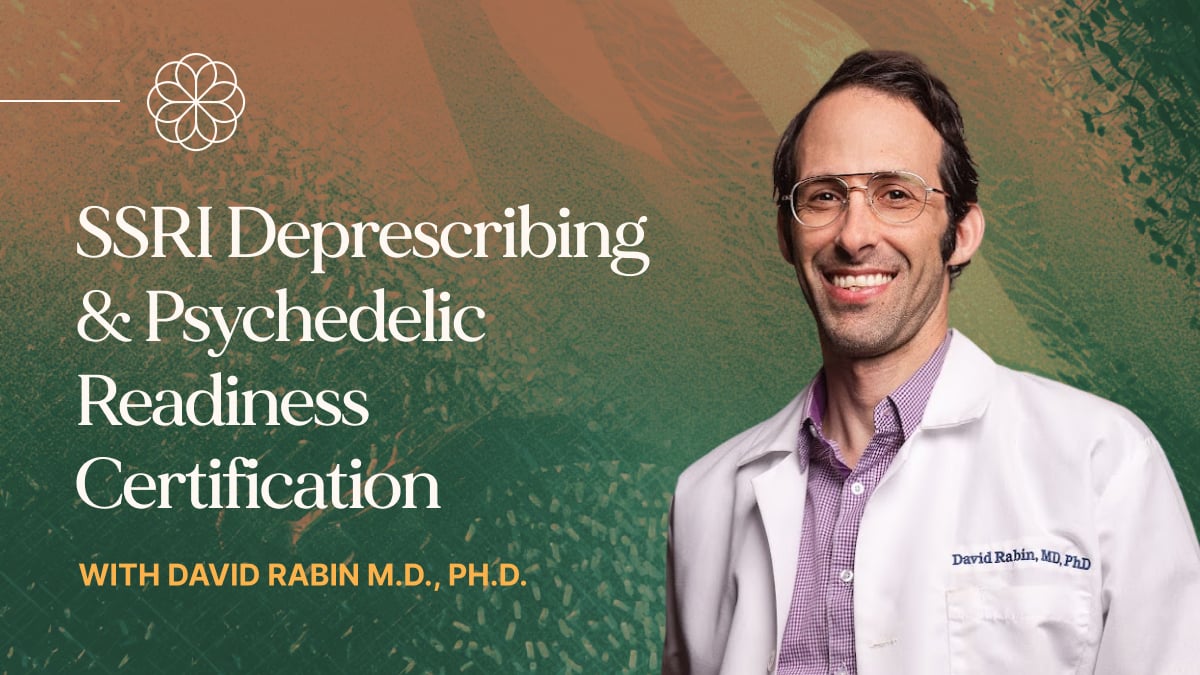
SSRI Deprescribing & Psychedelic Readiness Certification
A 3-month live online training led by board-certified psychiatrist Dr. Dave Rabin for therapists, clinicians, coaches, and facilitators working with medicated clients. Learn practical frameworks for tapering, withdrawal vs. relapse, prescriber collaboration, psychedelic readiness, and supporting clients within your scope.
Podcast Transcript
00:00:01 Paul Austin
If psychedelics are going to reshape mental health care, we need to understand the history of the system they're entering, especially what happens when a promising treatment becomes a story that we stop questioning.
00:00:13 Paul Austin
Welcome to the Psychedelic Podcast. I'm your host, Paul Austin.
00:00:16 Paul Austin
And about a decade ago, not long after I started Third Wave, a friend told me that if I really wanted to understand the mental health system and the impact that psychedelics could potentially have, I needed to understand the water we were already swimming in. And so she recommended that I read a book, Anatomy of an Epidemic, a book that fundamentally changed how I thought about psychiatric drugs, long-term outcomes, and the stories we tell about mental illness.
00:00:43 Paul Austin
My guest today is its author, Robert Whitaker, and this conversation gave me an opportunity to revisit those questions with the person whose work first opened me up to them. Robert Whitaker is an investigative journalist and the author of 5 books, 3 examining the history of psychiatry. His 2010 book Anatomy of an Epidemic, Magic Bullets, Psychiatric Drugs, and the Astonishing Rise of Mental Illness won the U.S. Investigative Reporters and Editors Award for Best Investigative Journalism.
00:01:12 Paul Austin
Robert is also president of the Mad in America Foundation and founder of madinamerica.com, which publishes research, reporting, and perspectives from an international community interested in rethinking psychiatry.
00:01:26 Paul Austin
Here's a little taste of what we'll cover today: how the chemical imbalance theory became accepted despite what the research was showing, what long-term studies suggest about antidepressants and psychiatric drug use, why withdrawal can sometimes be mistaken for the return of an underlying disorder, whether SSRIs still have an appropriate role in mental health care, how social conditions, relationships, meaning, and community shape mental health, what Robert learned from his own experiences with peyote and observing rituals with ayahuasca, and why psychedelic medicalization could repeat many of the same mistakes that are already happening in psychiatry.
00:02:05 Paul Austin
This is one of my favorite conversations so far. It is in the build-up to our new certification, SSRID Prescribing and Psychedelic Readiness, and so this is just another, you know, podcast to help cover some of the topics that we'll be diving into as part of that certification.
00:02:23 Paul Austin
It was a fantastic conversation and interview. Robert was very easy to speak to, and it will be provocative for some of you, so I'd encourage you to dive in, take notes, maybe listen even 2 or 3 times. And if it was helpful for you, if it opened up a doorway, a new perspective, a new thought, I would ask that you please share it with a friend.
00:02:41 Paul Austin
All right, folks, without further ado, I bring you this conversation with Robert Whitaker.
00:03:09 Paul Austin
Robert, thank you for joining us on the podcast.
00:03:11 Robert Whitaker
Well, thanks for having me, and thanks for that very nice invitation. It's a pleasure to be here.
00:03:15 Paul Austin
So we connected, I don't know, 4 or 5 days ago, and you were so gracious as to hop on. I think this we're, it's a Thursday now, and Sunday I was like, who would be another fun interview?
00:03:28 Paul Austin
And I, you know, about a decade ago, a friend had recommended this book, Anatomy of an Epidemic, because I was sharing with her that I had recently started Third Wave as a psychedelic education platform. And she's like, look, Paul, if you're going to be talking about psychedelics and mental health, you really need to know the sort of water that you're swimming in. And the best book to understand that is Anatomy of an Epidemic by Robert Whitaker.
00:03:51 Paul Austin
And so I picked up the book, and I was mentioning this to you before we went live, but it articulated for me something that I had felt, something that I even experienced through friends and family, the sort of iatrogenic harms of psychiatric overprescribing. And it's been really a fantastic text that I think so many people have been awakened to, been really, really learned from.
00:04:18 Paul Austin
And so I just want to first thank you and acknowledge you for setting out and writing this, because I can imagine the courage and bravery it took not only to write it but also to stand behind it for the years after its publication.
00:04:33 Robert Whitaker
Well, you know, it is a counter-narrative to the conventional narrative. The conventional narrative that we were told, of course, was they were making such great progress, psychiatric researchers, in uncovering the biology of disorders. These were diseases of the brain. We heard about drugs that fix chemical imbalances like insulin for diabetes. And all of that is a narrative of great progress. Think about it. They were telling us they discovered the very molecule that caused depression, caused madness, caused anxiety. But the problem, of course, it wasn't true.
00:05:03 Robert Whitaker
And actually, what we've seen in this modern era, the disease model was really adopted in 1980 when the American Psychiatric Association published DSM-III. And what we've seen is a disaster. We've seen the outcomes for different diagnostic categories are they run much more chronic than they used to. People are much more likely to be functionally impaired years later. We know that coming off these drugs is very difficult. You look at the burden of mental disorders in our society, it hasn't gone down, which is what usually happens if you have an effective treatment. It's exploded. And you actually see this in developed society after developed society that has really embraced this model of care and, you know, using the drugs quite frequently and that sort of thing.
00:05:48 Robert Whitaker
And the other thing, of course, is it changed growing up in the United States and increasingly now around the world, because those tribulations that virtually every kid has at some point while they're growing up and moves into adulthood, anxiety, you know, emotions up and down, that sort of thing. Well, we now pathologize so much of that that something like 25 to 30 percent of entering freshmen in college now have a diagnosis. 25 to 30 percent. And this is even at colleges where you have to really excel in order to get into those colleges. So if you're and more than 50 percent of college kids now access mental health care during their time.
00:06:32 Robert Whitaker
So what that's telling you is we have created a society where parents and youth, they're primed to see any discomfort in themselves, any behavioral things that aren't perfect as signs of a mental disorder. And next thing you know, you've got a diagnosis and a prescription. And all the long-term data does not tell that that is a good long-term outcome, at least in the aggregate.
00:06:58 Paul Austin
Now, you didn't start out as a major critic of the, let's say, psychiatric overprescription or overprescribing or the psychiatric establishment in general.
00:07:10 Paul Austin
Like, I think I, you know, was rereading the book this morning, and in the late '90s, you were a journalist who was covering this, and then something changed. Something happened.
00:07:19 Paul Austin
What is it that you started to learn about or be exposed to where you were like, oh, wow, I was not seeing the full story before necessarily?
00:07:26 Robert Whitaker
Yeah, I mean, I think this is a good point. I mean, you know, I had a long background covering medicine and science for newspapers, sometimes writing for magazines. And I, you know, I basically had a conventional approach to psychiatry because you would call people up on a, if you're calling psychiatrists up, they would tell you about the chemical imbalances. And that's a good story, right? Advances. They now know the molecules that sort of govern our emotions. It seemed like a great advance.
00:07:52 Robert Whitaker
But what happened was this. Two things really happened. One, I left Daily Reporting for a time, and I was director of publications at Harvard Medical School in the mid-'90s. And at this, it was a lot of time when they talked about, we need to have evidence-based medicine. Now, why do you need to have evidence-based medicine? Because doctors can be deluded about the merits of their therapies from their clinical sort of perspective. So that opened the idea that doctors could be a little bit deluded about whether the drugs are so helpful or whatever treatments they might be.
00:08:21 Robert Whitaker
And then I was doing a series, co-writing a series for the Boston Globe on abuses of psychiatric patients in research settings, okay? And it was a 4-part series. One part of the series was studies in which people diagnosed with schizophrenia, they would, with one, they would randomize them. One group would stay on the drugs. And by the way, this would be conducted in good responders to antipsychotics. It had to be a select group. And the other group, they would immediately withdraw them to see how quickly they relapsed.
00:08:51 Robert Whitaker
Now, at this time, this seemed utterly cruel. Because if the drugs fix the chemical imbalance, why would you take it away? And you thought they were like insulin for diabetes to see how quickly they got sick again. Really, you wouldn't do that for someone with diabetes. So that's how we presented it in the Boston Globe.
00:09:13 Robert Whitaker
But what happened was when I called up people with lived experience in psychiatric survivor groups, they would, and especially a man named David Oakes, he was the leader of something called Mind Freedom. And I said, what do you think about these studies? And he goes, well, the studies are horrible because when you withdraw the drugs quickly, you're forcing a relapse, right? He said, but we hate these drugs. We would like to come off these drugs.
00:09:38 Robert Whitaker
And then he said, you really should dig into this and see how these drugs are affecting us. Are they causing changes in our brain that are damaging? So all of a sudden, I had a voice in my ear, and a journalist is supposed to listen to the oppressed as well. You're not just supposed to be a stenographer for the powerful, right? So here we had.
00:09:59 Paul Austin
Ideally, yeah.
00:10:00 Robert Whitaker
Ideally.
00:10:00 Paul Austin
If you're an ethical journalist, yeah.
00:10:02 Robert Whitaker
Right. But here was someone from really a spokesperson for those who identify as psychiatric survivors do not like the drugs. So I then got a contract to write Mad in America. And as I one of the reasons I got this contract was the story that we'd been told was a story of progress, right? We're identifying the molecules, we can fix it, et cetera.
00:10:23 Robert Whitaker
But then while I was doing that series for the Boston Globe, in addition to talking to David Oakes, I came upon two studies that belied that story of progress. One was a study by Harvard researchers who in 1994 reported on long-term outcomes for schizophrenia patients. And what they said is they had declined since 1975. They hadn't gotten better.
00:10:42 Robert Whitaker
And they were now no better than they had been in the first third of the 20th century. And I'm going like, well, that was long before the antipsychotics. We always think of that as the bad old days. Now you tell me the recovery rate is no better? That belied this narrative of progress.
00:10:59 Paul Austin
As psychedelic medicine becomes more widely available, there's a practical problem that not many people are talking about. A massive number of people who are seeking psychedelic therapy are already taking psychiatric medications, which means the path into psychedelic work may not begin with psilocybin, ketamine, or a facilitated journey. For many people, it begins with a much more complicated question. How do I responsibly taper off the medication that I'm already on?
00:11:24 Paul Austin
Right now, there's a gap between the prescriber managing the medication and the practitioner preparing someone for psychedelic work. Our new certification, SSRID Prescribing and Psychedelic Readiness, was built specifically for that gap.
00:11:37 Paul Austin
This training is taught by Dr. Dave Rabin, a board-certified psychiatrist and neuroscientist who has more than 20 years of experience studying chronic stress, nervous system regulation, and the responsible reduction of psychiatric medications. Over 3 months, you'll learn a structured framework for screening and candidacy, tapering principles, withdrawal versus relapse, medication and psychedelic interactions, nervous system support, prescriber collaboration, and psychedelic readiness.
00:12:04 Paul Austin
Importantly, this is not about practicing outside your license or trying to replace the prescribing physician. It's about knowing your role, where the medical line sits, and becoming a much more competent partner in the process. Because as this field grows, I believe practitioners who understand this transition are going to become increasingly important.
00:12:23 Paul Austin
Learn more about the certification through the link in the description.
00:12:28 Robert Whitaker
Then I came upon a story, a study done by the World Health Organization who twice had done longer-term studies of schizophrenia patients in 6 developed countries. One was the US and 3 developing countries. One study was 2 years, one study was 5 years in length. And everybody diagnosed by Western standards. And what they found was that outcomes were much, much better in the developing countries, and specifically India and Nigeria.
00:12:54 Robert Whitaker
And after the first such study, people were like, how could this be? You know, we got this modern medicine. So they hypothesized, this is the World Health Organization researchers who are Western researchers, okay? They're from the Western world. They hypothesized maybe the reason for the better outcomes is the patients in the developing countries are more medication compliant. They're more willing to trust doctors and do what they say.
00:13:18 Robert Whitaker
Now, that's a valid hypothesis because if the drugs are so essential, compliance should be associated with better outcomes. So now they measure drug use in the second study, and here's what they find. In the developing countries, they used the drugs acutely when a person had an episode, but not chronically. Only a very small percentage were maintained on the drugs. Whereas in the US and other developed countries, that was the standard of care.
00:13:44 Robert Whitaker
And in fact, if you really looked at drug usage, the worst outcomes were in the countries with the highest level of long-term maintenance use. So now you see there's something belying that narrative that I believed in, okay? And then so I got this contract to sort of explore why are outcomes why is living in a developed country a strong predictor you won't have a good outcome if you're diagnosed with schizophrenia, which was the conclusion of the World Health Organization researchers.
00:14:12 Robert Whitaker
And so the first thing I did is I started calling up the experts and said, can you show me where you found that schizophrenia is due to too much dopamine? Because that's the dopamine hypothesis. Or can you show me where too little serotonin was found to be the cause of depression? And here's what they told me.
00:14:31 Robert Whitaker
Oh, and then I said, you know, like insulin for diabetes. They said, oh, that's just a metaphor. And I said, okay, I understand it's a metaphor, but where did you actually find that people before they went on the drugs had this problem? And you know what they said? We didn't find it. Now, this is in 1998. And I said, well, why do you why when I called you up before, did you tell me that this was true?
00:14:53 Robert Whitaker
And they said, oh, because we know these drugs are good for people, and it's a story that helps them understand why they should take the drugs. And I said to myself, you know, I'm not supposed to be a vehicle for lying to the patients, to the population. So that really was it. All of a sudden, basically, I had a story that I believed in from, you know, calling people up. And now all of a sudden, now that I'm embarking on a book, there are holes in that story.
00:15:24 Robert Whitaker
And then very quickly, what I did is I traced the history of investigations of the chemical imbalance hypothesis. And you see, for example, it was falling apart in the 1980s. 1993, a leading schizophrenia researcher said the dopamine hypothesis theory is really no longer viable. 1999, the American Psychiatric Association's own textbook said there is no evidence that low serotonin is a cause of depression.
00:15:54 Robert Whitaker
So what now all of a sudden what happened was this. You asked why. In a way, I thought I had stumbled upon a great story. A horrible story, but a story in which a conventional story had been told to the public, and we were organizing our care around that. That's how we were treating our kids, thinking these were diseases of the brain, that sort of thing.
00:16:15 Robert Whitaker
And research was not that story was completely out of sync with their own research. And that's really what I began as I began investigating this was that disparity between what the public was told and what their own research was told. And what you find, by the way, and then I'll be quiet here, there were a lot of efforts to assess the long-term outcomes going back to when they introduced these drugs.
00:16:39 Robert Whitaker
And over and over again, they were finding, in fact, that the long-term course of major disorders was turning towards a chronic end. It was becoming more chronically and more functionally impaired. And then once that shows up, they just don't want to deal with it because they become so as a guild, psychiatry has made drugs of what they do, and they just don't want to present information that undercuts their own practice.
00:17:06 Robert Whitaker
But the amazing thing about when I was writing Anatomy of an Epidemic, and this started with Mad in America, is there is a long line of research of many types that fits together remarkably well to tell the story of drugs that, you know, worsen long-term outcomes. And researchers have even identified a likely reason it has to do with how the drugs change how the brain functions.
00:17:32 Robert Whitaker
And what the researchers said, you know, basically the brain is operating now in a manner that is both qualitatively and quantitatively different than normal. And when you start thinking about it, they think, well, maybe that's not so good over the long term. Anyway, that's the long-term story.
00:17:46 Paul Austin
Well, let's I want to dive a little bit more into the serotonin imbalance theory, specifically around depression, because I know a lot of the folks who are listening to this podcast are interested in depression as a topic, and I'm sure almost everyone has heard about the serotonin imbalance theory, this sort of reductionist model around, you know, for biological psychiatry, essentially, that says, okay, you're depressed because you have low serotonin.
00:18:13 Paul Austin
So if you take this selective serotonin reuptake inhibitor, it'll keep, from what I understand, more serotonin in this synaptic cleft, which then will make sure that you are less depressed, or at least that's the theory in which it goes.
00:18:26 Paul Austin
And from what I understand, this theory was based on, and please add more nuance and correct me if I'm wrong, but it was based on the efficacy of penicillin. And that when penicillin was invented, it was invented to sort of address this very particular thing, this virus or whatever, you know? And then you took the penicillin or the antibiotic, it killed what it needed to kill, and all of a sudden, you were healthy. It was a magic bullet in many ways.
00:18:55 Paul Austin
However, we know by now the brain is much more complex than almost every other part of the brain. So I'd love if you could course correct me there or add more nuance or.
00:19:05 Robert Whitaker
No, no, that's really interesting because what did happen was so penicillin, they start learning how to mass manufacture penicillin at the end of World War II. And it really becomes a reason that we win the war because people were no longer dying, you know, from sepsis of wounds and all that. And this was, you know, so this was now all of a sudden for bacterial infections, you had a solution. And it was pretty miraculous, right?
00:19:31 Robert Whitaker
And then we got the polio vaccine. And now I was I'm born in '52. I know that the vaccine wasn't there. And we had people in my block that got polio and were walking along on crutches. And one of my first memories is taking the sugar cube because my parents were like, you can't imagine how overjoyed they were about that. But this is telling now that this is a belief that medicine is so powerful today, it can start curing everything.
00:20:01 Robert Whitaker
And now psychiatry, as it sort of it gets these new drugs, antipsychotics, which, by the way, when they first come in, they're understood to sort of take hold of the nervous system. They're not they're neuroleptics, okay? But psychiatry wants its own sort of magic bullets, and they rename them antipsychotics. And now think about that. You just said about antibiotics. This is feeding into that belief system. These are antidepsychosis, okay?
00:20:30 Robert Whitaker
And then next thing you know, well, so they were initially known as neuroleptics, drugs that took hold of the nervous system. They now they become antipsychotics. The first antidepressants were known as more as energizers, okay? But then pretty soon they became, as they wanted to build this story of magic bullets, antidepressants, okay? So now they're in their own mind. The drug has a name that says there's something in the drug that is the antithesis of whatever the problem is, the biological problem.
00:21:02 Robert Whitaker
So now in the 1960s, what they discover is researchers, and this is pretty amazing research, to be honest, with the antipsychotics, they find that this is Thorazine and Haldol, the first generation. The way they work is they block dopamine receptors in the brain, okay? So as you know how neurons communicate, you have a presynaptic neuron that releases that neurotransmitter into the synaptic cleft. That neurotransmitter then binds with receptors on the postsynaptic neuron, and that's how messages get passed along these neuronal pathways.
00:21:35 Robert Whitaker
So what do antipsychotics do? They gum up the receptors. So you slow down dopaminergic transmission, and that's why people walk more slowly. They're less emotional because you're basically limiting the passing of messages around these dopaminergic pathways that are responsible for emotional responses, movement, that sort of thing.
00:21:56 Robert Whitaker
Now, with the antidepressants, there were two types of antidepressants at this time. There were the tricyclics and the monoamine oxidase inhibitors. And what they found is they both kept serotonin or monoamines serotonin as a monoamine in that synaptic cleft longer than normal. Now, they did it versus different ways. The tricyclics, what they did is they blocked the normal so the way the neurotransmission system works is you release a neurotransmitter into the synaptic cleft, and then it has to be removed from that cleft to have a sharp message system, right? And it's removed in one of two ways. It either goes back up into the presynaptic neuron versus reuptake channels, or an enzyme comes along and, you know, metabolizes it, and the waste is it's carted off as waste. The metabolites are carted off as waste. Monoamine oxidase inhibitors inhibited the enzyme that metabolized.
00:22:56 Paul Austin
Metabolized it, right?
00:22:57 Robert Whitaker
Metabolized, thank you. Monoamines, thank you. I don't know where that was coming from. And then what the tricyclics did is they blocked the reuptake. So both of them increased the length of time that the monoamine stayed in the synaptic cleft. So they up serotonin reactivity. So researchers said, well, maybe depression is due to too little serotonin, okay? The opposite.
00:23:22 Robert Whitaker
So now, though, they have to do research to see, do people diagnosed with depression before they go on the drugs have abnormally low serotonin reactivity or monoamine activity? And now, as early as 1984, the NIMH did a big study on this, and they said, we're not finding that there's a lesion in the serotonergic system before you go on the drugs. And then they found a lot of different ways to measure serotonergic activity over the next 15 years. None of it showed that low serotonin was characteristic of people depressed.
00:23:57 Robert Whitaker
And so in 1999, the American Psychiatric Association's own textbook said, you know, this didn't pan out. And they even sort of made fun of the theory. They said there's no reason that the pathology of a disorder should be the opposite of a drug that does something with the symptoms. So they sort of made fun of it. Now, they didn't tell the public that, but that's what the research showed.
00:24:21 Robert Whitaker
And with schizophrenia, the same thing, basically. They had to see, do people with schizophrenia have hyperactive dopaminergic systems before they go on the drug? And they didn't find it to be so. So, for example, Stephen Hyman, who was a neuroscientist, was director of the NIMH. He wrote a book in 2002, and he says, there's no evidence that a lesion in the dopaminergic system is a cause of schizophrenia.
00:24:44 Robert Whitaker
Now, that's half the story, okay? So the story is they hypothesized it, they investigated it, and didn't find it to be true. But it was such a good story for advancing the prestige of psychiatry that they had these wonderful drugs. And, of course, the drug companies loved this idea.
00:25:03 Paul Austin
You know, they loved. It
00:25:03 Robert Whitaker
became a way to expand the market. By the way, in 1987, when Prozac came to the market, we were spending $800 million on psychiatric drugs in the United States.
00:25:13 Paul Austin
Yeah.
00:25:13 Robert Whitaker
Twenty years later, we were spending $40 billion. So this increased the market 50-fold. Now, you think, well, that's terrible, but no. For the drug companies, that's great. And in a way, it's great for psychiatry. Think about this. They're increasing their authority over this domain of our lives. But that's not the full story.
00:25:32 Robert Whitaker
So let's go with the dopamine story because it actually becomes sort of fleshed out first. So what they find is that, and this is in the '70s, 1970s, they find that, okay, antipsychotics block dopamine receptors, all right? And now, in response to that blockage, your brain goes, uh-oh, I have to try to maintain these systems. They're so important. And so it goes through a series of compensatory adaptations.
00:25:59 Robert Whitaker
So what are the compensatory adaptations? The presynaptic neurons put out more dopamine than normal because you're blocking it. They're accelerated. And that seems to last for about three weeks or four weeks, that compensatory adaptation. The second one is that postsynaptic receptors increase the density of the receptors for dopamine. They're trying to become hypersensitive. And what the researchers said, the brain is now super sensitive to dopamine.
00:26:24 Robert Whitaker
In other words, the drugs induce the very abnormality on hyper-system that was hypothesized to cause psychosis in the first place. That's the real story here, and we'll get to the antidepressants. And in the early 1980s, researchers from McGill University in Canada said, listen, when this happens, the brain is now more vulnerable to psychosis over the long term. That's the first thing, and more severe symptoms. And they're going to have trouble getting off because the brain has become accustomed to this new sort of balance, they say, trying to maintain a homeostatic equilibrium.
00:27:05 Robert Whitaker
So think about it. The drug puts down the brake. Your brain puts the accelerator on when it feels this brake. Now, take away the brake, and what have you got? You've got this dysregulated system. Now, that came out in the 1980s, and they said, we think we're making things worse.
00:27:21 Robert Whitaker
Now, how about the antidepressants? So the antidepressants increase serotonergic activity. Now, the brain, having all these feedback loops, tries to maintain an homeostatic equilibrium. So what does it do? It puts the brake, physiologically, on its serotonergic system. The serotonergic neurons start putting out less serotonin than normal. The postsynaptic neurons reduce the density of their receptors for serotonin. And there is even some research showing that maybe there's a decrease in the number of serotonergic neurons in the brain.
00:27:55 Robert Whitaker
But you can understand it. Think about this. There's an outside you know, the drug is something coming from the outside. It impacts normal serotonergic transmission by keeping the serotonin longer in the gap than you're supposed to be. So what does it do? The brain puts down the brake. And in 1996, Stephen Hyman wrote a paper called A Paradigm for Understanding Psychotropic Drugs. He laid this out. They perturb normal function. The brain tries to maintain a homeostatic equilibrium. It goes through this compensatory adaptations. And he said, 1996, the brain is now operating in a manner that is both qualitatively and quantitatively different than normal.
00:28:38 Paul Austin
This is 1986.
00:28:39 Robert Whitaker
1996, sorry.
00:28:40 Paul Austin
1996, okay.
00:28:41 Robert Whitaker
So think about this. We're being told these are normalizing drugs. And, in fact, they're abnormalizing drugs.
00:28:50 Robert Whitaker
Now, what do you know about depression in 1994? Well, researchers are going, this used to be an episodic disorder and basically a pretty infrequent disorder. And you'd have an episode, but virtually everyone would be better after six months, nine months, okay? And this is even in hospitalized depression. And often, even people who had hospitalized depression would have one episode in their life, okay? And there was a group that maybe might have an episode every three or four years, but very few people became chronic.
00:29:18 Robert Whitaker
And now, all of a sudden, they start noticing people are staying sort of with a slow-level dysphoria, a slow-level, you know, depression. So in 1992, it actually begins in the 1970s, people saying, are we causing a chronification of the disorder? But then Giovanni Fava, in 1992, raises it, says, and he was editor of Psychotherapy and Psychosomatics, a journal. He says, we got to ask ourselves, are we causing a chronification of depression?
00:29:49 Robert Whitaker
And by the way, antidepressants come in, and you start getting this rise of treatment-resistant depression. It didn't used to happen. And treatment-resistant depression is a sign that the depression is becoming chronic, right? And it's unresponsive.
00:30:02 Robert Whitaker
Anyway, there was a time in the '90s where Giovanni Fava was really raising this. And a guy named Ross Baldasserini is a very famous investigator of psychopharmacology, going back to the '60s, probably the grand pupa of grand he's the most respected guy in there. And he goes, you know, this is a difficult question, but we should be investigating it. However, the powers that be said, we're not interested. They literally wrote a letter to Giovanni Fava, said, no one cares about this. We're not interested in it. The drug companies are not interested, so stop raising it.
00:30:42 Robert Whitaker
And Giovanni Fava writes back, he's an Italian psychiatrist, well, maybe you in the United States aren't interested, but we in Italy are interested. And then what you got after that was some other people sort of confirming or saying, we think we know the mechanism for this. But have you ever heard of this other than in "Anatomy of an Epidemic"?
00:31:03 Paul Austin
No.
00:31:04 Robert Whitaker
It doesn't get picked up. It doesn't get picked up at the mainstream media because I don't know why. But it's solid research done by NIMH-funded researchers.
00:31:16 Paul Austin
One of the things I talked about on this podcast before and I openly discuss is, you know, a lot of these, let's say, the modern SSRIs, Prozac, Lexapro, Zoloft, you know, these classic SSRIs, you know, they say that they're really only supposed to be prescribed for three to six months and that in doing so, that they will, you know, if someone is in a bout of intense depression or suicidality, that they will help to stabilize it so they, you know, can eventually, you know, recover and get off of it.
00:31:52 Paul Austin
But the problem is, we both know, is they don't actually get off of it. So if you look at the fact that one in six Americans are now on an antidepressant, I believe one in ten have been on for longer than two years or longer than.
00:32:12 Robert Whitaker
10 years.
00:32:13 Paul Austin
And then maybe one in 15 have been on longer for, you know, 10, 20 years, like very much long term. It tends to be this sort of chronic use of it. And so I'm kind of just curious to hear your perspective on that.
00:32:28 Paul Austin
How did we go from, this is what the sort of research is showing, that really we should only be taking these for a short period of time, to the fact that, like, if you talk to most psychiatrists or psychiatric nurse practitioners or those who are prescribing these drugs, they never got any training in how to actually support clients in getting on and most importantly, getting off and tapering off the drugs so they could go back to their lives, basically.
00:32:56 Robert Whitaker
So this is really interesting what you say here, Paul. So when tricyclics start becoming so if we go back to the history of psychiatric drugs, the drugs for anxiety that unease people feel were the benzodiazepines in the 1960s and '70s. It was Valium and Librium. And so the tricyclics were not used so much, nearly so much, okay? The drug of choice for the walking wounded were benzodiazepines.
00:33:23 Robert Whitaker
And then when they but they were using the they began using the antidepressants for severe depression, like people depressed in hospitals and all. But if you go back to the '70s, here's what people said. And these are mood experts in mood disorders. We know that people will get better who are depressed over time. Virtually everyone will get better over time. But maybe we can speed it up with these drugs, okay? Because maybe what yeah, after 12 months, 85% of people who've been hospitalized are no longer in the hospital, and their depression has remitted. That's before we had the antidepressants. So the idea was, we'll use these to speed up the healing process. So that's how they get introduced.
00:34:07 Robert Whitaker
And the doctors at this time, the psychiatrists at this time, did take their patients off the medications. After we know if they got better, remitted, or something, okay, you're dead, and we're off. Now, what happened? They began to notice that once people came off, they were starting to cycle back into depression much more quickly than before. Now, some people said, I think we're causing a chronification of the disorder, right? Other people said, oh, we're finally finding out the true course of depression, because they wanted to save the image of the drugs, okay, of their product and what they did.
00:34:44 Robert Whitaker
So what you see is this change in conception in the 1980s and 1990s. And you literally can see epidemiologists saying, well, you know, we used to think it was an episodic disorder. Now we know the true course is a chronic disorder. But that was the course they were seeing with drugs. That was the new course with drug, you know, being treated with the antidepressants. But it was a way to preserve it. And that's why all of a sudden, we also began hearing, oh, I mean, there was the chemical imbalance story, but this is a chronic disorder, right? And you need to stay on the drugs. That became the message. And certainly, the chemical imbalance fit into that, right? You didn't get cured of that chemical imbalance.
00:35:29 Robert Whitaker
So what and what really did happen is the drugs might have been effective over the short term. For some people, severe. That's true. But then they found that once they came off, they were now relapsing back into depression much more frequently than people who remitted naturally. And this actually, there's two studies by the NIMH that brought this home so dramatic in the two different courses around the turn of the century. Because one, they said, what is the natural course of depression? So the NIMH funded it. And what did they find of unmedicated depression in modern times? 85% were well at the end of one year, just like it was back before the antidepressants, okay?
00:36:16 Robert Whitaker
Now, they had a much longer, a much larger study called the STAR D study. And this is a whole story about a scandal. I don't really need to know to get into it. But the real results were this from this largest antidepressant trial ever conducted. At the end of one year of the 4,041 patients who entered, and these weren't hospitalized patients. These were moderate people, outpatients. Only 3% were well and still in the trial at the end of one year. 3%. So only 3% had remitted and stayed well and in the trial to the end of one year. And they had hypothesized it would be 60% stay well rate at the end of one year. But it was 3%. But they hid those results. Only 35% ever remitted even after four tries. They spun those.
00:37:02 Paul Austin
And what does remitted mean in this context, just to.
00:37:05 Robert Whitaker
Oh, that the depression drops below seven on the HAMD scale. Basically, you're okay. You might have a little low level, but that's what that was the standard. Anyway, so what if we put those two studies together, 85% was the old one, 3% was the new one.
00:37:21 Robert Whitaker
Now, I don't understand how that 3% is so low. It's so dramatically low. I can't even really understand how it was that bad. But nevertheless, they were at odds with each other. And then they also had a seven-year study, the NIMH, and they found that those who took antidepressants were seven times more likely to become disabled.
00:37:41 Robert Whitaker
So you asked a really great question. How did this mindset change? It changed because there was a need to protect the drugs and not blame the drugs for these increased relapse rates once they were taken away. So they said, this is chronic. We got to maintain people on these drugs. And that's became the standard practice. I can tell you, people who wanted to come off, and they'd be told, don't come off.
00:38:07 Paul Austin
Right, right. Or they'll I mean, I was sharing a personal story with you before we went live. They'll come off, and they'll be off for a few weeks, and these symptoms will come back, and that will just sort of edify the fact that they had to be on them in the first place.
00:38:23 Robert Whitaker
Yeah, yeah. That was taken as proof of your need for the drug, as opposed to a relapse effect.
00:38:28 Paul Austin
Imagine how insane that would be if we said the same thing about, like, opiates. Oh, yeah, we're going to help you get off opiates, but then, you know, you might have some chronic pain that comes back, but that just means you should go ahead and take more opiates, you know? Like, it's insane.
00:38:42 Robert Whitaker
No, it's really what it is, you know, what you see here, you can see how a guild twists its thoughts to protect what it does.
00:38:49 Paul Austin
Right.
00:38:50 Robert Whitaker
You know, and psychiatry put all of its eggs in one basket. We'll be drug prescribers starting in the 1980s. And so many of them the academics began working for the drug companies. So there were a lot of financial influences to reinforce that new story that we were told.
00:39:06 Paul Austin
Well, and there's the I think it's the Upton Sinclair quote, you can't get a man to believe something that puts his job at risk. I'm not quoting that perfectly.
00:39:16 Robert Whitaker
Yeah, well, how does that quote actually go? It's very hard to convince someone of something if it's contrary to his financial interests, something like that.
00:39:24 Paul Austin
Exactly, yeah.
00:39:25 Robert Whitaker
And that's true, by the way.
00:39:28 Paul Austin
Right.
00:39:28 Robert Whitaker
I don't know if it's Upton Sinclair or Sinclair Lewis. I'm always mixing that quote up, so I don't.
00:39:32 Paul Austin
Yeah, me too. If I'd have had Sinclair Lewis, because Upton Sinclair was the jungle. Sinclair Lewis was the jungle.
00:39:37 Robert Whitaker
Yeah, I think it's actually Sinclair Lewis. But actually, I think I made a mistake and assigned it to Upton Sinclair in the book, actually.
00:39:44 Paul Austin
All right. So, I mean, my next question from here, you know, there has been more research coming out around other modalities that may be useful in helping to treat depression. And I won't get into the psychedelic part yet. We will get into that. But my next question is more so, like, are SSRIs ever appropriate? And sort of to hear your take on that, right?
00:40:06 Paul Austin
Like, we know, like, there was research coming out recently. Obviously, exercise is a very effective antidepressant. Creatine, which has been sort of a gym bro thing for a long time, is finding out creatine could be an effective antidepressant.
00:40:22 Paul Austin
Dancing, they've shown that dancing is a very effective antidepressant. You go to Nigeria, as an example that you mentioned before, they're going to be dancing. That's how they get out the blues, you know?
00:40:37 Paul Austin
Sunlight, I mean, there's other sort of cutting-edge things like red light therapy that could be effective as antidepressants. Kind of.
00:40:45 Robert Whitaker
There's also things about doing things with other people, socializing, trying to find meaning in life. So if you go to the social determinants, it's not just a physical thing. Can you make changes in your life that find meaning, find friends?
00:41:00 Robert Whitaker
So yeah, there's and by the way, before we were told that it was a biological thing, that's what people believed. It would pass in time. And what you needed to do, you needed to talk to your friends. You needed to make changes in your life. Maybe you were in a shitty job, that sort of thing.
00:41:18 Robert Whitaker
Improve your diet. Exercise, of course. Everybody knows exercise is good. So but that was the thought people understood was, well, maybe depression, in fact, is a signal. I got to make changes in my life. But that was pushed aside and, no, it's all this chemistry in your brain.
00:41:36 Paul Austin
Right. So psychedelics now. And we had talked a little bit about this coming in.
00:41:42 Robert Whitaker
Kind of. You said you asked if I think SSRIs ever have a place.
00:41:45 Paul Austin
Yeah, yeah, yeah. Please. Yeah, I mean.
00:41:47 Robert Whitaker
Sorry.
00:41:48 Paul Austin
Do you think they do? And if not, like, I mean, honestly, I feel a little radical. I do a lot of posting on LinkedIn these days, and I, you know, people will often come after me and say, oh, you're so anti-psychiatry, or you're so anti-SSRI.
00:42:02 Paul Austin
And, you know, one of my mental models, if you will, comes from the author Nassim Taleb, who wrote Black Swan and, you know, Anti-Fragile. And he talks about the Lindy effect. In other words, the longer an idea or technology has been around, the longer it will be around.
00:42:18 Paul Austin
And so I often write a lot about how, look, one of the core reasons SSRIs are so problematic is because we don't really understand their second and third-order consequences, because they've only been around for 40 years. If you look at something like psychedelics, ayahuasca, peyote, even ergot, which is what LSD is made from, there's anthropological evidence or archaeological evidence going back 2,000, 3,000, 4,000 years of humans working with psychedelics. So clearly, there's utility.
00:42:50 Paul Austin
So I tend to fall much more in the camp of, I really have a hard time believing SSRIs are ever a good idea, just like I have a really hard time believing McDonald's is ever a good idea.
00:43:01 Robert Whitaker
Yeah, you know, the truth this is, you know, there are people who will say, I was really in a mess, and these drugs helped me.
00:43:12 Paul Austin
Sure, for sure.
00:43:13 Robert Whitaker
Okay. And you don't want to be someone saying, well, you want to take that away from people, okay? But from a societal point of view, it's been a huge failure, okay?
00:43:26 Robert Whitaker
And I honestly believe if people had an informed consent around SSRIs, about sexual dysfunction, about gastrointestinal function, about, you know, obviously, sexual dysfunction, and about the long-term outcomes, difficulties coming off, I do not believe people would choose to go on the drugs.
00:43:42 Robert Whitaker
And if we didn't have the drugs, we would be embracing these other modalities, right? These more social service type things, exercise. You know, you could prescribe exercise. You can prescribe gyms, that sort of thing.
00:43:56 Robert Whitaker
So I will say this. If we got rid of the antidepressants and developed a society, other ways of helping people who got depressed, we would be better off. And I say that even though I would hate to even while acknowledging that some people said, it really helped me get out of a difficult time.
00:44:15 Paul Austin
Absolutely, absolutely. So one of the new projects that I'm working on with a psychiatrist and neuroscientist friend of mine is a training for practitioners on what we're calling SSRI deprescribing. So in other words, for folks who have been on these antidepressants, how do you potentially help them to taper off, to stabilize so they can potentially work with ayahuasca, or they can work with psilocybin, or they can work with some of these classic psychedelics that may be contraindicated or may be less effective if someone is on a psychiatric medication.
00:44:55 Paul Austin
And listeners know that, obviously, there's been a lot of positive momentum around psychedelics in the last decade. And we may be on the verge of medicalizing psilocybin for treatment-resistant depression and major depressive disorder. And I've made my sort of perspective on that very clear, that I don't think it's ideal. But I do believe that just on a purely physiological basis, psilocybin as a drug is better than SSRIs, just like a grass-fed burger is better than a double cheeseburger from McDonald's.
00:45:39 Paul Austin
I'm curious, though, to hear sort of your lens and perspective on, you know, what are these problematic aspects that we're not fully anticipating if we're looking to medicalize things like psilocybin and LSD? What are some of the second and third-order consequences that we should be aware of? What are some of the harms, the iatrogenic harms that could simply be replicated, you know, because the context or the setting remains the same? Kind of like, where do you fall on the psychedelic spectrum, if you will?
00:46:16 Robert Whitaker
Yeah, that's a good question. And, you know, as you might imagine, it's not like I have you know, when you get something new, your thoughts can be mixed. You're not sure of your thoughts, okay? And in a way, I think we're still discovering or starting to explore what are the possibilities, but what are the harms as well. But let me a bit long-winded and something we talked about before.
00:46:43 Paul Austin
That's what the podcast is for, too.
00:46:45 Robert Whitaker
Yeah, I did have experience when I was younger with some experimentation with mushrooms, LSD, and peyote. And peyote, in particular, I found really amazing, transformative. And, you know, you mentioned not really believing in God. I became an atheist a long time ago. But it was like an entry to a different realm for that time. You know, you could see differently, and you could see into yourself a bit differently. And I really found it transformative.
00:47:17 Robert Whitaker
And then I can I'm an old guy now. I can still remember those trips on peyote, like, almost, you know, like, very crystal and clear. And I'm like, different moments, like a reel from a movie. So and I found peyote actually very joyful. It wasn't so much with LSD for me, but peyote, I found very joyful. So on the one hand, I do think from my own personal experience, and I wasn't depressed or anything like that, that sort of thing, but you can see that there's something can be magical about it in terms of changing how you think about the world and changing how you see yourself. That's number one.
00:48:01 Robert Whitaker
Number two is, as I mentioned, I wrote this book that took me into the upper Amazon. It was called "Mapmaker's Wife." And I ended up staying going back to stay with a group in Sariayku, which is an indigenous group about halfway down the Bobunos river. And there's a shaman there, and, you know, they use ayahuasca. Now, I did not do ayahuasca. I was there by myself, and it was pretty perilous in a way because the shaman's son, I had his wife was someone who actually was from Quito, and that was my contact. And I arrived with her the second time with her, and he thought maybe I was sleeping with her.
00:48:46 Paul Austin
Ah.
00:48:47 Robert Whitaker
Ah, and so I was told it was a problem. And so when they this chance to do ayahuasca by myself with the shaman and the son there, I just thought, this is a recipe for a problem.
00:49:00 Paul Austin
Right.
00:49:01 Robert Whitaker
But I watched it, okay? And what happened with this night is and they have an animist philosophy, okay? Their ancestors live, like, in the trees, the cebu tree and stuff like that. And your whole well-being has to do with communing with the ancestors. So there was a woman that was not doing well. And so they had an ayahuasca ceremony, and we all gathered in this hut. And, you know, I just sat there.
00:49:23 Robert Whitaker
And there was a moment, it seemed like some wind came through in the hut. And, you know, I didn't make that much a deal of it, but I did notice the wind. Then the next morning, what and every there were some people who spoke Spanish. That's why I was able to communicate. They talked about, oh, that was the moment our ancestors came in and convened. And this was what was so meaningful for the woman. She was no longer separated from her ancestors.
00:49:51 Robert Whitaker
So there's a ritual there, right, and a group thing. And it worked well. And so but my point is, you saw it within a ritualistic way. And obviously, the shaman was a guide, okay? It wasn't that sort of thing. So I was really impressed by it, okay? And but it also speaks to, like, it's not just the drug. She got to meet her ancestors again, okay? It was an experience that fit into her worldview.
00:50:21 Robert Whitaker
So now we move into the commercialization stage, right? I'm really skeptical of it. And the reason I'm skeptical of it is, where are you going to do this? Are you going to do it in a, like, a hospital room or a clinical room with and some guys going to be that you hardly know sitting next to you? And are you going to be doing it by yourself?
00:50:47 Robert Whitaker
So the first of all, I don't know what the I know we've talked about some of the group things. And when I've talked to veterans doing that, that's one thing they really like it. They're on this journey together and not on a medical journey. There's not doctors doing it. So I think you strip away right away, you strip away the atmosphere that I think is so important.
00:51:08 Robert Whitaker
Then the second thing, when you medicalize, you're going to have people start talking about, what does this do to the brain, and what is it fixing? They're going to start putting it into, like, a drug effect. And that's going to strip away the magic, the mystery. And it's also going to lead to, like, I think, bad use of it, okay? So and then when things get commercialized, people start lying.
00:51:33 Paul Austin
Right.
00:51:34 Robert Whitaker
They're going to just talk about the benefits. They're going to exaggerate the benefits, and they're going to diminish the harms, the possible harms. Now, what are the possible harms? Well, you know, we have seen with ketamine that it doesn't last. It's not like it provides an enduring treatment for depression. So that needs to be known. And we do know that some people have had bad reactions to ketamine. I mean.
00:52:01 Paul Austin
And it can be quite addictive.
00:52:03 Robert Whitaker
And it can be quite addictive, okay? So that's and even though there's ketamine clinics springing up all over, charging, okay, it can be addictive. It can be dangerous, that sort of thing. And so and by the way, if you look at people newly diagnosed with schizophrenia today, young people, do you know what percentage have been doing marijuana? It's off the charts.
00:52:25 Paul Austin
25%, yeah.
00:52:26 Robert Whitaker
What? What did you say?
00:52:27 Paul Austin
Is it 25%?
00:52:29 Robert Whitaker
No, no. It's anywhere from 50% to 80%.
00:52:32 Paul Austin
50% to 80%.
00:52:33 Robert Whitaker
Of new onset with, you know, younger people, they've been doing marijuana. And, you know, it's much more powerful than when I was a kid, right, the THC kind of.
00:52:43 Paul Austin
Oh, yeah.
00:52:44 Robert Whitaker
So there's a risk there with drugs that were perceived to be without risk, right? Oh, marijuana's fine. It's a wild thing. So and, you know, we've also done a little covering about the MDMA efforts. And, you know, there was sexual abuse that occurred. And we've written and we've had published people that have written about this. They feel traumatized by that, understandably so. So there's a vulnerability in that medical setting.
00:53:10 Robert Whitaker
Who's got the power in that medical setting? Doctors have powers. The therapists have powers. So if you the bottom line is this. I think there's a real potential here. I do. And I've listened to the veterans. You know, Derek Blumke worked for a man in America and set up a veterans section.
00:53:32 Robert Whitaker
He found it to be dramatic when they went to, like, these three-day psychedelic retreats with other veterans. And there was a bonding. There was, I guess, you know, emotions flowing. And what he would say is they came back with their minds changed, their inner minds changed. So you don't want to lose that possibility.
00:53:55 Robert Whitaker
But from my point of view, it happens in environments that aren't medical environments. And there's no one in a position of power or authority over the other person as opposed to sort of a more of a collective thing. And you're on the journey.
00:54:10 Paul Austin
It's a circle.
00:54:11 Robert Whitaker
It's a circle. And it's a journey together and that sort of thing. So I worry that the commercialization is going to, you know, render this potential. It's going to push it into a box where ultimately it doesn't work that well and may even do a lot of harm. People becoming psychotic, that sort of thing, feel betrayed. I don't know. That's my outside opinion.
00:54:39 Robert Whitaker
You have and it's related to one thing you said, helping people taper from the medications, because so many people the only reason one reason we're having this is because the drugs don't work, right? If the drugs worked, there wouldn't be so many people looking to, you know, find an alternative. But this is really a sign that, you know, the antidepressants didn't work.
00:54:59 Paul Austin
One, it's a massive sign that the antidepressants didn't work in particular. I'm glad you said that. And I think one of my fears or concerns with this overly biomedicalized model is it's more medication.
00:55:12 Robert Whitaker
Yeah.
00:55:12 Paul Austin
Even though it may be a slightly superior drug pharmacologically, it's more medication. It's more drugs. It's there's still I mean, and you address this in the book a little bit, and we've talked about it, but we're still not doing a lot to actually address the socioeconomic context in which an individual lives, right?
00:55:34 Paul Austin
Like, I would make the case that a lot of mental health challenges are not only because of the overprescription. I think that's a huge part of it, especially now that I'm rereading the book and we're having this conversation. But it's like I mean, for a lot of people, life is kind of depressing.
00:55:49 Paul Austin
And, you know, when you have ecological destruction and, you know, income inequality reaching all-time highs and, you know, smartphones that we're all addicted to at this point, right, there's a lot of difficult.
00:56:03 Robert Whitaker
Yeah. Listen, you're getting on a key point here. And, you know, there's sometimes talk about the social determinants of health, right?
00:56:10 Paul Austin
Right.
00:56:11 Robert Whitaker
But one of the problems with the disease model we have, it puts the whole problem inside the head of the individual. It's the individual's problem. Their flaw. They're have the problem. But that's not who we are, human beings.
00:56:21 Robert Whitaker
Human beings are built to respond to an environment. And if anybody who's lived knows that you change according to what your environment on. If you go to go lose a job, go get divorced, have someone die you love, you know, these things knock you down. And most people have times where they're knocked down.
00:56:41 Robert Whitaker
But that's because we are built to be responsive to our environment. And if you have 25% of your kids mentally, you know, with a diagnosis, that means you've got a shitty society for raising kids.
00:56:54 Paul Austin
Right.
00:56:55 Robert Whitaker
And if you have so many people who need antidepressants and that sort of thing, what you've got to ask is, well, what sort of environment do they live in? Do they have access to health care? Do we have some, you know, we have trillionaires or billionaires, and then we have, like, half the country doesn't have a savings account or something. You know, do you have good housing? Like, so if you look at efforts that provide housing, that provide food, access to medical care, and then also helps them get a job, you can see you often or, you know, get a dog. But I mean, there are so many things environmentally that will people will respond to and get better.
00:57:34 Robert Whitaker
And by the way, the World Health Organization put out a number put out several publications in previous years. And I'm proud to say is they really followed Mad in America as they did this. They even hired a couple of our writers to be consultants. They went to places we had written about. And here's what they said. This biological model hasn't worked. It clearly is not working. But they said, we really have to focus on what are the living conditions people have? And can we change those living conditions?
00:58:05 Robert Whitaker
And they talked about where they prescribe where memberships in a gym or helping people go to join a bowling league or they garden or they go on a hike within a hikes with others. And it's all about breaking down isolation that happens to people, which is so bad, but improving food, improving getting them exercising, getting them out in nature. I don't know. Do you like to be out in nature? You love to be out in nature, right? It's the best. You go for a walk, and there's trees, and there's a pond, and you're like, well, I feel so much more relaxed.
00:58:38 Robert Whitaker
So that's a problem with the psychedelic part of you is that you're still saying you're fixing the inside of the individual's head. And are you going to do this forever, or can you make it a transformative experience and then make the social determinants different as well? From my point of view, if you have and I'm a novice on this, okay? So just if you could harness this as a transformative sort of thing, help them change their thinking, their outlook, their sense of self, and maybe have a sense of appreciation for the beauty of life, the nature, the spirituality.
00:59:16 Robert Whitaker
And then as they come out of that, can you help them gain a better place in life? I think that's a real model for transformation. But I don't think you want people taking psychedelics every month for the rest of their lives, right?
00:59:31 Paul Austin
No. No. And this is, I think, the concern with so the sort of most recent big announcement is Eli Lilly, the world's largest pharmaceutical company.
00:59:44 Robert Whitaker
Right. With
00:59:44 Paul Austin
a trillion-dollar market cap, just acquired this company called Atai Beckley that is now in phase three clinical trials with 5-MeO-DMT, the most potent psychedelic known to man. And the reason Eli Lilly is so interested in 5-MeO-DMT is because it fits within that same two-hour clinical window that Spravato does. J&J's patented as ketamine.
01:00:14 Robert Whitaker
Ketamine.
01:00:14 Paul Austin
Because 5-MeO-DMT is like a 15 to 30-minute experience. You need some time for prep, some time to hold people afterwards. And the CEO of Atai Becley, the company that was acquired by Eli Lilly, there's a video of him online saying, yeah, it's not going to be like Spravato where people have to go take ketamine every week because that's what some folks are doing with Spravato. It's this weekly treatment that they're just going in for. It might be every one to two months instead.
01:00:40 Paul Austin
And I'm just like and I've worked with 5-MeO myself in a ceremonial container. It's really best one-on-one because it's quite intense. And I've done it a few times, and I was like, that's good. Maybe I'll come back to it again, you know, five, ten years from now. But I don't feel an obligation to keep going back in.
01:01:01 Paul Austin
But I think the problem is going to be like people are going to keep coming back for their treatment because they're going to go from the experience back into their lives. And there's not going to be sort of, you know, like an addiction treatment. There's like a halfway house, if you will. You know, you go in for the addiction treatment. You have support coming out. And that helps you to sort of navigate past opioids or alcohol or whatever it is. And then ongoing, you have things like Alcoholics Anonymous, AA.
01:01:27 Paul Austin
But I think part of the sort of problematic issue, especially with modern Western culture, is the spiritual or the sort of community that's been at the center of life has been the church for.
01:01:40 Robert Whitaker
Yeah.
01:01:41 Paul Austin
I mean, 1,700 years maybe.
01:01:43 Robert Whitaker
Basically.
01:01:45 Paul Austin
And, you know, when Nietzsche predicted that, you know, God was dead and, you know, where will we find our meaning, you know, we're now living in this sort of
01:01:56 Paul Austin
it's like we're, you know, we're out in the desert, so to say. We're looking for what is that next community where we can feel held because the stories that the modern church has been telling and in many ways the behaviors that they have.
01:02:09 Robert Whitaker
Yes. That's not so good.
01:02:11 Paul Austin
Been validating or supported, they're not that good. And so I think one of my one of my big sort of hopes is that through this psychedelic work, it will act as an initiator for, you know, communities that can be in circle together, that can connect together, that can talk about their problems and their challenges together, that can feel supported in that.
01:02:36 Paul Austin
And it's not just go into this clinic, take this drug, and go back into your life, but it's actually it's kind of like an AA, but for those who are navigating these really transformative experiences and aren't quite sure how to hold it, you know, in modern culture.
01:02:55 Robert Whitaker
The idea that Eli Lilly is going to be a vendor of a powerful psychedelic drug is so horrifying.
01:03:01 Paul Austin
Right.
01:03:02 Robert Whitaker
So horrifying because they'll put marketing money behind this. And look what it you're not solving it. You don't have agency over your life. This is still saying that you need an outside agent to fix you, right?
01:03:17 Robert Whitaker
Whereas going back the other way, it's just an experience that can be transformative or can open your eyes, which, in fact, when you come back from it, the idea is you'll have more agency over your life, right? You'll have more understanding of who you are.
01:03:31 Robert Whitaker
But when you have Eli Lilly as a drug, it's like you're not giving people agency. You're not saying that you within you, there may be a chance to change make changes in your life that'll be helpful, like whether it be exercise or diet or going for walks and hikes and joining a community, right? It becomes just another chemical. And I think that will be a disaster.
01:03:56 Paul Austin
I mean, you were talking about peyote earlier.
01:03:58 Robert Whitaker
Yeah.
01:03:59 Paul Austin
And one of my favorite books is this book called "Mescaline: A Global History of the First Psychedelic" by Mike J. He's a British author. It's fantastic.
01:04:10 Robert Whitaker
I need to read it.
01:04:11 Paul Austin
Oh, it's his prose is wonderful, and the story is great. And a chapter of that is dedicated to the use of peyote by the Chihuahua and by the Comanche in the late 19th and early 20th century.
01:04:23 Paul Austin
And what was very clear about these circles that were emerging utilizing peyote was there were sort of these circles to ward off the scourge of Western civilization and specifically alcohol. And so the use of peyote was not just, I'm going to eat some buttons and, you know, go on my merry way.
01:04:47 Paul Austin
It was really like, we're going to stay up all night. We're going to have the drum. We're going to sit together. We're going to, you know, stay very focused. And it's an experience that we go through together as a community because it provides a level of, I guess, resilience and capacity to withstand the sort of genocidal onslaught of white America, more or less.
01:05:12 Paul Austin
And it feels like that that's part of my hope as well. Like, there's a lot of like these veterans even who are getting into psychedelics. The warrior ethos is important, and especially if it's directed towards something that is valuable, that is principle, that is maybe even heroic in a real heroic way, that has agency.
01:05:36 Paul Austin
You know, my sort of utopian hope or my maybe naive hope is that it will lead to societal structures that are healthier. But, you know, that remains to be seen whether or not that will actually that will actually pan out.
01:05:51 Robert Whitaker
So, you know, with the way you're talking about it, it's like something into society that can foster community at a time when we are having trouble finding places of community.
01:06:01 Paul Austin
Right.
01:06:01 Robert Whitaker
And then but then if we go back to the medicalization, there's no community involved. And I don't know about you, but, like, I always was with someone else when I was and I wasn't doing it a lot of times, okay?
01:06:12 Robert Whitaker
But I was always with someone else. I never did it by myself. And certainly with peyote, I felt quite glad to be on this journey with the other person because we were, you know, talking about it and what we're seeing and that sort of thing. So.
01:06:29 Paul Austin
Yeah. It's a wild time to be alive. Well, Robert, you know, again, I appreciate you coming on. You've been very generous with your time. We've even gone a little longer than we normally do. It's past 6 o'clock out there in Boston. So thank you. You know, thanks for coming on and.
01:06:51 Robert Whitaker
Well, thanks for having me. It was a great conversation. And I think it's what you're doing is really important because this is entering our society. We need to hopefully channel it down a smart way. So I think it's great that what you're doing and bringing this forward to the, you know, the population, to the people, to the public.
01:07:09 Paul Austin
Thank you. Thank you. And folks, I highly recommend picking up "Anatomy of an Epidemic." I mean, it was published in 2010. I think there was another.
01:07:17 Robert Whitaker
Yeah, there was an update in 2015, I think it was.
01:07:20 Paul Austin
2015. Okay. Fantastic. So highly recommend reading Robert's work. madinamerica.org is the blog?
01:07:28 Robert Whitaker
Oh, yeah. The website is madinamerica.com.
01:07:31 Paul Austin
.com. Okay. madinamerica.com. So check out Robert's work. And again, Robert, thank you so much for joining us for the show. It was a real pleasure to have you.
01:07:38 Robert Whitaker
Thanks for having me. It's a real pleasure.
01:07:42 Paul Austin
Hey, folks. So as I mentioned already, our new SSRI Deprescribing and Psychedelic Readiness Certification is starting soon. You can go to psychedeliccoaching.institute to get more details about that training.
01:07:53 Paul Austin
You can like, follow, rate, review, and share the Psychedelic Podcast, Spotify, Apple, wherever you may listen to the podcast. Subscribe to Third Wave on YouTube for full video conversations and follow us on social.
01:08:05 Paul Austin
I'm pretty active on LinkedIn, X, and even Instagram. So go find us, Third Wave or Paul Austin on social, and let us know that you're listening to the podcast. Go ahead and say hi.
01:08:14 Paul Austin
All right. Thanks for tuning in, and we'll see you next week.