
Episode 313B
Dave Rabin M.D., Ph.D.
Following our recent conversation with Dr. Robin Carhart-Harris on the neuroscience of SSRIs and psychedelics, this bonus episode takes the next step—focusing on clinical realities, tapering strategies, and patient safety.
Dr. Dave Rabin—a board-certified psychiatrist, neuroscientist, and co-founder of Apollo Neuro—joins Paul F. Austin for a candid, protocol-driven conversation. Together, they unpack why combining SSRIs with psychedelics can be dangerous, how to safely taper with support tools like ketamine and CBDA, and how to prepare clients for deeper psychedelic work.
If you’re a facilitator, therapist, or simply someone navigating antidepressants and interested in microdosing, this episode offers practical, medically-grounded insights.
Dr. Dave Rabin is a board-certified psychiatrist, neuroscientist, and co-founder of Apollo Neuro. He specializes in treatment-resistant depression, PTSD, and anxiety through innovative approaches that blend psychedelics, ketamine, and wearable tech. He is also executive director of the nonprofit Board of Medicine, helping to set clinical safety guidelines for alternative medicines.
Podcast Highlights
- How SSRIs blunt emotional range and alter awareness
- The neuroscience of serotonin and psychedelic receptors
- Serious risks of serotonin syndrome when mixing with SSRIs
- Ketamine’s role in tapering and unlocking neuroplasticity
- Practical tools to regulate the nervous system during SSRI withdrawal
- Recommended psilocybin strains for sensitive or anxious clients
- How long-term SSRI use may (or may not) affect psychedelic response
- Safety-first protocols for psychedelic integration
- The future of microdosing as a sustainable antidepressant approach
Show Links
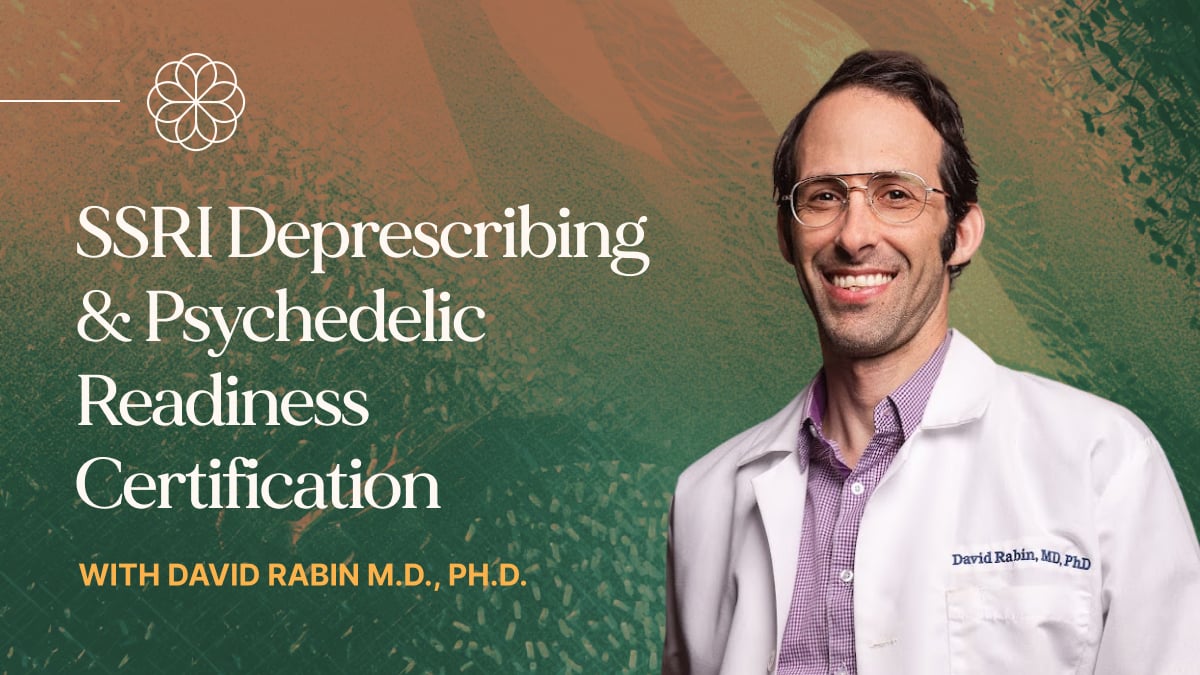
SSRI Deprescribing & Psychedelic Readiness Certification
A 3-month live online training led by board-certified psychiatrist Dr. Dave Rabin for therapists, clinicians, coaches, and facilitators working with medicated clients. Learn practical frameworks for tapering, withdrawal vs. relapse, prescriber collaboration, psychedelic readiness, and supporting clients within your scope.
Next cohort begins October 7, 2026.
Podcast Transcript
00:00:01 Paul F. Austin
What if the real breakthrough in depression treatment isn't more medication but less? Welcome back to the Psychedelic Podcast. I'm your host, Paul F. Austin, and in today's bonus episode we are sharing the replay of a live event we hosted just earlier this week: microdosing versus SSRIs, a psychiatrist's take on the future of depression treatment.
00:00:24 Paul F. Austin
Our guest is Dr. Dave Rabin, a board-certified psychiatrist, neuroscientist, and co-founder of Apollo Neuro. You may recognize Dave from his earlier appearances on episodes 218 and 74, and he's also a longtime faculty member at the Psychedelic Coaching Institute. This conversation is a direct follow-up to last week's bonus episode with Dr. Robin Carhart-Harris, where we explored the neuroscience behind SSRIs and psychedelics, how each interacts with emotional processing, brain entropy, and neuroplasticity. If you've missed that one, it's worth checking out for a more research-driven lens. We've linked it in the show notes.
00:01:02 Paul F. Austin
In today's session, Dave builds on that foundation with a more clinical and practical perspective, drawing from decades of real-world experience helping patients to taper off antidepressants and explore microdosing for emotional healing. We unpack why SSRIs tend to blunt both emotional pain and pleasure, the risks of combining SSRIs with psilocybin, how ketamine can serve as a safer bridge in the tapering process, and what to consider when supporting clients through this transition. If you're a practitioner, coach, or someone who is personally navigating this terrain, this episode offers grounded guidance rooted in both science and compassionate care.
00:01:40 Paul F. Austin
And frankly, I talked about Dave with things in this webinar that I really haven't had the chance to talk about publicly yet, around microdosing, SSRIs, and psilocybin. We also have a new cohort coming up that begins August 6th for our 10-month prep and integration coaching program. Dave is a faculty in this, and Robin Carhart-Harris will be joining us as our guest faculty in Costa Rica for the practitioner intensive number 5 to 10.
00:02:09 Paul F. Austin
All right, before we get into it, here is a quick word from our sponsors.
00:02:15 Paul F. Austin
Hey everyone, before we dive into today's episode, I want to take a moment to share something really important with you. It's about sourcing microdoses. If you're at Third Wave, one of our biggest commitments is helping people to explore the power of psychedelics safely, intentionally, and with the right support systems in place. That's why I'm excited to introduce you to our go-to microdosing partner, Golden Rule Mushrooms, a trusted friend and one of the most respected names in the microdosing space.
00:02:43 Paul F. Austin
Golden Rule crafts premium, ethically sourced microdosing and macrodosing products, including psilocybin and LSD options, all designed to support clarity, creativity, emotional healing, and performance. And what really sets them apart is their deep integrity with this work, both honoring traditional plant medicine while embracing modern science to support real and lasting transformation.
00:03:06 Paul F. Austin
Together, Third Wave and Golden Rule are working to make safe, high-quality psychedelic medicine more accessible while ensuring you have the education, tools, and community to feel confident on your journey. If you're curious about microdosing and want to try some of my personal favorites, head over to goldenrulemushrooms.com/thirdwave and use code THERDWAVE, that's one word, THERDWAVE, at checkout for 10% off. And you can use that not just once, but for every future order too. Again, that's goldenrulemushrooms.com/thirdwave and use the code THERDWAVE, one word.
00:03:40 Paul F. Austin
Now let's get into the episode. All right, that's it for now. Let's get into it with Dr. Dave Rabin.
00:04:11 Paul F. Austin
Dave, it's great to have you.
00:04:13 Dr. Dave Rabin
It's good to be here. Thank you. And I'm always enjoy.
00:04:16 Paul F. Austin
Welcome, Dave.
00:04:16 Dr. Dave Rabin
Thank you. Always, always enjoy this opportunity to share all the learnings that we have really achieved in neuroscience over the last couple decades that are not well taught. So thanks for having me.
00:04:30 Paul F. Austin
All right, let's just start with SSRIs. I want to start with what is the serotonin sort of hypothesis, if you will, and why is it that SSRIs have become the standard treatment of care for the last 40 years in the West?
00:04:44 Dr. Dave Rabin
So the, so I think the best way to start out with, you know, is what are, what are SSRIs? Because they are, SSRI stands for selective serotonin reuptake inhibitor. And these medicines inhibit, literally inhibit the reuptake of serotonin by the cell that releases it. And so when serotonin is in the synapse, it increases activation of the receptor. And when it gets uptake by the cell, it decreases in the synapse, and the cell reclaims serotonin to do another like burst release the next time you have an experience, right? And so, so selective serotonin reuptake inhibitors just increase the amount of serotonin molecules that are in the synapse where the message gets communicated to activate serotonin pathways.
00:05:38 Dr. Dave Rabin
This was one of the first discoveries of SSRIs that actually I think stems back to heavily, heavily contributed to by the Albert Hofmann's discovery of LSD that helped us to understand how the serotonin system works so that we could even come up with an SSRI. But the point being that those were developed as one of the first medications that targeted a single receptor site, the serotonin receptor, of which there are many. This is focused, this is particularly the one that's interesting in the psychedelic conversation is predominantly 5-HT2A and 5-HT1A, which are two of over a dozen serotonin receptors that we know of.
00:06:21 Dr. Dave Rabin
But they thought that because you could change the serotonin balance in the body with one drug and start to help stabilize people with very severe depression, that it meant that if you had depression, you have a serotonin imbalance in your brain. So that's the slippery slope of, of science, what we would call like scientific misinterpretation. Because just like, just because A leads to B does not mean that B leads to C. It means that A leads to B. And A leads to B means in this case that if you augment the amount of serotonin in the synapse, that you can stabilize people with severe depression and fairly reliably stabilize them within 4 to 12 weeks, which at that time in the '80s and '90s when these drugs were developed was like pretty great.
00:07:23 Dr. Dave Rabin
And you can't, if you overdose on them, you typically don't die from overdosing an SSRI. So it can be used with suicidal patients, actively suicidal patients. And so that's why these drugs exist and they're used to stabilize, but by nature of them stabilizing, they do, they numb us to emotion, not just negative emotion on the bottom end of the spectrum, but also to positive emotion. They shrink what's called the emotional window of awareness. And so that's how they stabilize you is by shrinking the emotional window of awareness. Are you still with me or did I lag too much?
00:08:02 Paul F. Austin
I'm still with you.
00:08:05 Dr. Dave Rabin
So yeah, so that's, so that's kind of, I just wanted to make sure people understand, like that's kind of how SSRIs are working. And they have a very important purpose, which is to stabilize people with very severe depression and, and intense anxiety episodes where other drugs would be more harmful to administer in those situations or not as effective. And they work for that.
00:08:29 Dr. Dave Rabin
But they don't work well for people who have like, generally speaking, like mild to moderate depression, who have to end up taking them for many, many, many decades or end up just taking them for many decades. It doesn't often work well for many of those people to achieve that stabilization effect. And then the question is, well, what happens, what do you do after you stabilize somebody? Right?
00:08:53 Dr. Dave Rabin
And then that's where we get into the interesting opportunity for psychedelic medicines to help in a lot of ways transition people off of lifelong SSRI therapy so they don't have to take it and risk getting the side effects for, you know, the side effects of SSRIs, which increase as you take them for longer. And so then you can use psychedelics as an opportunity to safely transition people off of SSRI and other antidepressants that are more harmful into, you know, what is eventually like a drug-free self-regulated life.
00:09:28 Paul F. Austin
So this notion of, you know, the serotonin hypothesis that if we, if we have an impact on serotonin, that depression is a chemical imbalance in the brain. I think the first book that I read that really nuked this theory in my mind was called Anatomy of an Epidemic by Robert Whitaker, which went into detail about the overprescription of not only SSRI medications, but also, also ADHD medications. And that these drugs are prescribed as young as three years old, four years old sometimes, which as you can imagine, is likely harmful for the development.
00:10:10 Paul F. Austin
So my, my next question is going to be then, you know, when we look at psychedelics and, and I also want to, I want to make something very clear that the, there will be some speculation today and probably most of that speculation may come from me. There may be some from Dave's part as well in terms of what he's seen when working with clients and folks like that. A lot of the clinical research that we have about microdosing is still early.
00:10:38 Paul F. Austin
And yet, Dave, I have to ask you if, if, if SSRIs help to, let's say, keep more serotonin in the synapse or generate more serotonin in the synapse, what is it that these 5-HT2A substances sort of agonists like psychedelics do? What is it that psilocybin is doing to serotonin and, and what are the potential risks or complications with combining then SSRI use with things like psilocybin and LSD and some of these classic psychedelics?
00:11:13 Dr. Dave Rabin
Sure. Yeah, I can, I can get into that. I think I'll talk about the second part first, because that's easy one to cover. And I think that's really, really important to mention is that you, we do not recommend combining SSRI antidepressants or for that matter, any antidepressants, including tricyclic and MAOI antidepressants with psychedelics that are activating of the serotonin receptor, which are basically nearly everything that we talk about here, except for cannabis and ketamine can, should, is not recommended to be used when you're taking SSRIs.
00:11:52 Dr. Dave Rabin
And the reason is because SSRI antidepressants, as I said earlier, work by decreasing the reuptake from the serotonin receptor, or sorry, from the, from the synaptic cleft where the serotonin gets released, they, there's uptake is inhibited. So it's not the serotonin that gets released is not going back into the cell as quickly. And when you take a psychedelic, it increases burst release of serotonin on one end. It, the psych in, in cert, with cert like MDMA, for instance, and MDMA-like molecules increase burst release of serotonin from the presynaptic neuron. Then they do, they bind to the side, the active site of 5-HT, of serotonin receptors. So they actually sit in the same location on the receptor that serotonin sits and increases activation instead of serotonin, does its own increase of activation. And so it's a sort of like partial competition for serotonin, but still boosting effect at the receptor.
00:12:58 Dr. Dave Rabin
And then the third thing that it does, it was discovered relatively recently in the last 10 years that is fascinating by friends Vollenweider's lab is that, and others working with him, that LSD and psilocybin, particularly LSD, bind to the side of the serotonin receptor, which is, and 5-HT2A receptor, which is called the allosteric site. And when they bind to that site, the receptor changes its shape and then clamps onto serotonin more tightly. So it's still, the receptor is now, the cleft is filling with serotonin from the SSRI preventing its reuptake. Then you get burst activation, more activation at the receptor site and LSD, psilocybin binding to the receptor and increasing the way that it binds tightly to serotonin and for longer.
00:13:48 Dr. Dave Rabin
So you get longer increased activation of these receptors plus more serotonin, no breaks. That is, start, that, that can start a chain reaction in the serotonin receptor where it gets overactivated to the point of causing serotonin syndrome. And so that's the biggest risk of combining these together, which is you can die and you have to go to the ER if you start having symptoms of serotonin syndrome. So it's like actually bad and it can happen at low doses of SSRI and low doses of psychedelics. So we recommend not mixing the MDMA family, phenethylamines or triptamines with SSRIs on board.
00:14:31 Dr. Dave Rabin
So your choices are then to taper off of your SSRI on your own or with a doctor's guidance, which can, I recommend with a doctor's guidance, which would take usually 4 to 12 weeks depending on, on you or your patients. And then, or, or to accelerate that, you can use ketamine. And so ketamine is compatible with SSRI and other antidepressant molecules. And it's also compatible with lithium when lithium is being used as a like gentle mood stabilizer in certain patients with like bipolar II. We don't recommend using psychedelics with bipolar I patients or with psychotic patients or people who have personality disorder, which can be hard to identify. So we do not recommend using psychedelic medicines with those folks because they're at extremely high risk for exacerbation of symptoms if they're not like managed very carefully by a trained psychiatrist.
00:15:29 Dr. Dave Rabin
But you can use ketamine for most people to, within three to six doses over the course of as fast as three weeks, as long as, you know, six weeks, you can accelerate the, somebody's taper of, off of SSRIs and then you can transition them into a microdosing protocol with, which is Paul Stamets' recommendation where you complete a macrodose experience, for instance, with ketamine and then you've unlocked three days of neuro, 72 hours of neuroplasticity, right? Like the, you, after the ketamine, after any powerful macrodose experience, you've unlocked a critical period where neuroplasticity, the normal neuroplastic learning processes in our brains are accelerated in their ability to form new network, form new connections and break old unuseful connections. And so if you amplify that neuroplasticity with ketamine to get 72 hours of, of experience of neuroplastic window, then you, critical period, then you have your integration therapy ideally, you know, right after and then on a continuous basis and you can start a microdosing protocol if you're a good candidate for one after the macrodose experience to really kick, like, like kickstart, jumpstart the, the recovery, healing, learning process. Does that make sense?
00:16:52 Paul F. Austin
It makes sense. And I want to go further in because I think this is like an essential point that we really need to cover in detail and, and, and I'm going to provide a little more context here so folks are aware. So this, you know, Dave, what Dave has communicated about, you know, do we know SSRIs, I'm sorry, do we know microdosing of psilocybin while on SSRIs came as, I would say, news or a surprise to me about a year ago because prior to that, there were folks like, you know, Jim Fadiman has said publicly, okay, it's safe to take SSRIs with microdoses.
00:17:25 Paul F. Austin
And look, Jim's a psychologist, right? He's not a psychiatrist. He's not a neuroscientist. He's a psychologist. And this is just from his Citizen Science reports. We've seen, you know, from the LICTI lab, the clinical research has come out. I believe this was paid for by Compass Pathways where they said it is safe to take psilocybin while on an SSRI.
00:17:46 Paul F. Austin
And obviously this is, this is a really important conversation because if you can treat people on SSRIs with psilocybin, your total addressable market is much bigger rather than having to taper them off for many weeks before you can actually start to use psilocybin. So there is a financial incentive.
00:18:03 Paul F. Austin
And I will, I also know that, you know, I know there are folks here who train practitioners or, or provide underground psilocybin. And there's a lot of people who have gotten off SSRIs while actively microdosing psilocybin and have had no problems.
00:18:18 Paul F. Austin
And so I'm curious just to go a little bit deeper into this, considering all that, why is it that you feel so strongly about the fact that psilocybin should not be used while on an SSRI whatsoever? And, and that ketamine is really a much better alternative for the, the tapering off period. What, I'm just like, I'm, I'm, I'm curious for that, just only to speak to the context of, of what's out there, because I think this is honestly one of the most important sort of talking points in the, in the psychedelic space today, the sort of psilocybin SSRI conversation.
00:18:57 Dr. Dave Rabin
So I was just saying, yes, absolutely. And I think it's really important for people to understand this point because it's commonly misunderstood and it's something that, that basically prevents avoidable risk, which causes, is the biggest problem with that is, you know, preserving, how do we preserve patient safety? And the, for lots of reasons, the way that pharmaceuticals, we've gotten used to pharmaceuticals being administered to the American population in a way where they're not being prescribed and they're used, the use of them is not necessarily being monitored in a way that is maximizing patient safety. And you can see that with the opioid crisis and the benzodiazepine crisis and the SSRI crisis, for instance, right?
00:19:48 Dr. Dave Rabin
And so the, there's a, there's an important statistic in clinical medicine when we're looking at interventions and their relative risk versus benefit. And ultimately, if you administer somebody who's a good patient candidate who is not taking an SSRI or other serotonergic antidepressant and you, and you administer the psilocybin to them, you have your number needed to kill, which is the number of patients you need to treat to have one death is zero. It's infinite. It's not applicable because there's no risk of death with psilocybin being used without SSRIs on board. All of a sudden, you introduce SSRIs and you look at that patient population and there's a non-zero number needed to kill.
00:20:41 Dr. Dave Rabin
And so when we think about, like, especially as physicians, like we're trained and we're, and my non-profit medical board, the Board of Medicine is, it's actually just wrote to HHS and proposed a clinical program for them to deal with the SSRI over prescription problem with this taper method so that patient safety is prioritized as number one. And ultimately, if you, if we understand that there is a risk of death that's relatively unpredictable with SSRIs on board when you treat somebody with psilocybin and that goes away completely without it, with just a standard patient screening interview, then from that standpoint, you might as well just work with somebody to taper them off of their SSRI first, right? And so it's just minimizing risk.
00:21:30 Dr. Dave Rabin
And that's the, that's the old way of practicing medicine that kept people safe, kept the American population safe over the last 20 to 30, 40 years, in large part because of the way that opioids were handled. It hasn't been that way in a lot of areas of medicine. And so we need to get back to that because that's how we maintain, that's how we maintain trust with the medical system as a system that evolves with our society that helps continue to make us healthy and integrate new treatments and iterate quickly. Like our system is like stagnant as of like 25 years ago, except in certain surgical specialties, everything else is the same, you know?
00:22:08 Dr. Dave Rabin
So we need to like upgrade medicine and make it easy to, to upgrade with these tools and, and safety has to be the priority. 'Cause if, if just a few people die accidentally from using these SSRIs, for instance, with, with psilocybin in particular. And I think on the last call that I talked about this last course, there was at least one person on the, on the course who was attending, one of the attendees had had this happen to them with a microdose of psilocybin with SSRIs on board. So it's a, it's not a trivial chance that this could happen. It's like one in a hundred or two in a hundred people who take psilocybin with an SSRI and it's just a dose-dependent thing that they're going to have an increased likelihood of, of getting it. So if we minimize risk, we increase the likelihood of psychedelics being approved without safety, as many safety concerns from the federal government as well.
00:23:02 Paul F. Austin
That makes sense. What about Wellbutrin?
00:23:06 Dr. Dave Rabin
I mean, Wellbutrin is like more like an amphetamine antidepressant in terms of how it works. It's like more glutamatergic, it's more speedy. And so I think that in general, for a better quality of psychedelic experience, and that's also part of it with SSRIs, like what you don't really, what you, what we forget is that if you're shrinking the motional window of awareness and then you're putting somebody into that shrunken window with a bunch of psychedelics, like it's going to take so much more medicine for them to get to full awareness, but full awareness is capture them here, right?
00:23:43 Dr. Dave Rabin
So you, that's actually one of the big reasons why people end up in the macrodosing world or microdosing world, they end up taking too much 'cause they're like, I don't feel this without, I remember feeling this dose. So then they take more and then they still don't feel it because the SSRI is restricting their awareness. So that's why another reason, like you end up just wasting medicine when you're taking SSRIs at the same time, 'cause you have to use so much more and you still can't get to the peak effect that you would otherwise get to in a macrodosing experience.
00:24:15 Dr. Dave Rabin
With Wellbutrin, it just decreases the effect. Amphetamines just decrease the effect. Antipsychotics decrease the effect of psychedelics.
00:24:24 Dr. Dave Rabin
Lithium is one of the only antidepressant medicines that actually, and mood stabilizers that actually works with ketamine in a positive way. So if you have lithium on board, you can actually administer ketamine and ketamine, ketamine's effects in a few studies have been shown to be potentiated, meaning they last longer with, with lithium on board.
00:24:50 Dr. Dave Rabin
And so oftentimes I will have my patients do five to 10 milligrams, especially if they have mood lability as a symptom. Like when they come to me, they're not bipolar, they're not like, they don't meet criteria for manic depressive disorder, but they have a lot of like mood instability where they're bouncing up and down a lot and having trouble regulating. And so as a trick, I'll use like five to 10 milligrams of lithium, which is a microdose of lithium. And then that continues through their ketamine experiences and it augments their ketamine experiences, but it does not augment experiences with other psychedelics, just ketamine.
00:25:24 Paul F. Austin
Okay. The third and final point, right? And this is, I think, an important point. I'm, I'm mostly, you know, I'm not doing this in a, in a, and taken a stick away. It's just these are the, the questions that I'm seeing in the conversations that I'm.
00:25:35 Dr. Dave Rabin
Yeah, no, of course.
00:25:36 Paul F. Austin
I've seen this with a few even legal psilocybin facilitators in Oregon who are noticing this. I think the final point about the SSRI conversation is this sort of notion that getting someone weaning off or just going cold turkey off SSRIs so they can do psilocybin is also problematic, right? That it may cause destabilization. And so that's some folks' concern is, you know, the SSRI can sometimes help to create stability in the midterm before someone is fully ready to wean off.
00:26:09 Paul F. Austin
So I sort of want to, you talked about this a little bit, but just to make this very practical and easy to follow, when you're working with clients as a psychiatrist who's very well-versed in traditional psychiatric medications and psychedelic medicine, how are you typically helping them to wean off SSRIs? What does that protocol for you look like? And what is the role of the, the nervous system in that process?
00:26:32 Dr. Dave Rabin
That's a great question. So it's actually a lot simpler than most people would think, but again, we're just not taught it that well. So, so follow, follow with me for a minute. So basically SSRIs, going back to what we were talking about before, shrink your window of awareness, right? So that means you don't feel as low lows, but you also aren't feeling as high highs. So that's why you lose, that's why most people who take SSRIs stop feeling as depressed and deeply sad and anxious, but they also lose the ability to climax an orgasm, right? 'Cause that's a peak joy state. And so you get, that's the downside of those medicines. You lose both. And that's basically explains almost every side effect of SSRIs as well, is they come from that losing of the top and the bottom, cutting it off.
00:27:24 Dr. Dave Rabin
So that includes the extremes of feeling on, in both sides of the spectrum, on the, on the downside, you know, the side we consider unpleasant and the side we consider feeling good and elated and happy. And so when you remove the SSRI, the first thing that happens is people start to feel a lot more feelings. And those feelings are both oftentimes really joyful and happy, but they're also feelings that are equally as present that, or maybe more present that are fearful and sad and upset and guilty and shameful. That's everything is coming back from those two ends of the spectrum that were cut off from before.
00:28:02 Dr. Dave Rabin
And sometimes it comes back really fast and sometimes it comes back kind of slow, but consistently over the course of your days of taper. And it definitely stays because you're, it's not something that wasn't there. It's just your awareness, the breaks on your awareness that were prevent, keeping it here have been taken away. So that means your awareness now is like all of a sudden nearly instantly fully expanded over the course of, it's not instant, it's like, you know, a couple, it takes four weeks, four weeks-ish for the serotonin SSRI to leave your system completely. So over the course of that four weeks from the moment you stop taking your SSRI, your awareness is expanding a little bit more every day to get back to that full spectrum.
00:28:42 Dr. Dave Rabin
And that can be really scary for people because that's a lot of feeling that wasn't there before. And they may not have learned the psychotherapy techniques that their doctor was supposed to be teaching them to understand how to cope with and adapt to that sudden increase in feelings again that comes from when we stop your medicine. That's the way we used to do it is help the psycho, the drug is the bridge to the psychotherapy that stabilize people enough to do the psychotherapy to learn the emotional regulation techniques. And then you remove the drug and they are good.
00:29:14 Dr. Dave Rabin
But so what we, if we understand what happens to people when the medicine is, breaks are removed from awareness, you understand also that overwhelming feeling can cause feelings of fear, lack of safety, heart rate goes up, blood pressure goes up, respiratory rate goes up, people start sweating, they start having like racing thoughts, like anxiety, significant anxiety. And that puts the body into a state of resistance and, and threat like fight or flight.
00:29:42 Dr. Dave Rabin
So all of the tools that we use are tools that help to soothe the body into a state where, which is basically a state of slightly heightened vagal nerve tone, vagal nerve activation, which governs the entire recovery nervous system of the body from the brainstem. And by doing different techniques, which include everything from the deep breathing, meditation, mindfulness, yoga, soothing touch, soothing music, eye to eye contact, touch therapy, and things like Apollo. And combining all of these different vagal nerve techniques, that sends a huge amount of soothing, soothing stimulation to the nervous system.
00:30:25 Dr. Dave Rabin
And then your awareness is widening. So you're still getting the, you're still have, you're still noticing more and on both sides of the spectrum and it's still challenging, but you, your body feels safe when it's going through it. It's not triggered into a fight or flight survival response. And when your body feels safe, then you know, you're reminded that you can get through it and then you get through it faster. And then, you know, but, but biochemically speaking, it does take four weeks for the SSRI to completely leave your system.
00:30:54 Dr. Dave Rabin
So that's the protocol they use in the MAPS studies, for instance, is they had at least four weeks of taper of no SSRI onboard in the system before they administered MDMA to ensure that there were no side effects. So it's, it's, it's real, you know, and I think like the main thing is like, you know, luckily we have other tools. Like I think that, that psilocybin microdosing is actually much less effective while you're still taking your SSRI because they are, they are opposing each other in mechanism.
00:31:25 Dr. Dave Rabin
And so if you take the time to work with your natural tools or with Apollo or with ketamine and a seasoned provider, even in one dose of ketamine, you can, you can taper off of your SSRIs and be like good and not have withdrawal. I've seen it happen. You know what I mean? So it's like, it's not a huge amount of work, but it's like a solid one to four weeks of effectively preparation for your microdosing course that hones your intention to maximize what you get out of the microdosing experience in terms of breaking old habits and learning new ones. Does that make sense?
00:32:00 Paul F. Austin
Totally. Yeah. I'm, I'm, I'm tracking and following everything and all the comments. And I think, I think I, I do want to spend a little bit more time talking about psilocybin specifically.
00:32:08 Paul F. Austin
So let's, let's assume there's a process that an individual can follow where they, they utilize ketamine to get off SSRIs, right? They've been clean of SSRIs for, for, you know, about four weeks. If someone wants to start to do, let's say therapeutic work with psilocybin, they're interested in higher dose work, they're interested in potentially microdosing, how might that previous relationship with SSRIs impact their sensitivity, impact their dosage, impact, you know, their, their, their, their sort of normal capacity in that space? There's, there's a few questions around that.
00:32:45 Paul F. Austin
In other words, Dave, maybe another way to ask the question, if someone's been on SSRIs for 30 years, are they actually going to be able to feel anything, even if they've been off their SSRIs for a month? And how does that compare to someone who's just been on SSRIs for a year and they're weaning off now and now they're trying to get into to work with, with psychedelics or psilocybin?
00:33:06 Dr. Dave Rabin
We don't know for sure the difference between somebody who's been taking them for 30 years versus one year. You know, these, we haven't done those really long-term studies or they're, a lot of them are still in progress, but.
00:33:18 Paul F. Austin
Any speculation that you could share in terms of maybe what you've seen in clinical practice or kind of.
00:33:23 Dr. Dave Rabin
I mean, what you, what's the data, what the data that we do have would suggest is that the longer you're on the SSRI, the longer you have spent in kind of like an awareness constricted state with less feeling. But the thing is, when you, and, and, and when you take the medicine away, when you remove it or taper it slowly, people do genuine, genuine, generally nearly every time have this pretty profound expansion of awareness. I haven't seen a significant difference in my patients between people who have been taking it for 30 years versus 10 years. And sometimes the 30-year people actually respond to the psychedelics more because they haven't felt in so long that their sensitivity to it has heightened dramatically. And they have like breakthrough much more quickly, quick breakthrough psychedelic experiences where like I have a woman right now who actually had a very, very unpleasant psilocybin macrodose experience shortly after tapering off of SSRI.
00:34:31 Dr. Dave Rabin
It was not related to the SSRI that she had the bad experience. It was because she didn't, she wasn't prepared properly for the experience and didn't, and the, and the guides who seemed fine were not prepared to hold somebody who had such severe childhood trauma and had such severe depression and addiction issues that she was like, like she needed, she needed a lot of support and help and they just didn't know how to prepare her for what she was going to face or to hold her in that space. And so she had a very hard time.
00:35:04 Dr. Dave Rabin
And so she came to me afterwards and we started doing, we started doing ketamine work together. And again, this woman had been taking SSRIs for decades and she had tried ketamine before. She had tried sometimes with, sometimes without psychedelic, without her SSRI onboard. And then she stopped the SSRI two weeks before she did her psilocybin experience and then restarted it because she was felt so bad after the experience that she couldn't, she needed something.
00:35:36 Dr. Dave Rabin
So we did ketamine with her and have tapered her off of her SSRI and one dose of ketamine was all it took for her. Like I would have thought it would have taken six going into it for sure. One dose with the practices that we, that we do in our clinic, which are about, you know, the basically all the brain rewiring practices that I teach about and attention training and all these things like with some cognitive behavioral therapy and some IFS thrown in there, right? And you, you get in motivational interviewing and you get this like really nice window of change where people can like all of a sudden by making like, by playing just a little bit more safe to feel their feelings, they're able to understand what those feelings are telling them.
00:36:18 Dr. Dave Rabin
And then their feelings are telling them what to do to feel better. Like think about how simple that is. Like it blows your mind when you think about how simple that is in terms of like the path to healing. It's feeling safe enough to feel your feelings for even just a little bit of time, like 60 seconds, so that you can understand what the feelings are signaling or telling us so that we can do what we need to do to get, allow that feeling to like get out of our bodies basically to like move through us. And then we move on to the next thing, but we have to feel safe enough to feel it.
00:36:56 Dr. Dave Rabin
So that's, so, so I think like the duration of the SSRIs I think doesn't really matter that much. I would say like if you have four weeks off of your SSRI, you're going to be golden for your psychedelic experience. I'm not, I don't, I'm not concerned at all about people's response.
00:37:15 Dr. Dave Rabin
What does decrease response in addition to that is if they have like really intense anxiety when the SSRI has stopped and that their anxiety is like unmanageable levels of anxiety, like generalized anxiety disorder, high levels of anxiety that will shut down almost any psychedelic experience. I've seen that shut down everything like LSD, MDMA, ayahuasca, ketamine, all of it. If you have anxiety at that level, then that person's probably not ready for a psychedelic experience. They probably should be, you know, slow, more slowly tapered or trained more in psychotherapy techniques to help them manage.
00:37:58 Paul F. Austin
So we have some great questions coming in, including from, from John, but the, the final, the, we have about five minutes. So Dave, if I can get two more questions in this first question and then, and then, and then another one would be good as well.
00:38:11 Paul F. Austin
Talk to us about strains of mushrooms and how those may differ in terms of the experience. We were talking about this a little bit before we went live and you mentioned penis MD, for example, versus golden teachers. Like talk to us a little bit about what you're noticing from a strain perspective and the impact that it may have on anxiety and sort of the experience of microdosing with psilocybin.
00:38:30 Dr. Dave Rabin
Sure. So there, there are many different strains of mushrooms, like probably as many as there are strains of cannabis. There are so many strains, thousands of strains, and each one of them has different plant alkaloids and other bioactive molecules in them in the hundreds. And they don't just have psilocybin. They have hundreds of other plant molecules that change the way that psilocybin affects our bodies. And so different mushroom strains have not only different percentages of psilocybin, they also have different experiences that come along with them.
00:39:10 Dr. Dave Rabin
And so there are certain mushrooms like penis MD mushrooms, which we talk about a lot and we see a lot because they are some of the cheapest, biggest mushrooms to grow that are very dense in high levels of psilocybin. And so a lot of people who really like to give out stronger medicine, sell stronger medicine and use stronger medicine will gravitate towards those. But those became the more common, most common strains that are around in chocolates and other microdosing tinctures. So you, it's important to find out if you can what mushrooms are in there. If they're not labeled at all, they're usually penis MD mushrooms.
00:39:44 Dr. Dave Rabin
Penis MD mushrooms increase rumination and increase your self-critic and increase your self-referential analysis of yourself, which is fantastic if you're in like a deep in a psychotherapy session with a, with a, you know, trained provider or ideally two, but not exciting at all when you're at work or interacting with your family or, you know, at home alone or doing other things that like driving a car, right? Like not good for any of those other kinds of situations, not good for microdosing for most people. Some people will, who are very tolerant of psychedelics, many will microdose with penis MD, but especially for people who have anxiety and anybody who is new to microdosing, that's the last one that I recommend along with the blue azorenzins and some of the other blue and stronger mushroom varietals.
00:40:38 Dr. Dave Rabin
I will just stay away from those for, for golden teachers. I find it are really the golden teachers are a very, are very reasonable place to start, like middle of the road, and they're of medium strength. So they're not super, they're like kind of gentle in the experience, but there are now even better strains that we can use that if you know, if you have the ability to get them or grow them, then you can, you know, Maui platinum is a very, very good gentle strain. It's very like chill and, and not anxiety driven at all for most people.
00:41:13 Dr. Dave Rabin
And then Mexican style mushrooms, this Mexican strains of mushrooms also tend to be slightly lower psilocybin levels, slightly more gentle than golden teacher and just easier for people to tolerate. And so we always like to start there if we can because it just helps people have a better first experience and they are motivated to come back and do it again with different and have different experiences.
00:41:36 Paul F. Austin
All right, Dave, final question, then we're going to open it up for some Q and A before we have Ali. Final question is, you know, you're a psychiatrist, you're a, you're a psychedelic practitioner. You've been a faculty in our 10-month certification program since the get-go.
00:41:48 Paul F. Austin
Dave and I, by the way, are co-producing a course that we will come out with around psychedelic safety and nervous system regulation. So we'll have more details about that in the fall, but I just want to peek that.
00:42:00 Paul F. Austin
What's, what is your toolkit when you're, when, when you're working with clients who are on, just to sort of recap all of this, when you're working with clients, they come on, they're on SSRIs, they want to get off SSRIs, you want to make sure you can support them to the best of your ability and their ability.
00:42:13 Paul F. Austin
What toolkit are you bringing into those conversations? If you could just sort of like run through that, that list for us, what, what are the sort of the most essential items that, that, that you're ensuring are, are brought into that?
00:42:25 Dr. Dave Rabin
I mean, do you want me to, do you want me to start with like the supplements and things I use of that variety or are you more interested in like the psych, the psychotherapy techniques?
00:42:37 Paul F. Austin
Everything. If you had a top five, because I am being mindful of time, we don't have too much, but if you could sort of summarize in one to two minutes, what is that optimal toolkit for you? What, what would that be?
00:42:47 Dr. Dave Rabin
So I'll give you a few of them right now. So one of them in terms of supplements is this CBD-A tincture that is absolutely stunning. And it's the best, it's best in its class. It's CBD-A. It's not CBD. So it's really, really hard to get because it's effectively the cold pressed extra virgin olive oil organic version of CBD. And it's, it's thought to be 30 to 50 times more potent than standard CBD, which is heated when it's produced, where CBD-A is cold extracted. So it's more, most cannabinoids are actually more anti-inflammatory and healing in the anti-inflammatory end of the spectrum when they're not heated, which is not something that many people out of California has been passed on. So that's the, that's the main, that's the main supplement that I would recommend in addition to polystamids, the immune complex mushrooms that are like 21 different mushrooms. I think it's called like the immune complex, which has specific mushrooms that increase cognition, learning, neuroplasticity and work well with psychedelic medicines, including ketamine and psychedelic mushrooms.
00:43:59 Dr. Dave Rabin
And then the last tool that I use is Apollo as a primary tool, which I, everyone starts with when they first start working with me. And Apollo is a wearable and an app on your phone, if you have an iPhone, that can basically deliver soothing vibrations to your body that regulate your vagus nerve and help improve the functioning of your, of your nervous system and affect as if you were meditating or deep breathing, but sound wave assisted. And you can wear it or you could try it if you go to the hugvibe.com in your iPhone, you can try it on for free. Free trial only exists for iPhone, unfortunately, but the wearable works for the Android and iOS.
00:44:41 Dr. Dave Rabin
And then I think the last couple quick things are on like the way that once people have the tools in their toolbox, they know they're not alone just figuring this out on their own with those three tools I just mentioned. Then people have something that they're taking regularly for adaptogenic boosting, anti-inflammatory boosting and cognition. So that's the CBD-A and adaptogenic mushrooms do those three things. And then the, and then they have the Apollo for regular mood stabilization, as use, recovery, enhancement, and sleep enhancement, et cetera, but also importantly as needed relief. If you're feeling distressed, if you're feeling like you're stuck in like a really tough place, you can just go and use that anytime and it trains you how to self-regulate in stressful situations and it has no side effects. So that's, that's the toolbox that we can arm people with, including some playlists also, which are like, you know, people understand the impact of music in these, in this way.
00:45:38 Dr. Dave Rabin
Then there's the way you talk to people, which has to be genuine eye to eye contact, actually connecting with people in a natural way that shows that you're listening to them without judging them. And that's really all we're communicating is non-judgmental listening. And one of the first things that once we communicate that as the core focus of the interaction that starts to build trust with our clients, we, you know, we, we focus on a series of three primary therapy types. We do some other stuff in there too, but the main one to focus on first is motivational interviewing because motivational interviewing is brief interventions that are 10 to 15 minutes or five to 15 minutes long that help like under, help us as clinicians understand what somebody's motivators and drives are and what motivates them to do the things that they do in a non-judgmental way, of course.
00:46:32 Dr. Dave Rabin
And then once they have shared that with us, then we can, by understanding their motivations, help them start to motivate them to ask questions like, how do I do it differently? What options do I have? Like, can you, can you teach me about how different healing techniques work? And then you're like, oh, what would you like to know about CBT? And they're like, that could, they're like, could that help me? And you're like, yeah, there's actually a lot of evidence to show that it can. And here's a technique that we use. And then we offer some core cognitive behavioral therapy techniques when they ask for it, but when they ask for it, they're much more likely to actually do it. So we don't want to offer it to them before they ask. So it's like a very, you know, thoughtful, like meet them where they are approach, which does not take a ton of training, which is actually the beauty of it.
00:47:17 Dr. Dave Rabin
We're releasing a manual to teach people how to do this work soon, but from our clinic, but that's, that's the gist is just like connecting with people in this way that they're heard and seen and don't feel judged and feel held. And then they'll tell you what they need to do to feel better because they know, they know like way better than we know. We just are kind of like a guide to help them hear themselves figure it out for themselves and kind of like hold their hand and guide them to the, to the answer. So that's, so that's really helpful when that foundation of trust carries over into every part of your clinical experience. And when you experience that, the administration of medicine afterwards as part of that experience, you will see that the outcomes with your clients will be much better and longer lasting because it's built on the foundation of trust that we have built with them. And then of course there's like IFS and some psychodynamic, you know, Freudian stuff you can comes out in there too along the way, but you know, we don't force that on people. We like let them kind of ask for the support that they need through their insight into their motivation.
00:48:26 Paul F. Austin
I love it. All right, let's get into questions, Dave. So first question is from David. If most SSRIs take four plus weeks to be therapeutic, how long does psilocybin or microdoses of psilocybin take to actually work? So let's say someone has ongoing low-level depression, has never been on SSRIs. What is the protocol you would recommend? And I would share more on this, but I'm about to cough.
00:48:52 Dr. Dave Rabin
Most
00:48:57 Dr. Dave Rabin
SSRIs are, are most antidepressants, whether you're looking at like psychedelic-like antidepressants, like of which ketamine is, and you could call psilocybin and also other antidepressants that preceded SSRIs like tricyclic antidepressants and MAOIs. They're, they all work or start working almost instantaneously. Like as soon as you've digested and metabolized the medicine, it is, it could be start to have a noticeable effect for you.
00:49:29 Dr. Dave Rabin
Whereas SSRIs don't, because they work by inducing a long-term delayed reuptake response in the receptor where that's reuptaking the part of the cell that's reuptaking serotonin, their mechanism actually takes much longer, but it's relatively unique to SSRIs that you have that like four to 12-week window where the full effects are not necessarily achieved yet.
00:49:57 Dr. Dave Rabin
So most other drugs that we use work nearly immediately. And I don't know, what was the protocol that you wanted to.
00:50:07 Paul F. Austin
But I think, I, I think just 'cause I want to keep, we'll keep moving because we have a few more questions.
00:50:11 Paul F. Austin
I think the, the sort of standard protocol of what I would call the Paul Stamets protocol, four days on, three days off, or the Jim Fadiman protocol, one day on, two days off.
00:50:19 Paul F. Austin
And I've, I've seen folks who start to experience an uplift in like one to two weeks or sometimes even with the first dose. It just depends on how it's done and the.
00:50:28 Dr. Dave Rabin
Yeah. I would say, yeah, you, oh yeah. And for that, it's, I, I'm, I'm more a fan of for people, the kind of folks we're talking about who are like new to psychedelics, who haven't had a lot of experience. I think it's, I think the, the Fadiman protocol is actually the best way to start. It's more gentle, gives you more frequent time for introspection. And then I think like the Stamets protocol is more like an advanced microdosing protocol is kind of how I look at it when you already have some experience doing it.
00:50:59 Dr. Dave Rabin
But I would say you're right. I mean, it's probably like you shouldn't notice the effect in, as in one day with microdosing. It's supposed to be a, a sub-threshold effect where you don't really notice much when you're microdosing as dose guidance is concerned. So you really should, you know, I would say, like you said, it's really, it's similar in that way.
00:51:17 Dr. Dave Rabin
And then it's probably two to four weeks before most people notice like their mood is substantially different or they're ruminating a lot less or they're having like a lot more less negative intrusive thoughts or things like that, you know, more energy. Yeah, I would say it's usually two to four weeks.
00:51:34 Paul F. Austin
Okay, final question, 60-second response. Then I got to bring Ali up to do her thing. Do you believe microdosing psilocybin is going to be sort of an upgraded SSRI, or do you believe that these low doses of psilocybin actually offer a totally new paradigm of care?
00:51:49 Dr. Dave Rabin
I think low dose psilocybin is going to be, and drugs like it are going to be the, like the next generation of antidepressant medications that's going to be mainstreamed, right? And it's going to be dosed in a like antidepressants are dosed. It's going to be not every day maybe, but it's going to be dosed like every third day for a really long time. And hopefully there are therapy protocols that are encouraged along with it, but we know that those are not always upheld.
00:52:16 Dr. Dave Rabin
But I think that, you know, the macrodosing is really where the different, the paradigm shift happens because it, in the macrodose experiences, you're really like, you have ego death opportunities and opportunities to really like dramatically shift consciousness in a single eight-hour period. You can shift how somebody sees themselves as a human being and what being alive means to them, right? And that's not something that typically happens or should not be happening in your daily microdose experiences or your weekly experiences. So I think like that's where that matters more.
00:52:48 Dr. Dave Rabin
But I think microdosing will, in fact, like the data is showing that like it needs to be looked at as a very affordable, very successful way to start to manage antidepressants, start to manage depression more effectively than what we're currently doing. And it has a ton of promise and we just need to not accidentally hurt ourselves along the way.
00:53:09 Paul F. Austin
I love that. Dave Raben, it's been an honor. Thank you so much for joining us. For those of you who are coming for the first time today, thank you. I see a lot of familiar faces here. So we really appreciate you showing up and asking all these great questions. It's been fun. We'll see you next time, folks.
00:53:31 Paul F. Austin
Hey listeners, Paul here. If this conversation with Dr. Dave resonated with you, be sure to check out last week's bonus episode with Dr. Robin Carhart-Harris, where we explored the neuroscience of SSRIs, psychedelics, and microdosing. You'll find the link to that episode along with full show notes and resources in the description below.
00:53:47 Paul F. Austin
And if you're looking for support on your own journey or simply to connect with others in this emergent third wave of psychedelics, join us inside our community platform at community.the3rdwave.co. It's free to join.
00:53:58 Paul F. Austin
Make sure to follow the Psychedelic Podcast wherever you listen so you never miss an episode. And if you found this to be helpful, useful, please consider sharing it with someone you care about. Thanks for tuning in and we'll see you next week.