
Episode 372
Paije Alexandra West
In this episode of The Psychedelic Podcast, Paul F. Austin speaks with Paije Alexandra West, founder of ETÉREO, about iboga, ibogaine, and Bwiti initiation. Drawing on Paul’s recent retreat experience in Baja, they examine what can be lost when iboga is reduced to a clinical alkaloid, and how ceremony can coexist with rigorous medical screening. Paije explains root bark versus total alkaloid extract, the role of Bwiti music, and why discomfort, community, and long-term integration are central to working responsibly with this demanding medicine.
Paije Alexandra West is the founder and lead iboga provider at ETÉREO | Center for Truth, an iboga retreat center outside Todos Santos, Baja California Sur, Mexico. A twice-initiated Bwiti practitioner, she first came to this medicine from the clinical side, spending years supporting guests through detox and aftercare at ibogaine clinics. Her commitment deepened after losing her brother to a fentanyl overdose.
In 2021, Paije traveled to Gabon for initiation with the Missoko Bwiti and completed the Nyembe rites in 2022. In 2025, she was initiated a second time with the Fong. Her work blends traditional Bwiti ceremony with EKGs, pharmacist reviews, licensed therapists, and IFS-informed integration. Paije draws on her earlier work as a full-spectrum doula and trauma-informed training, approaching psychedelic facilitation through education, advocacy, and non-impositional care. She runs ETÉREO with her husband and co-founder, Fletcher Burdick, a Q’ero-initiated facilitator. In November 2025, they launched the Stone West Foundation to fund scholarships and Indigenous-led iboga replanting in Gabon.
Podcast Highlights
- From ibogaine treatment to Bwiti initiation
- What medicalized ibogaine can leave behind
- Clinical screening inside a ceremonial container
- Why saying no protects participants
- Root bark vs. total alkaloid extract
- Bwiti music as a brain chisel
- Discomfort, community, and modern convenience
- Why iboga integration is a long game
Show Links
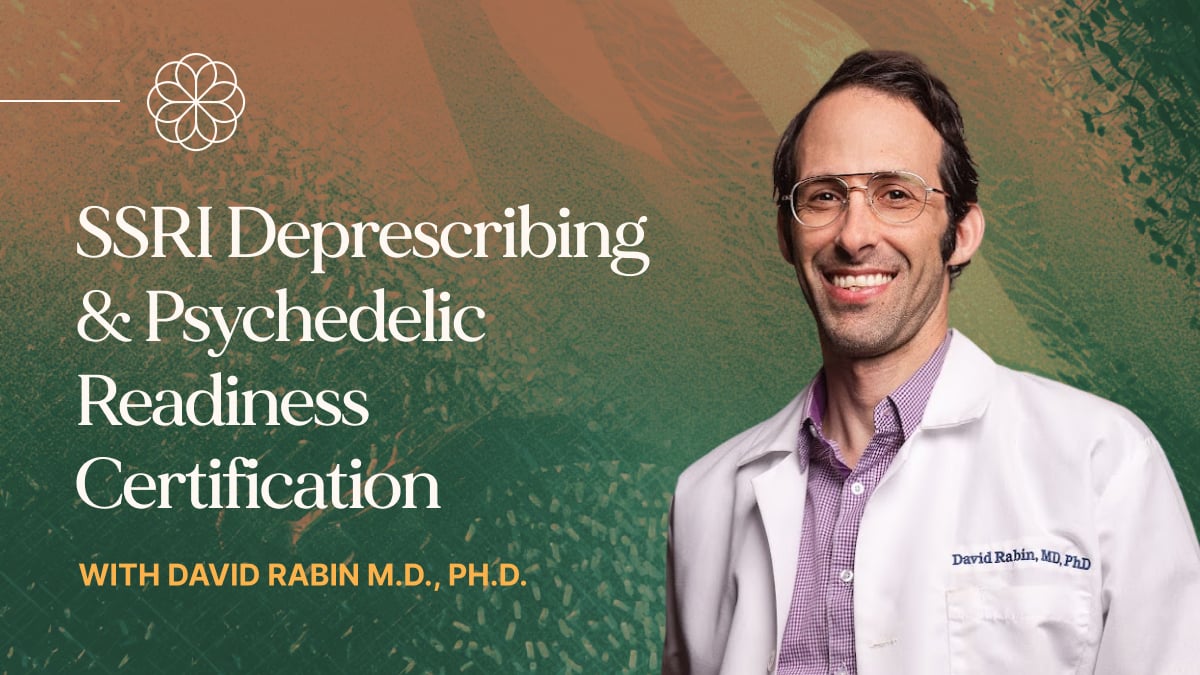
SSRI Deprescribing & Psychedelic Readiness Certification
A 3-month live online training led by board-certified psychiatrist Dr. Dave Rabin for therapists, clinicians, coaches, and facilitators working with medicated clients. Learn practical frameworks for tapering, withdrawal vs. relapse, prescriber collaboration, psychedelic readiness, and supporting clients within your scope.
Next cohort begins October 7, 2026.
Podcast Transcript
00:00:01 Paul Austin
Iboga is not a psychedelic that I would casually encourage just anyone to take. In fact, it was one of the most demanding experiences that I've ever had, and for me, that discomfort was part of the medicine. Welcome to the Psychedelic Podcast. I'm your host, Paul Austin, and about 6 weeks ago I joined Paije Alexandra West and her team for an iboga retreat at ETÉREO in Baja, just outside Todos Santos. And this experience gave me a very personal understanding of why this medicine requires such a tight container, and why reducing iboga to a single clinical alkaloid—ibogaine—can often leave out the culture, ceremony, and community that have carried it for generations. And so I wanted to bring Paije on the podcast to talk about what is really required to hold both sides of this work with integrity.
00:00:53 Paul Austin
Now, who is Paije? Paije is the founder of ETÉREO, an iboga retreat center outside Todos Santos in Baja, California Sur, Mexico. She is a twice-initiated Bwiti practitioner who first came to this medicine through years of supporting detox and aftercare at ibogaine clinics. After losing her brother to a fentanyl overdose, Paije traveled to Gabon for initiation with the Missoko Bwiti in 2021, completed the Nyembe Rites in 2022, and was initiated with the Fong in 2025. At ETÉREO, she combines traditional ceremony with EKGs, pharmacists, licensed therapists, and IFS-informed integration. She runs this center with her husband and co-founder, Fletcher Burdick, and together they launched the Stone West Foundation to support scholarships and Indigenous-led iboga replanting in Gabon. So, just to give you a taste of what we'll cover in today's episode: how ibogaine first changed the course of Paije's life and family, what Bwiti initiation asks of the body and mind, the cultural cost of reducing iboga to one alkaloid, how ETÉREO screens for cardiac and medication risks, why saying no can be a sacred part of care, root bark versus total alkaloid extract, how Bwiti music works like a brain chisel, and why discomfort, community, and integration matter long after ceremony.
00:02:15 Paul Austin
Now, if you're interested in attending ETÉREO, the website is etereobaja.mx/iboga. You can just click that you found out about the retreat through Third Wave, and you'll hear me talk a lot about my own experience with iboga on the podcast itself. I've also published a little bit about it on social media. Incredibly powerful experience, massive pattern interrupter, and I really don't know if I ever want to work with iboga again. It was that intense. I was in a place of comparative desperation, and it was really, really helpful medicine, and I'm glad that I did it. Before we get into this episode with Paije, let's quick hear a word from our sponsors.
00:02:59 Paul Austin
If you work with clients who are taking SSRIs and asking about psychedelics, check out our new SSRI Deprescribing and Psychedelic Readiness Certification. It's taught by Dr. Dave Rabin, a board-certified psychiatrist and neuroscientist with more than 20 years of experience working with psychiatric medication reduction. You'll learn how to assess readiness, understand the tapering process, collaborate with prescribers, and support clients through the transition while staying within your professional scope. Learn more through the link in the description. All right, folks, let's get into this conversation with Paije Alexandra West.
00:03:52 Paul Austin
Paije, thank you for joining us for the podcast.
00:03:55 Paije Alexandra West
Hi. I'm super honored to be here. Thank you.
00:03:59 Paul Austin
Let's start with how you met this medicine. You supported people for years through detox in Los Cabos and around Baja before you ever sat with the Bwiti. Tell us a little bit about how you found iboga and ibogaine, this sort of ancient medicine.
00:04:20 Paije Alexandra West
The origin story. So, let's see. I first traveled to Baja about 14 years ago to sit with ibogaine. This was long before beautiful, sort of refined clinics existed. This was a converted dental office walking across the border to experience ibogaine. I sought out ibogaine to really heal my complex PTSD, symptoms of ADHD, treatment-resistant depression, all of these labels and sort of diagnoses that had been floating around since I was a teenager. I had really exhausted all Western modalities, it felt.
00:05:05 Paije Alexandra West
You know, certainly medication, traditional sort of CBT therapy. I had been, you know, sent to therapeutic boarding schools as a teenager due to self-harm and addiction, and I was really ready to try something different. My husband actually first sought out ibogaine due to an ongoing heroin addiction that had really plagued him for well over a decade, and we had a small baby at the time, and he had a really bad relapse, and so he decided to seek out ibogaine. When he came back, he was absolutely transformed. It was like nothing I'd ever seen before. And so I decided it was time for me to follow suit.
00:05:59 Paije Alexandra West
You know, the birth of my son really allowed me to let go of any substance use issues, but everything that was underneath the surface was right there waiting. And so I decided to head on down to Baja, where I live now, so I think that part of the story is so kismet. And I had an absolutely transformative experience. It was like nothing I had ever looked at before, and I really, I really fell in love with this medicine at that time, which was fascinating because I was in a group of people that, you know, had a really, really challenging ibogaine experience, and I found it to be so beautiful and expansive and transformative and intense, which is really a big part of who I am. I really carry that intensity and hold it. So there I met one of my first teachers, and I went knee-deep into the work.
00:07:01 Paije Alexandra West
At that time, I sort of did what you're not supposed to do, which is, "I've had this powerful psychedelic experience, and now I want to serve this medicine." I did that with a lot of intention, but I certainly went all in. And, yeah, the rest is sort of history. I started serving 5-MeO. I used my background as a doula, so I was a doula for many years, working as a full-spectrum postpartum birth and termination doula. And I really used that foundation of, and that model of care to carry my work as a facilitator, you know, working around education, advocacy, space holding as opposed to filling, and drawing my, drawing from that, that doula work in my work as a psychedelic facilitator.
00:07:57 Paije Alexandra West
So on I went, working with many teachers along the way, and I think using that background as a doula with the ability to sort of traverse clinical realms as well as ceremonial-style realms, so supporting therapeutic and clinical frameworks in ceremonial models, as well as sort of supporting clinical realms with a ceremonial or more intentional traditional style as well. So traversing those realms has always been really comfortable with me, for me, starting in doula work.
00:08:38 Paije Alexandra West
And then, yeah, I went on and finally met iboga after the death of my brother. I was working with insurmountable grief. It was all-consuming and very deep. It was in a powerful excavation process around my family of origin after the death of him, and I knew it was time for me to meet the full-spectrum route. And of course, there I went, down to Costa Rica, and after my first ceremony on that very tender recovery day, I had open-eyed visuals of Bwiti outside of my window telling me that I needed to come to Africa. So, yeah.
00:09:23 Paul Austin
That sounds like a much more exciting great day than I was given as part of my iboga, you know, experience. And I'll talk about this throughout the podcast, but, you know, about 6 weeks ago I was down with Paije and at ETÉREO at one of the retreats, and these great days, which tend to be the day after ceremony that you're referring to, are very sort of potent days for self-reflection and sitting with the medicine.
00:09:51 Paul Austin
And, you know, by the end of the great day, you've been up, you know, anywhere from 36 to 42, 45 hours even in length of time. So there's definitely an sort of an uncomfortable aspect to working with the root, the full-spectrum medicine. I'm sure with ibogaine as well, I just don't have any sort of familiarity with that.
00:10:17 Paul Austin
But comparatively to, you know, when you would tell stories about going through initiation, what we went through in this sort of nice, bougie retreat model was nothing compared to what you navigated with initiation.
00:10:32 Paul Austin
And so I'm curious, kind of without sharing too many of the sort of details, what is initiation when it comes to iboga? And you've been initiated twice now, once with the Masoka and once with the Thang. Why go twice? And maybe what were some of the differences there in those initiation processes?
00:10:54 Paije Alexandra West
Initiation is such a powerful portal. It is really an opportunity to see what you're made of and to look at yourself physically, emotionally, mentally, spiritually. You know, in the Western world or the Global North, let's say, we don't have these rites of passages anymore that used to exist when we lived in smaller communities, in, you know, villages or whatever it may have looked like in your culture and lineage. But it's really absent in the modern world.
00:11:29 Paije Alexandra West
And I think women, you know, have somewhat of an initiation with their menstrual cycle, right? Like, it happens regardless of how you're held through it. And so there is sort of a crossing over that is natural to women in that way. But I really think that this opportunity to transition through such a powerful and deep experience like initiation, and there's all different types of initiations in many cultures and lineages, of course. And the Bwiti initiation is pretty, it's pretty intense. It's something that really, again, requires you to look at yourself.
00:12:12 Paije Alexandra West
And so first, I guess I'll say that Bwiti is a tradition, and it is practiced in West Africa, Equatorial West Africa, primarily in Gabon. I do believe a little bit in Cameroon. And in this tradition, it is a way to look at yourself. It is a way to study life. It is a process that does require initiation. So anyone can be initiated. It's not necessarily something you're born into, although you can be, but through being born into it, you must get initiated. So I have seen, you know, 2 and 3-year-olds in Gabon going through the initiation process, which is absolutely wild.
00:12:59 Paije Alexandra West
And so within this sort of branch, let's say this, the tree of Bwiti, there are many different branches, and all of those branches have a different way of expressing Bwiti. And so Masoka is one way, Punu is another way, Dusumba, Thang. And so my desire to learn more about Bwiti and to deepen my relationship with Bwiti and iboga really propelled me to be initiated into multiple different traditions and different sects, I guess, of Bwiti.
00:13:37 Paije Alexandra West
Masoka, I would say, is, it's a little bit more action-oriented. I don't love to always drop into the binary of masculine and feminine. However, it does have a little bit more of a masculine energy to it. It's a bit of a different style. Again, it's a lot of, like, movement. Sometimes it feels like a Bwiti obstacle course, like you're going through the forest and going through all of these different sort of tests and things that you have to move through.
00:14:13 Paije Alexandra West
And then my experience of the Thang, and I really felt called to work with this very specific village. It's the Natan village, who now we have a really close relationship with. I'm so grateful to really have connected in such a deep way with this family in the forest. We actually have a relationship with them where we, you know, support through reciprocity, reforestation. We've done some infrastructure improvements, et cetera, in the village. But such a beautiful gift of reciprocity is also that the village holds ceremony at the same time as we do in Baja, which is such a powerful gift of spiritual protection.
00:14:56 Paije Alexandra West
And Mamu, who is the head nyima of this village, very specifically said that this living bridge of connection and reciprocity does need to go both ways, right? It can't just be us, you know, giving resources and checking off that box. It needs to be a living connection and a living relationship. So, you know, I am always texting Mamu on WhatsApp. We are chatting. I mean, she sends us videos while we're in retreat. It's such a beautiful relationship.
00:15:26 Paije Alexandra West
But then I guess I will just speak a little bit about my experience of Thang, which is, it's a very sort of stationary and inward experience, so less movement, and it's more about purification. And so in your week-long initiation, you are very stripped down. All I had really on my person was the skirt that I was wearing. No phone, no toothbrush, no nothing. Just going into the spiritual clinic, which is a place where you go for initiation. There's no photos allowed in there. It's a very deep and reverent time.
00:16:06 Paije Alexandra West
And again, a lot of purification. So the consuming of plants, various washings, lots of washings, being painted with paste. And then as you are, as the bonzis, which is the name for initiates, as the bonzis are presented to the greater community, you go into the temple and have an incredible Bwiti afterparty where there is dancing and so much joy and lots of iboga.
00:16:40 Paul Austin
Was there one that you found to be more trying or challenging for you? It could be just because of the context of what you were navigating at the time or because of the structure of the initiation yourself, or did they sort of challenge you in different and unique ways?
00:16:56 Paije Alexandra West
They challenged me in different and unique ways. I think because my first initiation, I had very little context, right? You're really not supposed to share too much about what happens during initiation. It's a private experience. It's something that you really hold close to the bones. So I didn't know what it would be like. I had many, many ideas. And so I think that initial sort of shock to the system was incredibly challenging the first time.
00:17:26 Paije Alexandra West
The second time, I knew to expect nothing and to expect everything. I knew it would be different, but I also had at least some level of context. However, the second experience was unbelievably trying in entirely different ways. So it's difficult for me to say. I think that I was at very different places in my life. You know, I was already an iboga provider by the time I had my second initiation.
00:17:57 Paije Alexandra West
And so there was an awareness of going into this village and being a white Western woman coming in saying, "I already serve iboga. I'm a new person to this village." And I was so grateful to be welcomed with open arms and to be taught with such generosity and to experience many rituals, you know, where Mamu would say, "This is how you can see what your clients need. This is how you can talk to the spirits and have these powerful understandings and downloads so you can support the people you work with."
00:18:33 Paije Alexandra West
So that aspect was a surprising delight because I was fully prepared to begin working with this village. And if I needed to take a step back, I would. I think something that is really important to me and the philosophy at ETÉREO is really approaching things with beginner's mind.
00:18:53 Paije Alexandra West
And then the other thing I will say about the Natan village, who again, I'm just so grateful to, is that it's a women-led village. And that allowed me to feel so safe and so held in such a powerful way. All of the head nyimas in the village are women. And so to witness that power and as a woman in leadership myself, it was something that I really needed to see. And that felt incredibly comforting to me.
00:19:22 Paul Austin
One of the biggest misconceptions I see around SSRIs and psychedelics is the idea that someone can simply stop the medication, wait a few weeks, and then be ready for a psychedelic experience. The truth is that this process is much more nuanced. The drug leaving the body and the nervous system adapting to its absence are two very different things. And during that transition, anxiety, insomnia, emotional volatility, and other withdrawal symptoms can sometimes look remarkably similar to the condition that the medication was originally prescribed to treat.
00:19:55 Paul Austin
Then you add psychedelic medicine into the equation. SSRIs can significantly alter psychedelic response, and different psychiatric medications come with very different considerations around interactions, tapering, and timing. So in many cases, timing itself becomes one of the most important parts of the intervention.
00:20:13 Paul Austin
That's the focus of our new SSRI Deprescribing and Psychedelic Readiness Certification. This training is taught by Dr. Dave Rabin, a board-certified psychiatrist, neuroscientist, researcher, and clinician with more than two decades of experience studying the nervous system and helping patients to responsibly reduce psychiatric medication.
00:20:31 Paul Austin
Across six live classes and six facilitated labs, Dave will teach you how to assess readiness, understand tapering and withdrawal, work collaboratively with prescribers, and properly sequence the transition towards psychedelic work when appropriate. This is designed for therapists, clinicians, coaches, and facilitators who already work with clients and want a precise framework for navigating one of the most complicated transitions in mental health today. Learn more through the link in the description.
00:20:59 Paul Austin
Let's talk a little bit about maybe where your approach differs from what most folks perceive as the mainstreaming of this plant, for lack of a better term, right? And there's a couple aspects there that are salient. One is this distinction between iboga and ibogaine.
00:21:20 Paul Austin
Most of our listeners are familiar or may know about this bill that was passed in Texas, where I think $100 million was put behind clinical trials to study ibogaine in the last week. There was a very big announcement from, I believe, from Donald Trump himself about the fact that the federal government was given free access to a 1994 IND that Deborah Mash did out of the University of Miami for ibogaine. And so there's a lot of conversation right now about ibogaine, which, as we both know, is one of the alkaloids in iboga, but there are many, many other alkaloids.
00:22:01 Paul Austin
What do you think are some of the concerns that people should be aware of with the overemphasis on ibogaine, the sort of attempt to medicalize ibogaine, especially within the American healthcare system? And
00:22:17 Paul Austin
yeah, just the considerations that we really should be aware of in terms of this seemingly hype cycle that is starting to surround ibogaine, the alkaloid.
00:22:27 Paije Alexandra West
So I have a lot to say about this, as you might imagine. I mean, I think that the clinical realm is certainly an important environment to create access for certain demographics of people. I think just as in my work as a doula, you have to honor somebody who wants to have a hospital birth versus at a birthing center versus at home, right? But the idea in creating access is that all of those things should be available to people, and they can make educated, sort of informed choices around what's available to them. So that's one thing I'll say. I think that the clinical realm is incredibly important, and it serves a great purpose.
00:23:12 Paije Alexandra West
Where I do see some issues or just things that we're sort of looking over, obviously, you know, the healthcare system in the United States is for profit. And, you know, big pharma, of course, wants to get involved. You cannot patent a plant, but you can surely patent an alkaloid. And so I think that that is, you know, a big part of what's happening here. And I think that in many ways, the clinical realm can be very reductive, right? So not only are we extracting an alkaloid, but we're also extracting an entire culture and a tradition from this experience.
00:23:54 Paije Alexandra West
You know, we're in a clinical environment. It's sort of this holistic hospital environment. And I know all types of clinics look differently, so I can't certainly speak to all of them. But what I have noticed is late-stage capitalism, I mean, colonialism, gentrification, all of these things that are happening globally are reducing the intricacies of communities, of traditions, you know, into the monoculture, right? And it's stripping things away. So whether you are speaking about an alkaloid or a tradition or a culture, it's just being reduced and reduced and reduced. And so this is where I see some issue with these environments.
00:24:47 Paije Alexandra West
I would love to see ibogaine clinics teaching about Bwiti. I would love to see ibogaine clinics, you know, having more reciprocity movements and efforts. I would love to see some traditional aspects brought in with respect and reverence, right? And still, if you need to work with the isolated alkaloid because it is more suitable for the people that are coming your way, I respect and understand that. They are very different experiences, but of course, they both certainly hold the spirit of iboga.
00:25:25 Paije Alexandra West
As far as our work at ETÉREO, we really blend that clinical and ceremonial model. And I think that, of course, it is crucial to have strong medical screening to mitigate risk in every way possible. What we do is really offer everything that is available at an ibogaine clinic outside of continuous heart monitoring. So in our space, it is a temple environment with, you know, mats on the ground and, you know, your purge bucket, et cetera. But there are not the heart monitor is not happening throughout the night, which is something that does happen in ibogaine clinics.
00:26:08 Paije Alexandra West
Outside of that, we've adopted the magnesium IV protocol prior to ceremony. Of course, we do vitals checks, you know, before each ceremony and as needed. We do a very thorough EKG and blood work overview with our medical coordinator. We have doctors and nurses on site. In addition to that, we have the local bomberos, the firefighters of Todos Santos sitting outside our retreat center in case of emergency with an AED, with a defibrillator ready to go. We've never had a medical event, knock on wood there. And, you know, I think that it is possible to have that level of medical and clinical infrastructure without, you know, leaving the culture and ceremony behind.
00:27:04 Paul Austin
And let's talk a little bit more about that because I didn't really have any concerns coming into the retreat. My girlfriend, my partner, had, you know, some concerns. In fact, she was sort of secretly hoping that my EKG would come back negative, so I wouldn't be able to go. And that obviously didn't happen.
00:27:24 Paul Austin
And one of the things that we hear about iboga and ibogaine and part of the conversation even in terms of the medicalization of ibogaine is, will the FDA really approve a drug like ibogaine that is known to have potential cardiac issues? You know, I think I've heard a stat, something like one in 350 people who work with this drug, this plant, this medicine have cardiac arrests. But there's obviously a lot of nuance within that.
00:27:51 Paul Austin
So help us understand the nuance a little bit of how risky really is iboga and ibogaine. What are the things that you do as a retreat center to mitigate that risk, both for the clients that you're serving, but also for you as a retreat center who's offering this? So who are you vetting out that might not be a good fit for ETÉREO and really should be going to a medical clinic where they have continuous heart monitoring? Help us understand the nuance there a little bit more.
00:28:17 Paije Alexandra West
Absolutely. So we are really looking at the QTc interval of the heart and the way that the rhythm, you know, is looking. And obviously, an EKG is one singular snapshot. So something could be certainly overlooked. And it's really, really, really important to look at each client that comes to us on a case-by-case basis, looking at our, you know, very in-depth intake form. It's like close to 100 questions, looking at their medical history, looking at any medications they're taking.
00:28:58 Paije Alexandra West
And we really sort of screen every client through all the ways of perception, all levels of perception, right? So spiritual, mental, emotional, physical, and physical, of course, includes medical. And, you know, there's been so many times where we have looked at a client and let's say their EKG comes up perfect. You know, they have great blood work. So we're looking at the liver, we're looking at the kidneys. Iboga and ibogaine can be hard on the liver and kidneys. It's metabolized through the liver, becomes what's called noribogaine. That noribogaine stays in the body for a prolonged period of time. And so we're really looking at the health of the whole body in addition to things like electrolytes, et cetera. So really a full panel.
00:29:50 Paije Alexandra West
And there have been times where somebody really comes out perfect on paper. And we will have a Zoom call, we will have a conversation, we will, you know, look at their medication that they may have recently tapered off from. And we are simply not afraid to say no. No is sacred. It's a complete sentence. And there might be a no or not right now or a yellow light or a pretty straightforward green light. And I think where people really get in trouble is this idea of we need to fill beds. And it's, again, this sort of capitalist model of, you know, bringing people in and sometimes ignoring those things.
00:30:33 Paije Alexandra West
So it's very, very important to take it incredibly seriously. Again, sometimes we say no to someone who looks perfect on paper. And sometimes there might be a little bit of a yellow light. And, you know, it's a six-month process of preparation. And, you know, our medical coordinator is having them drink milk thistle to flush out their liver or, you know, doing contrast therapy or stimulating the vagus nerve through singing and humming to raise their heartbeat, right? So there's many, many things that we can do, and there's many ways to say no and many reasons.
00:31:15 Paije Alexandra West
I think that the reason that we would refer someone to an ibogaine clinic is if someone was currently dependent on an opioid, particularly a longer-acting opioid, if it is something like methadone, suboxone, fentanyl, which is fat-soluble and stays in the body for a longer period of time than shorter-acting opiates, even though it sort of functions like a shorter-acting opiate. It's kind of complex in that way. Along with these Kratom extracts, 7-OH, et cetera, people are going to be in a prolonged post-acute withdrawal. They're going to have just a longer process. And so we've had people go into traditional detoxes to prepare for coming, but we really don't take anybody who is currently chemically dependent.
00:32:14 Paije Alexandra West
All that to say, we have certainly had people walk in our doors clearly detoxing, and we have worked with them. And it is not to say that it is entirely contraindicated, but we are not willing to take more than one or two sort of high-risk patients in that way, right? So if somebody is chemically dependent on particularly an opiate, alcohol is incredibly risky as well because iboga and ibogaine lower the seizure threshold. And of course, detoxing from alcohol, as well as benzodiazepines, lowers the seizure threshold, and that can be a pretty high risk as well.
00:32:55 Paije Alexandra West
So again, it's very, very case-by-case, always beginner's mind, right? While, of course, drawing from the foundation of training, from the spectrum of dosing, there's many considerations. It's an incredibly complex process that requires so much attention and rigor. And at times, it feels like walking a tightrope, but I feel incredibly supported by the beautiful team that I have in order to do the work.
00:33:24 Paul Austin
Right. Because one thing that comes up for me is one of the hallmark signs of addiction is lying. And so even when I was running Synthesis back in the day, which was just psilocybin, which with everything is basically safe, I mean, outside of if someone's on an antipsychotic or, you know, lithium or something like that. But, you know, psilocybin's super safe.
00:33:44 Paul Austin
But we would even have people come through. We were like a wellness retreat, and we would have people come through every now and then who were just sort of blatantly lying on their intake forms. And we're coming in and they were clearly withdrawing, not necessarily an opiate, but it could be from ADHD medication, or it could have been that they were an alcoholic and they didn't really mention it. And so we sometimes had to navigate these situations.
00:34:03 Paul Austin
So it feels like the stakes are even higher with something like iboga or ibogaine, where, you know, what they say on their intake form might not be the full truth. And even how they may come across over Zoom may not be the full truth. And so when you're actually physically in person with them, there are subtleties and signs that can be picked up on that may be harder to assess or understand, definitely over an intake form, but even maybe over Zoom.
00:34:32 Paul Austin
So it sounds like, you know, you all have in the just-in-case sort of situation, you even have everything that you still need. You have a medical doctor on staff, you're doing the magnesium IVs, you know, you have the defibrillator that's within sort of reach. So it's like irrespective of how someone comes in, there's still all of the sort of safety protocols that may be necessary and needed.
00:34:56 Paije Alexandra West
Absolutely. And what you're speaking of around dishonesty or whatever happens, you know, during someone's process, particularly around substance use issues, this is where actually that spiritual screening really takes, you know, has a lot of value. We have many people on our team, including my lovely husband, who has a history of substance use issues. So sometimes he will see things that I am not seeing. He's like, "Come on, babe." I'm like, "Oh, yeah, yeah, yeah. Okay. Of course, of course, right?" Like someone is clearly not being honest. We always sort of, if somebody says, you know, "Oh, I have two weeks off, we're going to cut it in half," we're just going to assume that it's cut in half. And that's sort of some experiential stuff.
00:35:43 Paije Alexandra West
But back to the spiritual screening, I mean, in our process and in our initiations and in our learning from our elders and teachers, this is where tracking is so important. And we have to really work as a community. And this is really the Bwiti Way, a little micro community, the ETÉREO team, right? So the Bwiti Way is really looking and using your senses, which sounds very simple, but these are the tools that we have as human beings. Using your senses. If something feels off, it's that saying, right? If you see something, say something.
00:36:21 Paije Alexandra West
And everyone on the team has their beautiful little special talent, their special sauce, you know, that they can drop in with somebody and they might see something that I didn't see. You know, Fletcher will see something that I didn't see. You know, Violet, our lead therapist, our apprentices who are learning and growing, you know, under our care, they see things that sometimes we don't see. And we work together as this really powerful micro community in our tracking process. So I just want to say that that piece is also really important.
00:36:56 Paul Austin
One of the other sort of points of nuance that I picked up from, you know, being with ETÉREO at the retreat experience was this distinction between, you know, we've already talked about ibogaine versus iboga, but also within iboga, there's the sort of consumption of the root bark and there's the extract, the total alkaloid extract.
00:37:18 Paul Austin
And what I didn't realize, but sort of learned from, I think, one of our conversations, is there are quite a few iboga retreat centers that don't actually serve the root bark itself, but they just serve the total alkaloid extract. So let's go a little bit into that.
00:37:35 Paul Austin
Like kind of what is the distinction between, you know, eating the root bark versus taking the TA extract? Kind of how do you hold that as a facilitator? What's your preference?
00:37:49 Paul Austin
You know, that's a point of nuance that I just picked up on. And so I think it would be helpful because listeners at home may also be like, "Oh, I've never heard of sort of this distinction or this difference before."
00:38:01 Paije Alexandra West
Absolutely. So root bark, of course, is the shavings of the second layer of the root on the iboga shrub. And it is not changed in any way. It is simply, you know, shaved off and possibly ground down, right? Sort of like a sawdust-type mixture, I suppose. And then TA is the total alkaloid extract. And so eating copious amounts of root bark can be pretty challenging on the tummy. When you go to Gabon, it is, of course, only root bark and you are eating a lot of it. And yeah, it can be taxing on the body, right?
00:38:47 Paije Alexandra West
And so TA is a way of working with many of the alkaloids, most of them, let's say, extracting it. It's a very simple extraction process from the root bark. And it is, you know, brought down to a much smaller amount of matter, right? And then we, of course, have ibogaine, which is also known as HCl, right? Hydrochloride ibogaine, which is one isolated alkaloid.
00:39:20 Paije Alexandra West
We am proud to say that we do all of our alkaloid extractions, or I'm sorry, our total alkaloid extractions in-house. And so a member of our team who specializes in fermentation, he's our chef. He has a beautiful fermentation lab in Todos Santos. And Paul does the extractions. And so really knowing who is handling the medicine and who is extracting it is incredibly important.
00:39:48 Paije Alexandra West
I've worked with TA from some of my other teachers, and it just feels really good to have everything sort of within the ETÉREO sort of universe. And he does it with a lot of love and intention. He writes, "I love you on the jars," and he plays Bwiti music while he's doing the extraction process. So it's really sweet and tender, and you can feel that in the energy of the medicine.
00:40:11 Paije Alexandra West
The reason we might use TA, and it is pretty much on a case-by-case basis, I would say it's a little bit more supplemental. Sometimes if people are coming in again with substance use issues, it can be important to offer them, you know, TA because taking in, you know, a smaller amount of plant matter that has been extracted, it's going to have more ibogaine in it. And you can essentially get more ibogaine in someone's body, which can be important as opposed to eating copious amounts of root bark. Some people simply have a higher tolerance.
00:40:50 Paije Alexandra West
But that being said, again, the spectrum of dosing is very, very nuanced, right? There's a very specific timing structure. There's a very specific way of speaking to people and checking in with them. Because, you know, as we all probably know, when it comes to master plants, psychedelics, master molecules, you can always add, but you can't subtract, right? And when it comes to iboga, right, like this is, you know, high-risk territory. So it's very important to be careful about administering too much TA, right? Because it's small, small little bits of medicine.
00:41:32 Paije Alexandra West
And I think another reason we might offer TA outside of maybe a general tolerance, and tolerance is really masked by fear and masked in many different ways. So again, that spiritual tracking really comes into play. But we might also, if somebody has, you know, a strong trauma history, there's a wide variety of reasons. Again, very, very case-by-case as to why we might.
00:42:04 Paije Alexandra West
And I have also seen people take one teaspoon of root bark and, you know, be totally sent, unable to walk, you know, and wobbly. And, you know, so that test dose of root bark is incredibly important. I think many of the iboga retreats that primarily offer TA will give, you know, one test dose of root bark and then primarily work with TA after. Whereas we, you know, we have some root bark, you know, and it looks different for the two ceremonies within the week's time. And if needed, we'll also add TA.
00:42:42 Paul Austin
Yeah, I remember Fletcher said something that stuck out to me, which was just sort of the felt experience of really eating with or eating or working with the root bark just feels a little bit different than sort of the experience of total alkaloid. And I also remember you saying that for the hardheads, the total alkaloid is sometimes necessary, which I imagine, you know, like I have a certain level of sensitivity. But even for myself, on one of the evenings, you know, did work with TA and it was helpful to, you know, really get deep into the medicine.
00:43:21 Paul Austin
And then once I was in the medicine, you know, I got a piece of advice from a mutual friend of ours who has sat with, you know, a teacher of yours, I believe. And he said, you know, the music is important as part of the overall experience, but don't sit too close to it, which I chose the place that I sat as a result of that.
00:43:50 Paul Austin
Talk to us a little bit about the music. And, you know, we're happy in the show notes to drop a link to a Spotify playlist if folks want to get a sense of the Bwiti music. It's particular. There's really no other music like it. In fact, when I heard it the next day, I think you all were just playing the music during the day, sort of close to where you were staying. I was just sort of in shock that anyone would listen to this in their spare time.
00:44:20 Paije Alexandra West
I'm sorry to interrupt you, but we were not. You were simply hearing the music.
00:44:24 Paul Austin
Really?
00:44:26 Paije Alexandra West
Yes. That's very common. I will often, as ceremony is approaching, on the day of ceremony during a retreat, I will start hearing the music in my mind, which sounds a little kooky, not to sound so woo-woo, but I do. I hear it in the fan. I hear it in the air conditioning. I hear it in, I don't know, the mariachi music down the street, you know, that's going. So.
00:44:50 Paul Austin
It like gets it grained, you know?
00:44:53 Paije Alexandra West
It's, yes.
00:44:54 Paul Austin
So what is it about the music that's so helpful in terms of the container of it, you know, and helping the mind to, I suppose, do what it needs to do with the iboga?
00:45:06 Paije Alexandra West
Well, I'm sure you remember us calling it a bit of a brain chiseler, right? It just has this way of working on the mind in a very powerful, deep, and potent way. I would say, of course, there are aspects of it around like the brain waves of the human brain that are important. So, of course, it's polyrhythmic, and so it works on the brain in this way where you really can't predict what's coming next. And that's incredibly powerful on the mind and neuroplasticity.
00:45:42 Paije Alexandra West
And it can be a really, really complex technology, honestly. And so it's incredibly fascinating to consider how ancient this music is and how it works on the brain in this way that only we now know with neuroscience and with all of these, you know, modern advances. So that piece, I think, is really interesting. I have also heard, and I will not, you know, I would never make any medical decisions on this, just to say, but I've also heard that the Bwiti say that it regulates the heartbeat as well. Because, again, like our body is trying to find the rhythm, and it's not there. So our body responds to it or may respond to it in that way. So I think those two things are incredibly fascinating.
00:46:39 Paije Alexandra West
It really has a way of working you, for sure. Some people love it, other people hate it. Of course, I love it. I'm very devoted to Bwiti and iboga, but I can understand if it is challenging, and really it's supposed to be at times.
00:46:57 Paije Alexandra West
I will also say just a little bit about the tradition. It's so beautiful. First of all, seeing this music played in person when you are undergoing an initiation or witnessing ceremony in Gabon is absolutely spectacular. It's like nothing you've ever seen before. It is so beautiful and powerful.
00:47:17 Paije Alexandra West
The mouth harp, the magongo, which is part of the masoko tradition, it's sort of this very low, twangy sound that is so particular, as you said, it's like nothing you've ever seen or heard. And it also is so simple. It looks like a bow, like a bow and arrow, but just the bow part is what it really looks like. And then there's the gombi, which is from the fang, and it has a bit of a higher frequency. And it's like it's more of a harp-looking instrument. It is a harp. So each of these harps have a very different, a sort of different sound and way of working on, you know, the human mind and body.
00:48:08 Paije Alexandra West
I will also say Bwiti practice animism, which, of course, is, you know, the understanding that everything has a soul, everything has a spirit. So the mountains and the stones and the rivers and the trees and the moon all have a spirit, including inanimate objects, right? So including the harp. So they are very dedicated to the harp, particularly the fang, very, very dedicated to the gombi. My spiritual father in Gabon says, "I don't play the harp, the harp plays me." And watching him play that harp is like, your mind is blown. So it's very powerful.
00:48:42 Paije Alexandra West
And I'll also just tell a quick story of a gentleman who had like pre-verbal trauma. And it was also like a physical injury involved. I don't want to get too specific. But, you know, not only was there like the emotional and physical and mental trauma, but of course there was significant TBIs that were ongoing in his life due to sports, et cetera. And this person particularly spoke about how the music was one of the most transformative aspects of healing his mind from, again, a trauma perspective, from a traumatic brain injury perspective, et cetera.
00:49:31 Paije Alexandra West
So the music is incredibly important. I would love to see ibogaine clinics use the music. To my knowledge, much of them play sort of more neutral ceremonial type music that is not connected to the tradition. And I think it's incredibly important.
00:49:48 Paul Austin
This is one thing that sort of stuck with me from our retreat experience and something that you primed us with at the outset, which was, you know, embracing the sort of uncomfortable nature of this experience, right? Like eating, I call them wood chips because it just sounds more intense to folks because they know what wood chips feel like. And hopefully they don't know what wood chips taste like, but if you go work with iboga, you will. But, you know, you're eating wood chips.
00:50:17 Paul Austin
You know, for at least the first part of the experience, it's outdoors with this music, you know, the gray day afterwards where essentially we spend the entire day from about 7:00 a.m. until you can finally fall asleep by yourself. I mean, folks come check in on you and bring you some snacks and whatnot, but by yourself with your mind in a deep sort of space of confrontation and reflection. And coming out of it, it really helped me to take on or confront, you know, some of the more challenging things in my life that I needed to take on or confront.
00:50:59 Paul Austin
And I think one of the challenges in sort of modern life, especially for those of us who live in the West, is the accessibility to convenience. And so it almost feels like creating an experience like this was in some ways a mini-initiation. Creating that experience with this focus on safety, but being uncomfortable was a lot of the value in it, where a lot of the medicine was for me.
00:51:28 Paul Austin
And so I think that ability to embrace the discomfort of it was, you know, if you're just in a, and this isn't anything against ibogaine clinics, including some of the very, very nice ones, but if you're just in a very comfortable setting the whole time with sort of nice spa music, you might be missing a certain aspect of
00:51:53 Paul Austin
the context that the medicine has really sort of grown from and developed in.
00:52:01 Paije Alexandra West
I'm so glad that you really were able to see the value in this because I do think, as you said, you know, here in the West, particularly in the United States, I mean, the convenience is unbelievable, right? And just having had the privilege to immigrate to Mexico and live in this, you know, tiny little desert town where we don't have Uber and we don't have Instacart and we don't have, I mean, I have to wait like three weeks for my packages, you know, if they even arrive. So, you know, this idea of everything just being delivered to your doorstep, I think, is causing a lot of problems. And it's also really not allowing us to step into this idea of community.
00:52:46 Paije Alexandra West
And it's something I'm really passionate about. I know community is a little bit of a buzzword right now, and sometimes it can feel a little performative. But, you know, I mean, being part of a community and having a village, you know, things have to be inconvenient sometimes. Helping your friend move is inconvenient. Picking them up from the airport is inconvenient. You know, I mean, we all have really busy lives. And if your friend just had a baby, you know, make some banana bread and walk it over, you know?
00:53:15 Paije Alexandra West
I mean, I just think that because of this hyper-individualism we're all experiencing, again, in the West, particularly in the United States, and just the idea that we're really out for ourselves and not looking at one another and experiencing the inconvenience that comes, but with great reward. And so that's part of initiation. That is part of why we structure our iboga retreats in the way that we do. And all that being said, you know, yes, there is discomfort. You can handle discomfort. Discomfort is a doorway.
00:53:49 Paije Alexandra West
And you're in a very nice room with air conditioning and like a cozy bed and, you know, in a really beautiful space, right? Walking distance to the beach, you know, it's a nice spot. You're having a wonderful chef make you, you know, his, you know, fermentation meals. And, you know, I mean, it's a beautiful space. And also, let's look at ourselves. Let's understand what it means to feel uncomfortable and see what you're really made of. See how you show up for yourself when it's hard. How you speak to yourself when it's challenging.
00:54:24 Paije Alexandra West
I mean, so many people come to us, and I am so grateful to have the privilege of witnessing them in their process and all of their humanness, right? The full range of human expression. And they come down and, you know, they're so trusting and vulnerable and hopeful and sometimes desperate, you know? Iboga is a strong medicine. It's a strong master plant. And so a lot of people come to us having tried a lot of other things, you know?
00:54:55 Paije Alexandra West
And they come, and at the end of the day, the medicine is like, you got to love yourself. And it's like the simplest things are the hardest things. And we are like ruminating and having this mind purge. And, you know, we have these strong, big, beautiful minds. And iboga is like chiseling it out and all the stuff that we don't need. All that nonsense that we don't need that's been stuck in there. And really, it shows us ourself and our soul. And sometimes it takes a while for all of that to really become clear.
00:55:26 Paije Alexandra West
It's a long game medicine. It is not, oh, I went to a retreat for eight days and I came back and now everything's in a tighted little bow. It continues to work on you, you know, in a physical way with the nor ibogaine in so many different ways. I mean, so many people will call, you know, six months later and be like, oh my God, everything in my life has changed. But I felt like absolute shit, pardon my French, in the retreat. You know, I felt I was coming up against myself. I couldn't understand what this all meant. What was this? What have I done? You know, it's such an intense experience. And it's an incredibly brave thing to do. So yeah, I don't know. That was a bit of a tangent, but.
00:56:09 Paul Austin
No, it was helpful because even when I came back, you know, you mentioned a lot of people come to this in a place of desperation. I wouldn't have considered myself desperate, although I've definitely been going through it the last four or five months with some things. But what I did say afterwards is I hope I'm never that desperate again, that I do have to go work with this powerful medicine.
00:56:29 Paul Austin
Because it was like, you know, I've done a lot of things, you know, backpacking, traveling. I've been stuck in random places. I've spent the night in airports and train stations and, you know, worked with, you know, basically everything under the sun. And this was just kind of another level overall, especially the length of time.
00:56:58 Paul Austin
That for me was one of the most challenging aspects is, you know, it's a mind medicine that's chiseling for almost 24 straight hours. I mean, not quite, but almost 24 straight hours. And that inability to get outside of myself for that time and sort of the amplification of the self-criticality and, you know, just kind of beating myself up about certain things.
00:57:22 Paul Austin
It's, you know, and it goes to show that oftentimes the thing that is blocking our own path is ourselves, right? And so iboga, I think, really does a great job of showing you that. And not only ourselves, but our mind in particular is both our greatest ally and our greatest enemy. And so learning how to be friendlier with it, I think, is one of the core things that I'm sort of leaving or have left the iboga experience with.
00:57:49 Paije Alexandra West
I think also in our space, right, we have a wonderful therapeutic framework, right? We primarily do parts work, IFS work as a supportive tool in the space. And with all psychedelic experiences, I do think internal family systems and looking at all of these parts of ourselves and being gentle with ourselves and looking at them and talking with them. And, you know, in a potentially visionary experience, you may interact with one of those parts.
00:58:20 Paije Alexandra West
And then, you know, you maybe leave the retreat and maybe IFS really landed for you. And then it gives you sort of a tool instead of going and finding a therapist and being like, I just did iboga. Although we have a wonderful referral list of people who are iboga-informed. And that's really important. But it can be nice to at least have like a tool to hold on to when you leave the experience, when you leave the retreat at part of the experience.
00:58:49 Paije Alexandra West
And in your integration process, you can really look at these parts of yourself, be gentle with these aspects of yourself that you maybe had, you know, the chance to meet in a visionary experience or look at or to have magnified or, you know, the way one part of you maybe talks to yourself while another part of you may, you know, interact with, let's say, your soul or the self in a different way. So I think also some of the, you know, therapeutic frameworks that we bring into the space can be really supportive too.
00:59:20 Paul Austin
So ETEREO is doing retreats three, four, five times a year, right? And your next retreat is coming up in November. You take a little bit of time off in July, August, September, into October because apparently the sort of weather and bugs are pretty awful around Todos Santos. But you have your next retreat coming up in November.
00:59:44 Paul Austin
Folks, if you do want to learn more about ETEREO, that's ETEREO, E-T-E-R-E-O, okay? E-T-E-R-E-O Baja, B-A-J-A dot M-X, okay? ETEREOBAJA.MX. We'll also drop the link to ETEREO's retreats calendar, you know, their teams. You can learn a little bit more about what they're up to down in Baja in the show notes.
01:00:11 Paul Austin
You know, I'll kind of say this for the last time. I had heard about iboga in 2016. I went to the Global Ibogaine Conference in Tepoztlan. It was the first ever psychedelic conference that I attended. I met Jonathan Dickinson there. I met a bunch of other, you know, Dennis McKenna there, a bunch of other folks. And iboga was the sort of, not the final, because I still haven't worked with Peyote, but it was basically one of the final experiences that I came to. So it took me more than 10 years to really come into a place where I felt like, okay, now is the time.
01:00:39 Paul Austin
And what I mentioned with some of the social posting that I did around this is iboga is really something that I don't think anyone should be encouraged to go do necessarily. The invitation is open. It may be something that you want to explore and look into. And when the time is right, you'll know. So if this does feel like an invitation or you are curious about more, I would encourage you to go to ETEREOBAJA.MX, learn about what Paije is up to with Fletcher and their entire team at ETEREO.
01:01:10 Paul Austin
And Paije, I just want to thank you. You know, thank you for such a beautiful space, you know, also a safe space, which is really important with the iboga. And, you know, for helping to facilitate an experience that meant a lot to me and has really helped to sort of help me to chart a different path forward from where I had been these last few years pretty deep in substance use and knowing that there was a path out. And this really was a pretty massive inflection point for me on that path.
01:01:42 Paul Austin
So I just want to, you know, thank you for your support in that. And, you know, thank you for all the work that you're doing and the way that you're helping change lives at ETEREO and otherwise. I think this is important work. And especially with iboga, it really needs a tight container for it. And you and your team are doing a really fantastic job of holding that.
01:02:02 Paije Alexandra West
Thank you so much. Thank you for the kind words. And most of all, thank you for the trust. It's a very, very brave thing to do. And I just appreciate you trusting us and coming in with all this vulnerability, even with your breadth of experience in the psychedelic world. And yeah, yeah, I'm excited to see how it all unfolds.
01:02:23 Paul Austin
Great. Well, thanks again for coming in today for the podcast. Folks, if you do want to learn more, ETEREOBAJA.MX, that is the URL. And reach out to Paije, reach out to their team. If you do have any questions, reach out to us as well. We're happy to answer any questions that you may have about iboga. Thank you, Paije.
01:02:42 Paije Alexandra West
Thank you.
01:02:44 Paul Austin
Hey, folks. So if you enjoyed this episode, like, follow, rate, review, and share the Psychedelic Podcast, Spotify, iTunes.
01:02:51 Paul Austin
We also publish these full video conversations on YouTube, so you can subscribe to Third Wave on YouTube if you do want to watch the full video conversations.
01:03:00 Paul Austin
I'm pretty active on social these days. So if you're on Instagram, X, LinkedIn, send me a note, reach out, say hi, let me know you listen to the podcast. I always love to hear from listeners.
01:03:11 Paul Austin
All right. Thanks again for joining us for the show today, and we will see you next week.